


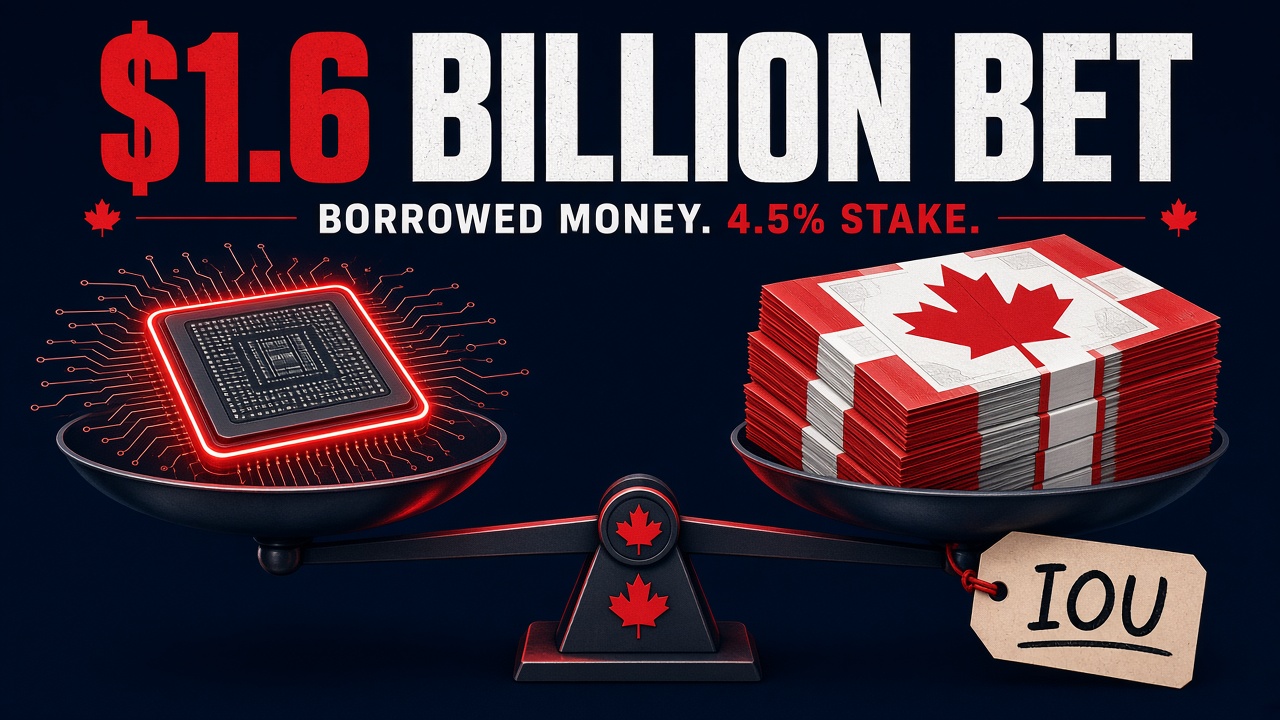
On October 29, in the middle of a Canada–EU summit in Montreal, Prime Minister Mark Carney announced that Ottawa plans to invest up to $1.6 billion in Cohere, the Toronto artificial intelligence company. He wrapped it in the language of national destiny: Canada, he said, is “not waiting for the future of AI to be decided somewhere else by those we don’t know or those we don’t trust.”
It was a stirring line. It was also a very large cheque, written by a government that is borrowing heavily, for a company that was already raising billions from some of the richest investors on earth.
A company that wasn’t short of money
Start with the obvious question: did Cohere need Ottawa’s money?
According to Reuters, as published by CBC News, the federal stake is part of a funding round led by Germany’s Schwarz Group, the owner of Lidl and Kaufland, targeting $7 billion and valuing Cohere at about $36 billion. The Globe and Mail reported that Cohere said it had secured most of that round, with backers including chip giant Nvidia, Bell Canada’s venture arm, Inovia Capital and Prosperity7 Ventures, an arm of Saudi Aramco. The Globe called it the largest financing ever by a Canadian startup.
When Nvidia, a German retail empire and a Saudi oil giant’s venture fund are already lining up, the case that taxpayers must also pile in gets thin. As Charles Lammam put it in a commentary for The Hub, “A company that has lined up all that money privately does not obviously need a federal co-signer.”
“Sovereignty” for about 4.5 per cent
The government’s whole pitch is sovereignty. Carney said that “when the AI that runs our economy and public services is built in Canada, Canadians decide how it works and who it answers to.”
But do the math the government didn’t put in its press release. At a valuation of roughly $36 billion, Lammam calculates that up to $1.6 billion buys Ottawa about a 4.5 per cent stake. “Sovereignty is a big word for a stake that small,” he wrote. “It hands Ottawa control over nothing.”
A minority position that small doesn’t let Canadians decide much of anything. What it does do is put public money at risk alongside private investors who can afford to lose it.
The “strong terms” we haven’t seen
Carney told the audience that “we’ve secured strong terms for Canadians.” The official news release lists what Cohere has promised: at least 1,000 new technical jobs by 2030, at least $1.7 billion in Canadian computing infrastructure by 2030, keeping its incorporation and headquarters in Canada, research partnerships, and continued work with the Canadian AI Safety Institute. It says the money will flow in stages, with “regular reporting on progress.”
What the release does not say is what happens if those promises aren’t met, what price per share Canada is paying, or what rights come with the stake. AI Minister Evan Solomon told the Globe the investment was made on “very favourable commercial terms.” Canadians are being asked to take that on faith.
Reuters also noted that Cohere had completed only an initial close of the round and did not say how much had been committed so far or when it expects the round to close.
We’ve seen this movie before
This isn’t Ottawa’s first cheque to Cohere. Before this, the federal government committed up to $240 million to Cohere to build “domestic AI compute capacity.” That deal drew fire because, as the Globe reported, the money was used by Cohere to buy computing capacity at a data centre built by CoreWeave, a U.S. company. “All of the value and wealth effects of the $240-million look to be captured by a U.S. firm but paid for by Canadians,” intellectual property lawyer Jim Hinton told the paper.
So the “sovereign AI” story already has one chapter where Canadian taxpayers ended up subsidizing American infrastructure. Now the bet is roughly six and a half times bigger. And according to Lammam, Solomon has said this won’t be the last stake Ottawa takes.
Borrowed money, by the government’s own watchdog
None of this is happening with spare cash. Just nine days before the Cohere announcement, the Parliamentary Budget Officer’s Economic and Fiscal Outlook projected a $63.3 billion deficit this fiscal year, peaking at $70.2 billion in 2027–28. The PBO also warned that federal borrowing will grow far faster than deficits, because Ottawa is borrowing “to finance loans, capital investments, defence procurement and other financial assets.”
An equity stake in a private tech company is exactly that kind of financial asset. On the government’s books it can look like an investment rather than an expense. In the real world it’s more borrowed money, with interest, riding on one company’s future.
Picking winners is not a strategy
Supporting Canadian innovation is a worthy goal. The way to do it is lower taxes, less red tape and a capital market that keeps homegrown firms here on their own merits, so every startup has a shot, not just the one the Prime Minister chose to put on stage beside European leaders.
Instead, Carney has made Ottawa a minority shareholder in a single company, on terms Canadians can’t fully see, with money the country has to borrow. If Cohere thrives, the private investors who took the real risk will do just fine. If it stumbles, taxpayers will be the ones holding a small, expensive slice of a big promise.
That isn’t sovereignty. It’s a bet, and Canadians weren’t asked whether they wanted to place it.
Please consider helping!
Awake Freedom TV On Roku is Broken! 🙂

I could no longer maintain the costs on my own, so I moved the off of a dedicated server which was needed for the TV platform to work. On top of that, I want to build an app Awake Freedom TV app, for mobile phones. We need your help to first resurrect our TV channel, and then build the mobile app. In order to do that, I need a minimum of 800/month on subscription payments. Please help anyway you can with the form below.


Leave A Comment