


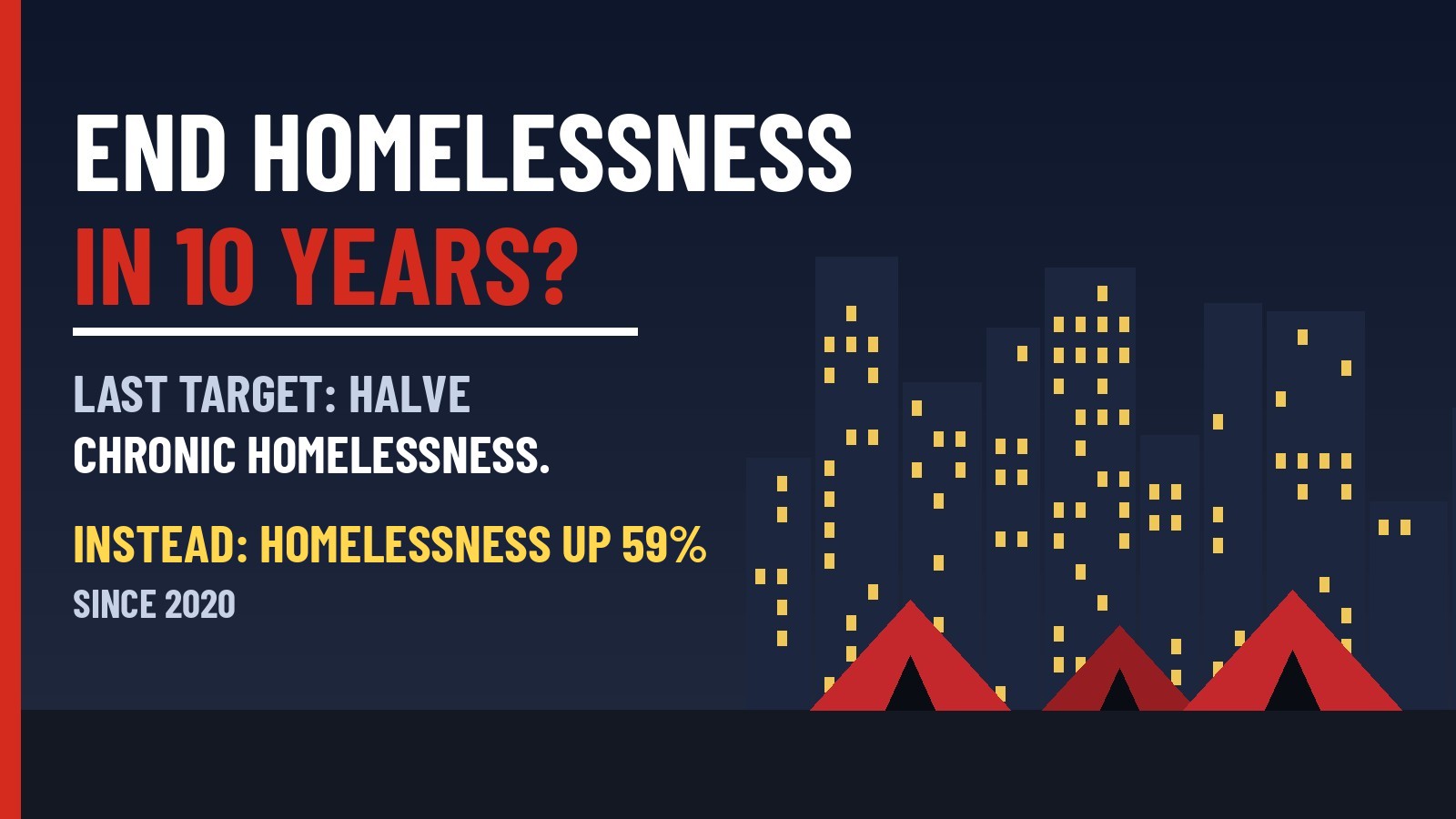
Prime Minister Mark Carney has a new ten-year promise: end homelessness in Canada. Not reduce it. End it.
It is a big, warm, headline-friendly pledge, announced in Budget 2026 and taken on the road to Winnipeg the next day. Carney called it a “$30-billion co-ordinated national plan.” But read the fine print and the record behind it, and the promise starts to look a lot like the last one, which failed.
Ottawa has made this promise before
In 2017, the federal government pledged to cut chronic homelessness by 50 per cent by the 2027-28 fiscal year. In 2020, a throne speech went further and promised to focus on “entirely eliminating chronic homelessness in Canada,” as CBC’s Aaron Wherry recounts.
So how did that go? According to CBC News, homelessness surged by 59 per cent between 2020 and 2025, citing a report from Housing, Infrastructure and Communities Canada. The federal government’s own progress report acknowledged a 34 per cent increase in chronic homelessness among shelter users between 2016 and 2024, CBC reports. The share of homeless people sleeping unsheltered, including in encampments, rose from 23 per cent to 27 per cent.
The goal was to halve the problem. Instead it grew. Now the same federal government, under a new leader, is promising to eliminate it entirely.
They didn’t even know if it was working
This isn’t just bad luck. In 2022, Auditor General Karen Hogan found that Infrastructure Canada had spent $1.36 billion on its flagship Reaching Home program between 2019 and 2021 and “did not know whether chronic homelessness and homelessness had increased or decreased since 2019 as a result of this investment,” CBC reported.
Hogan described “minimal federal accountability” for the goal. The federal housing agency, CMHC, told her it was “not directly accountable for addressing chronic homelessness.” Infrastructure Canada said it was “not solely accountable” either.
Carney’s answer? Renew Reaching Home for another ten years. The budget says the program “will require rigorous reporting, including real-time data, as a condition for continued funding,” with details to be “released early in the new year.” Ottawa is making a ten-year commitment to a program its own auditor said it couldn’t measure, and the accountability rules haven’t been written yet.
The “$30 billion” includes old money
The $30-billion headline sounds like a fresh mountain of cash. It isn’t. As The Globe and Mail reported, the figure “includes both new spending announced in Thursday’s budget and the renewal of existing programs.”
The budget itself shows $11.2 billion over four years, starting in 2027-28, plus $17.8 billion “in future years.” In other words, the money for this “urgent” crisis doesn’t start flowing until next fiscal year. The Reaching Home renewal doesn’t begin until 2028-29. More than half of the total, $17.8 billion, sits in unspecified “future years.”
Ottawa builds, provinces pay forever
Here is the catch that matters most. Under Carney’s model, Ottawa pays to build supportive and transitional housing, while “provincial and territorial partners will be expected to fund ongoing operations and wraparound services,” the budget says.
That means the ongoing, never-ending cost of staff, health care, addictions treatment and income supports gets handed to the provinces. Even homelessness researcher Nick Falvo, who praised the plan as a “down payment,” told CBC that the challenge is operational funding and “I’ll be very interested to see what happens with the provinces.”
Ottawa gets the ribbon-cutting. The provinces get the bill.
The minister in charge has tried this before
The man responsible for delivering this plan is Housing Minister Gregor Robertson. As mayor of Vancouver, Robertson pledged to end street homelessness in that city by 2015. According to The Globe and Mail, Vancouver’s homeless count was roughly 1,600 when he took office in 2008, around 2,100 when he left in 2018, and over 2,700 in the most recent count.
Asked about it, Robertson blamed other governments: “The federal and provincial governments were not co-ordinating.” Now he is the federal government.
No homes, no end to homelessness
Ending homelessness depends on building housing, and that is where Carney’s record is weakest. During the 2025 campaign, the Liberals promised to double construction to almost 500,000 new homes a year. Instead, the Globe reports that CMHC projects housing starts falling to 223,400 in 2027, down from 241,400 in 2026 and 259,028 in 2025. Build Canada Homes itself reported the six-month trend in starts was virtually flat in September.
You cannot house 65,000 homeless Canadians, the government’s own estimate, while overall home building is heading in the wrong direction.
A pledge is not a plan
Nobody disputes that homelessness is a crisis. Encampments are in parks and downtowns across the country. But Canadians have heard this promise before, from the same party, backed by the same programs, with no way to tell whether the money worked.
Even commentators who share the goal are skeptical. Writing in The Hill Times, Susan Riley called it an “out-of-left-field, Trudeau-esque pledge” and listed it among the abrupt policy shifts that have her asking whether Carney is “tossing out tidbits to appease his party’s restive left flank.”
Carney says hard problems require “the humility to learn from previous well-intentioned efforts that have fallen short.” Here’s the lesson: a ten-year target, back-loaded money, recycled programs and a bill passed to the provinces is how the last promise failed. Canadians deserve measurable results this year, not another decade of slogans.
Please consider helping!
Awake Freedom TV On Roku is Broken! 🙂

I could no longer maintain the costs on my own, so I moved the off of a dedicated server which was needed for the TV platform to work. On top of that, I want to build an app Awake Freedom TV app, for mobile phones. We need your help to first resurrect our TV channel, and then build the mobile app. In order to do that, I need a minimum of 800/month on subscription payments. Please help anyway you can with the form below.





Leave A Comment