


Today in Shenzhen, Prime Minister Mark Carney sat down with Chinese President Xi Jinping and, according to the official readout from his own office, the two leaders “agreed that the Canada-China strategic partnership is working successfully.” They even discussed deeper cooperation on electric vehicles.
Working successfully for whom? Look at the one promise that was supposed to make the whole bargain worth it for Canadian workers, and the answer is not Canada’s auto sector.
The deal Carney sold
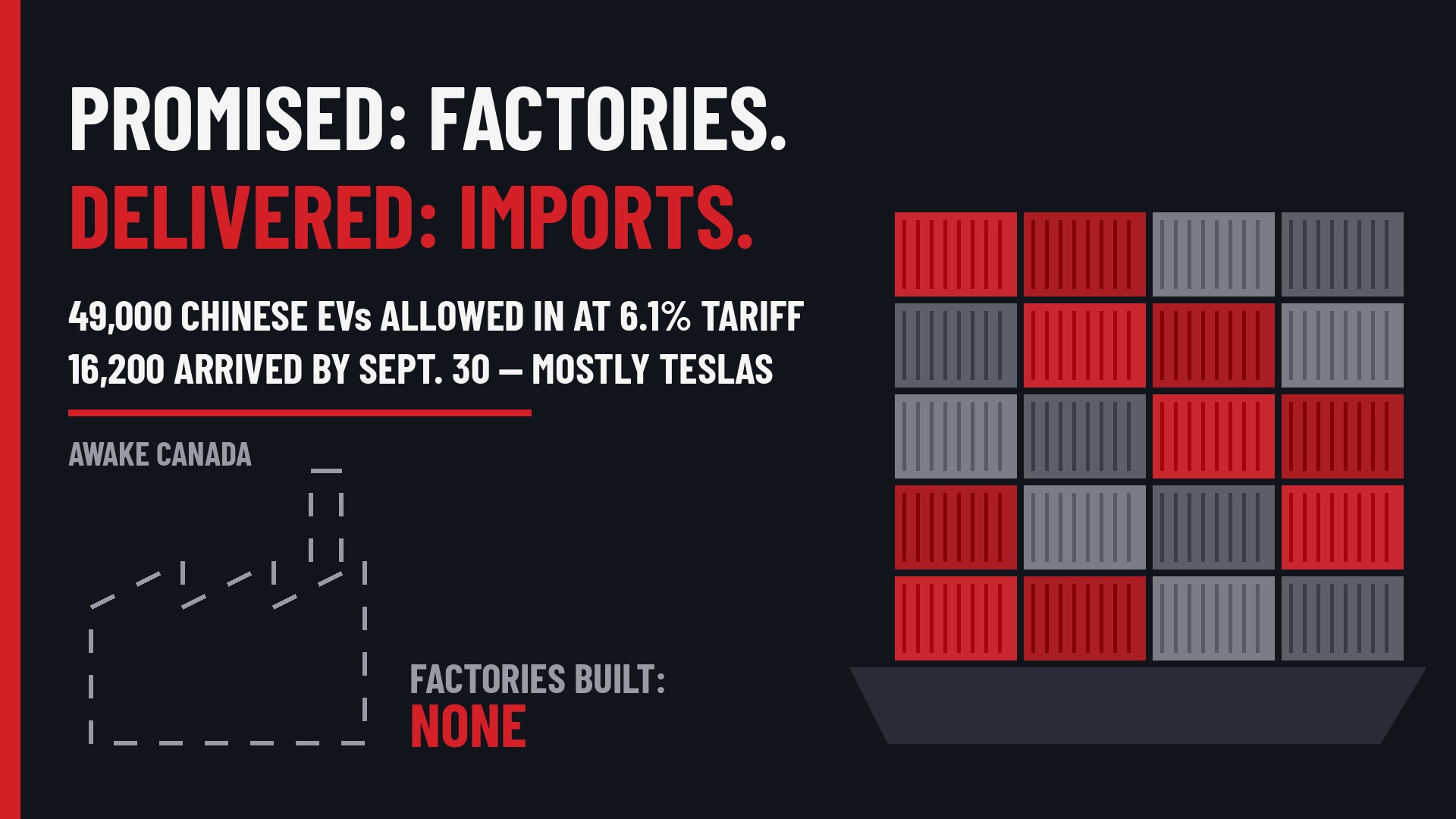
In January, Carney broke with the United States on Chinese electric vehicles. Canada and the U.S. had both slapped a 100 per cent tariff on them in 2024. Under Carney’s new arrangement, The Globe and Mail reports, up to 49,000 Chinese-made EVs a year can now enter Canada at a tariff of just 6.1 per cent, with the quota rising each year to 67,000 by 2031. In return, Beijing cut its retaliatory levies on canola and other farm exports.
The sweetener for auto workers was investment. When the deal was announced, the government said it expected significant Chinese auto investment in Canada “within three years.” As the Associated Press reported via The Guardian, Carney said at the time he expected the agreement to attract Chinese investment in Canada’s auto industry and create jobs.
What actually showed up
Ten months on, here is the scorecard.
As of September 30, only about 16,200 Chinese EVs had entered Canada under the quota, according to the Globe, citing a Global Affairs website. And most of those were not even Chinese brands. International Trade Minister Maninder Sidhu acknowledged that most of the quota used so far reflects imports from American automaker Tesla’s Chinese factories. A number of high-end Lotus cars, a brand owned by China’s Geely, were also reportedly shipped in.
So the “affordable EV” pitch has, so far, mostly meant a cheaper way into Canada for an American automaker’s China-built cars.
And the factories? The Globe put it in five words: “Nothing has materialized thus far.”
Not one plant. Not one assembly line. Not one announced investment.
Meetings, meetings, and more meetings
It is not for lack of trying to look busy. In June, Industry Minister Mélanie Joly met four Chinese companies in China, BYD, Chery, Geely and Shanghai Launch Automotive Technology, about building EVs in Canada. Earlier this month, Sidhu met BYD, Chery and Geely again.
His report back? The companies are “still studying the Canadian market.” In Sidhu’s own words: “They need to be able to understand the market before anybody dives in and makes those billion-dollar investments to open up a plant to manufacture vehicles in Canada.”
What Chinese carmakers are investing in, Sidhu said, is “charging infrastructure or building up dealerships.” In other words, the infrastructure to sell Chinese cars to Canadians, not to build cars with Canadian workers.
Sidhu now predicts that by the first quarter of 2027, “You’ll see more cars in terms of affordable vehicles coming from China into our market.” More imports. Still no plants.
Meanwhile, the real auto crisis keeps growing
All of this is happening while Canada’s actual auto industry is under siege. Canadian-made vehicles still face a 25 per cent U.S. tariff, the Globe reports, and Carney is still trying to talk Washington down from it. Stellantis has moved planned Jeep Compass production from Brampton to Illinois and agreed to sell its idled Canadian assembly plant, according to the AP.
Carney’s answer this week was to float China as a Plan B. “There’ll be other options: European options; Asian options, of course – Chinese, Japanese,” he told reporters in Phnom Penh. Asked if that was leverage against Washington, he said: “It’s not leverage. But action, reaction.” And: “Canada is going to move forward either way.”
That is a risky game. The Trump administration was angry about the EV deal from day one. U.S. Trade Representative Jamieson Greer called it “problematic” and warned, “I think in the long run, they’re not going to like having made that deal.” Ontario Premier Doug Ford, whose province is the heart of the industry, warned that letting Chinese EVs in could threaten Canadian jobs and jeopardize access to the U.S. market.
Conservative MP Jamil Jivani said the Xi meeting shouldn’t be happening at all, and MP John Brassard accused Carney of “cozying up” to China instead of fighting the “systematic dismantling” of Canada’s auto sector, CBC News reported.
Beijing keeps score. Ottawa keeps hoping.
There is one more detail worth noticing. A source familiar with the trade talks told the Globe that Beijing has been insisting on cutting tariffs only on a matching, dollar-for-dollar basis: China lowers levies on Canadian goods only if Ottawa lowers its own on a comparable amount of Chinese imports.
Today’s readout boasts that “over 90% of Canada-China trade is now on reduced tariffs,” with new cuts on pork, halibut, shrimp and other seafood. Good news for those exporters. But China is driving a hard, transactional bargain, and the one thing Canada asked for in return for opening its car market, real manufacturing jobs, has not arrived.
The bottom line
Carney promised that letting Chinese EVs in would bring Chinese factories, Canadian jobs and Canadian supply chains. Ten months in, Canadians have gotten roughly 16,200 imported cars, mostly Teslas, a pile of ministerial meetings, some new dealerships, and zero plants. All while angering our largest trading partner at the worst possible moment for Canadian auto workers.
The Prime Minister calls the partnership a success. For auto workers in places like Brampton, watching their industry slip away, it looks a lot more like a one-way street.
Please consider helping!
Awake Freedom TV On Roku is Broken! 🙂

I could no longer maintain the costs on my own, so I moved the off of a dedicated server which was needed for the TV platform to work. On top of that, I want to build an app Awake Freedom TV app, for mobile phones. We need your help to first resurrect our TV channel, and then build the mobile app. In order to do that, I need a minimum of 800/month on subscription payments. Please help anyway you can with the form below.


Leave A Comment