Sea Level ‘Acceleration’ Isn’t What the Measured Data Show
Direct, long-term tide gauge measurements around the world do not show the dramatic acceleration of the sea level implied in the satellite-based narrative, says Anthony Watts.


Source: Shutterstock
Anthony Watts
Date: 14 June 2026
The recent ScienceAlert article ‘Sea Level Rise Is Accelerating, And We Now Know The Biggest Reason Why’ claims that sea-level rise is not only accelerating but that scientists have now “closed the budget” and identified ocean thermal expansion as the dominant driver. This is false. Direct, long-term tide gauge measurements around the world do not show the dramatic acceleration implied in the satellite-based narrative.
The distinction between satellite altimetry and tide gauges is critical. Satellite measurements of global mean sea level began in 1993. That record spans about 30 years and involves multiple satellite missions stitched together over time. Each transition between satellites requires calibration adjustments. Even small offsets can introduce artificial curvature into the record, creating the appearance of acceleration.
New York City
By contrast, tide gauges measure sea level directly at specific coastal locations, in many cases for more than a century. For example, in Figure 1 below, the Battery tide gauge in New York City has operated since 1856. It shows a steady rise of about 2.8 to 3.0 millimeters per year, with no statistically significant acceleration over more than 160 years.
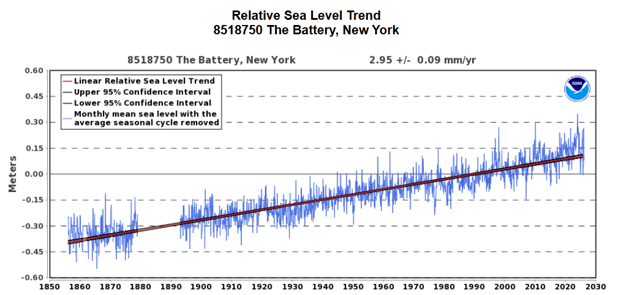
Figure 1. The relative sea level trend is 2.95 millimeters/year with a 95% confidence interval of +/- 0.09 mm/yr based on monthly mean sea level data from 1856 to 2025. Source: NOAA Tides and Currents.
Many other long-term gauges around the world display similarly linear trends.
This matters because tide gauges measure what actually affects people; sea level at the coast. Satellite altimetry measures global averages across the open ocean. When the two datasets diverge in character, the longer, directly observed tide gauge record deserves greater weight.
The pattern in the Pacific Ocean known as El Niño causes sea level rise by changes in prevailing winds piling up water in the eastern Pacific Ocean, seen in Figure 2 below.
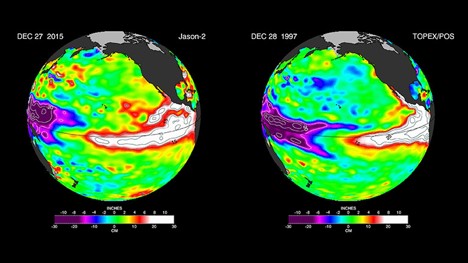
Figure 2. This satellite image of Pacific sea surface heights from Jason-2 (left) differs slightly from one 18 years ago from Topex/Poseidon (right). In Dec. 1997, sea surface height was more intense and peaked in November. This year the area of high sea levels is less intense but considerably broader. Credit: NASA/JPL-Caltech.
That bulge of water makes it into the global satellite sea level record but does not reflect what happens on coastlines.
Budgets
The article leans heavily on the “global mean sea level budget” concept and emphasizes acceleration from 2005 to 2023. It should be pointed out that “budgets” are a human creation and that nature pays no attention to such things. But this budget conclusion depends primarily on the satellite era, which is short and subject to calibration uncertainties. When evaluating acceleration, the window of time chosen can dramatically influence the result. Starting in 1993, near the beginning of a strong El Niño cycle, naturally increases the likelihood of seeing curvature in the trend.
The Climate at a Glance sea level analysis shows that sea-level rise has been ongoing since the end of the Little Ice Age in the 1800s and remains modest and largely linear in long-term observational records. The rate today is not unprecedented compared to earlier 20th-century values.
The article also asserts that thermal expansion accounts for roughly 43 percent of recent rise. That may be true within the assumptions of their model budget closure. But again, this depends on reconciling satellite altimetry with Argo float temperature data and other modeled components. Budget closure is not the same thing as independent measurement confirmation. It is an internal accounting exercise constrained by the datasets selected.
Argo
Thermal expansion is a well-understood physical process. Warmer water occupies more volume. However, ocean heat content measurements prior to the early 2000s are sparse. The global Argo float network, which provides the most reliable subsurface temperature coverage, only became operational around 2005. That means the supposed acceleration tied to thermal expansion relies heavily on a short, modern dataset.
When you examine tide gauges in stable tectonic regions around the world, where the tide gauge is not affected by land rise or subsidence, you do not see a sudden doubling of the rate since 2005. What you see is continuity. Slow, steady rise.
The broader implication of the article is that accelerating sea-level rise will inevitably threaten millions of people in coming decades. That claim is entirely climate model driven. Projections are sensitive to assumptions about future warming, ice sheet dynamics, and feedbacks. Yet the historical record shows resilience and adaptability. Coastal engineering, improved drainage, land elevation adjustments, and infrastructure planning have long been part of managing coastal risk.
Sea level has been rising for more than a century. Cities such as Boston, Amsterdam, and Tokyo have adapted. The narrative that acceleration is newly discovered and unprecedented does not align with the long-term observational record. If acceleration were truly dramatic and recent, we would expect clear, unmistakable signals across century-long tide gauges. That signal is simply not there.
Biased
The difference between a stitched-together satellite record and continuous measurements should not be glossed over. Satellite data are valuable, but they are short indirect measurements and heavily calibration dependent. Tide gauges are long and direct measurements.
In the end, this article presents a technically sophisticated but selectively framed argument. It emphasizes acceleration derived from a short satellite era while underweighting the longer coastal measurement record. The public deserves to know that the evidence for dramatic new acceleration is far weaker in the observational data than the headlines suggest.
Sea level is rising; it has been for generations. The key question is whether it is accelerating in a way that justifies claims of looming crisis. The longest, most reliable measurements say no. ScienceAlert failed to look at all the science available, and in the process, created a biased and false article.

This article was published first on ClimateRealism.com om 12 June 2026.

Anthony Watts
Anthony Watts is a senior fellow for environment and climate at The Heartland Institute. Watts has been in the weather business both in front of, and behind the camera as an on-air television meteorologist since 1978, and currently does daily radio forecasts. He has created weather graphics presentation systems for television, specialized weather instrumentation, as well as co-authored peer-reviewed papers on climate issues. He operates the most viewed website in the world on climate, the award-winning website wattsupwiththat.com.

more news

Global rice production has nearly doubled over 50 years despite climate change
Global rice production nearly doubled between the 1960s and the 2010s and rising atmospheric CO2 was the primary environmental factor contributing to increased production.

Here Comes the Super Mega Ultimate Hyper Giga Godzilla El Niño
The media predict that 2026-27 will turn out to have the worst El Niño of all recorded time. But according to Charles Rotter, the honest answer is that no one knows yet. And the people most qualified to know are openly saying so.

What’s Up With The Endangerment Finding Litigation?
Is the Court of Appeals going to delay the appeal about the Endangerment Finding, so that it can’t be decided by the Supreme Court until after Trump has left office? If that occurs, it would give a potential incoming Democratic administration in 2029 the ability to reverse course on the regulations, says Francis Menton.
The post Sea Level ‘Acceleration’ Isn’t What the Measured Data Show appeared first on Clintel.
Please consider helping!
Awake Freedom TV On Roku is Broken! 🙂

I could no longer maintain the costs on my own, so I moved the off of a dedicated server which was needed for the TV platform to work. On top of that, I want to build an app Awake Freedom TV app, for mobile phones. We need your help to first resurrect our TV channel, and then build the mobile app. In order to do that, I need a minimum of 800/month on subscription payments. Please help anyway you can with the form below.