Global rice production has nearly doubled over 50 years despite climate change
Global rice production nearly doubled between the 1960s and the 2010s and rising atmospheric CO2 was the primary environmental factor contributing to increased production.


Rice fields on Bali, Indonesia. (Source: Shutterstock)
Eric Worrall
Date: 13 June 2026
“… rising atmospheric CO2 was the primary environmental factor contributing to increased rice production by enhancing photosynthesis and improving water-use efficiency …”
from phys.org:
Global rice production has nearly doubled over 50 years despite climate change
by Lois Yoksoulian, University of Illinois at Urbana-Champaign
edited by Stephanie Baum, reviewed by Robert EganGlobal rice production nearly doubled between the 1960s and the 2010s, despite the negative impacts of climate change, according to a new study from the University of Illinois Urbana-Champaign. The study found that management decisions—including expanded irrigation and increased nutrient inputs—played a central role in sustaining rice production and offsetting climate-related losses. The results suggest that future food security will depend not only on environmental conditions but also on how rice production systems are managed and adapted to changing conditions.
The study by climate, meteorology and atmospheric sciences professor Atul Jain and former graduate student Tzu-Shun Lin, combined observations and process-based modeling to examine the factors that shaped global rice production over the past half-century. The researchers evaluated how environmental change and agricultural management together influenced rice production across regions and over time. The results are published in the journal Scientific Reports.
…
The study also demonstrates that climate change is the only factor in the analysis that reduced rice production, lowering global production by an estimated 7% between 2006 and 2015 because of warming temperatures, heat stress and water shortages. In contrast, rising atmospheric CO2 was the primary environmental factor contributing to increased rice production by enhancing photosynthesis and improving water-use efficiency. Together, these findings illustrate the complex and sometimes opposing ways in which environmental changes influence agricultural production.
…
Read more: https://phys.org/news/2026-06-global-rice-production-years-climate.html
Abstract
Here’s the abstract of the study (headline: Management practices and elevated atmospheric CO2 levels helped to sustain a high level of global rice production); Tzu-Shun Lin & Atul K. Jain in Scientific Reports (3 June 2026):
We are providing an unedited version of this manuscript to give early access to its findings. Before final publication, the manuscript will undergo further editing. Please note there may be errors present which affect the content, and all legal disclaimers apply.
Abstract
Rice is a staple agricultural resource for over half the global population. Using the data-modeling methods, which account for major biophysical processes and all major environmental and management factors, our study shows that rice production for 2006–2015 has increased by almost 2-fold since the 1960s, despite growing concerns about climate change and other extreme climate event risks. Management practices through the expansion of irrigated and non-irrigated cropping harvested areas and the increased rates of N fertilizer and manure application have helped to maintain higher production rates since the 1960s. The global production of rice for the decade 2006–2015 was 713 million tons per year, with South and Southeast Asia by far the largest rice-producing region, and China (24%), India (22%), and Thailand (9%) being the top three producers. Multiple cropping increases overall production, with the highest rice yield in season one due to a longer growing period and favorable conditions, while yields decline in the subsequent seasons. The results show that global transplanted rice yields are 25% higher than direct-seeded rice yields. Accounting for the effects of management factors, the total production increased by 76%. The expansion of rice-planting areas was the primary management contributing factor (52%), with the expansion of irrigated planted areas contributing 39% and rainfed 13%. Other management practices that helped increase production include N fertilizer and manure (24%). Our results also reveal that environmental factors increased productivity by 24% in the recent decade, with rising atmospheric CO2 concentration increasing productivity by 30% and N deposition by 1%. In contrast, climate change reduced production by 7%. These findings highlight the critical role of management practices, especially the expansion of irrigated areas and fertilizer use, in driving recent increases in rice production. Accounting for these factors is crucial for accurate projections and effective rice cultivation planning.
Read more: https://www.nature.com/articles/s41598-026-55973-0
An interesting contrast – the study abstract (admittedly in draft) mentions CO2 fertilisation in the title, but you have to read down to the 4th paragraph in the phys.org article to learn CO2 played a significant role. Almost like phys.org are reluctant to tell their audience CO2 can do anything good.
So how much further could yields increase? Likely quite a lot.
Commercial greenhouses elevate CO2 levels to over twice the atmospheric CO2 to stimulate growth. As we burn the remaining fossil fuel reserves over the coming 2-3 centuries, CO2 fertilisation will continue to drive yields up, even without the benefits of future agricultural science.
The only question is, what will our descendants do to keep CO2 levels elevated, once the fossil fuel runs out?

more news
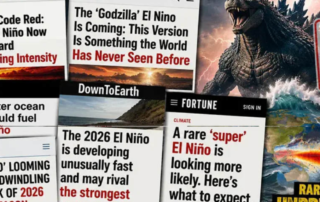
Here Comes the Super Mega Ultimate Hyper Giga Godzilla El Niño
The media predict that 2026-27 will turn out to have the worst El Niño of all recorded time. But according to Charles Rotter, the honest answer is that no one knows yet. And the people most qualified to know are openly saying so.

What’s Up With The Endangerment Finding Litigation?
Is the Court of Appeals going to delay the appeal about the Endangerment Finding, so that it can’t be decided by the Supreme Court until after Trump has left office? If that occurs, it would give a potential incoming Democratic administration in 2029 the ability to reverse course on the regulations, says Francis Menton.

No, New York Times, Climate Change Is Not Making Tennis Players Ill
In this article, climate researcher and writer Linnea Lueken examines claims by The New York Times that climate change is making tennis players ill during the French Open. She argues that player health, tournament infrastructure, and individual heat sensitivity provide more plausible explanations than climate change, and that a single heatwave does not constitute evidence of a long-term climate trend.
The post Global rice production has nearly doubled over 50 years despite climate change appeared first on Clintel.
Please consider helping!
Awake Freedom TV On Roku is Broken! 🙂

I could no longer maintain the costs on my own, so I moved the off of a dedicated server which was needed for the TV platform to work. On top of that, I want to build an app Awake Freedom TV app, for mobile phones. We need your help to first resurrect our TV channel, and then build the mobile app. In order to do that, I need a minimum of 800/month on subscription payments. Please help anyway you can with the form below.