


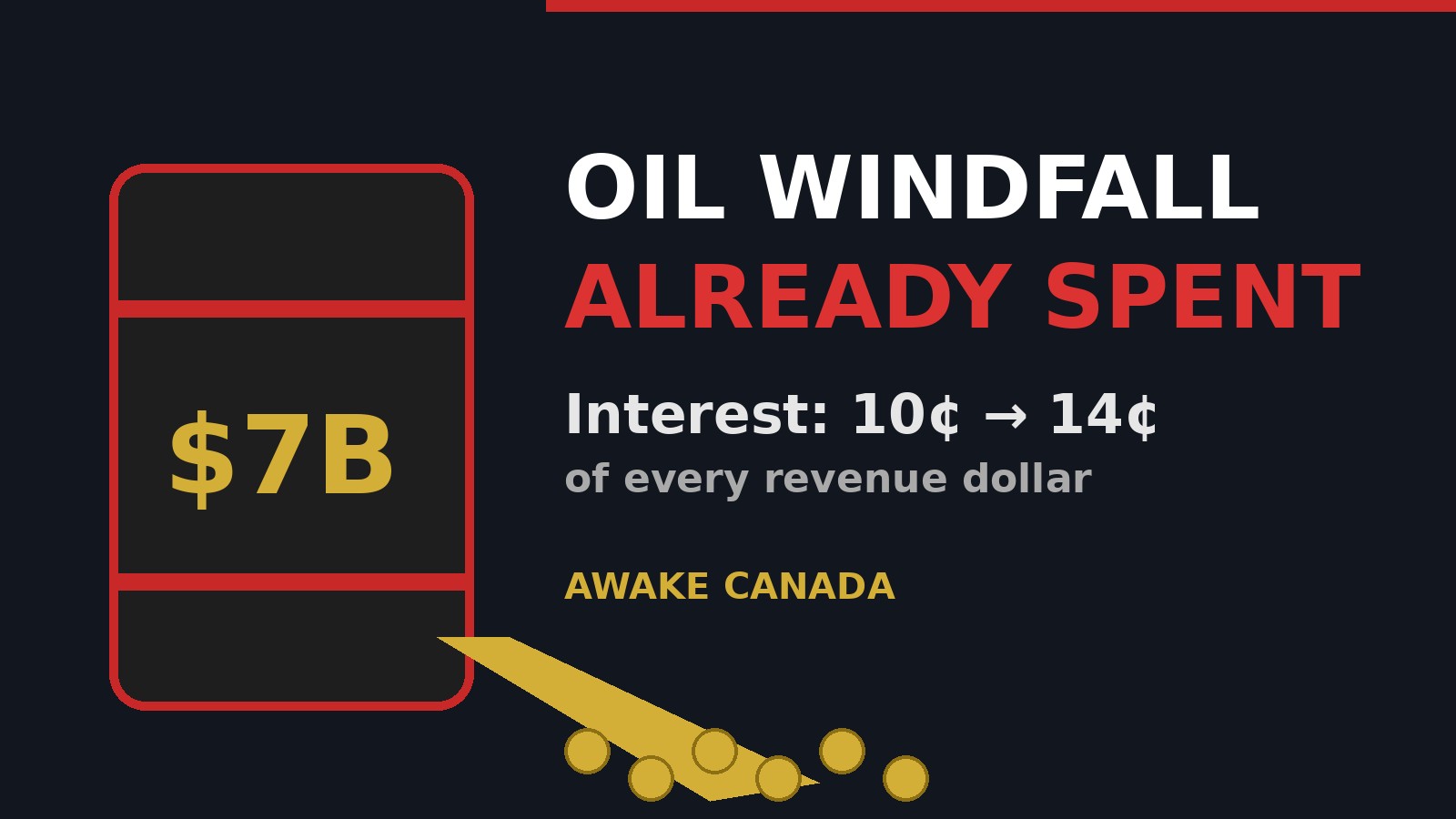
Most households know the rule: when an unexpected cheque shows up, you pay down the credit card first. Ottawa just got that cheque, in the form of higher oil prices, and economists say the Carney government has already spent most of it before Finance Minister François-Philippe Champagne has even tabled his fall budget.
The windfall nobody planned for
The 2025 federal budget assumed West Texas Intermediate crude would average US$65 a barrel in 2026. April’s spring update bumped that to US$73. Since then, tensions in the Strait of Hormuz have pushed oil to around US$90 a barrel, according to The Globe and Mail.
That means more tax revenue. Marc Desormeaux of the Business Council of Canada told the Globe the oil-linked gains could be as much as $7 billion. Desjardins economist Randall Bartlett put it plainly: “revenues have been surging at the federal level.”
This was a chance to shrink a deficit the spring update pegged at $65.3 billion for this fiscal year. Instead, the money was spoken for almost as soon as it arrived.
Spent in two announcements
In September, Champagne extended the gas tax break that was supposed to end on Labour Day. It now runs until January 31, 2027, then gets halved until the end of March. The Finance Department’s own estimate of the cost is about $2.9 billion in lost revenue.
Two weeks later, at an investment summit in Toronto, Carney announced a “productivity mega deduction” letting companies immediately write off the full cost of many new investments. The government’s estimated price tag: $36 billion over five years.
UBC economist Kevin Milligan told the Globe the government likely knew the extra revenue was coming before it made those moves. “If things had not looked good on the revenue front, they might have been a bit tighter on some of those announcements,” he said.
Former senior Finance official Don Drummond was blunter about how much room is left: “I think it’s all used up.”
A deficit that could get bigger, not smaller
Drummond, co-author of the C.D. Howe Institute’s pre-budget report, told the Globe he expects the deficit to climb into the $70-billion to $80-billion range. He also said net debt would likely remain over 40 per cent of GDP, “which is unacceptably high in my view.”
And the bills keep coming. The Parliamentary Budget Officer has said additional core defence spending could add $63.7 billion, or 1.4 per cent of GDP, to the deficit in 2035-36.
Even Bartlett, who sees the near-term ratios improving thanks to oil, suggested Ottawa “should probably try to keep a little powder dry.” Carleton’s Jennifer Robson said she isn’t seeing much evidence of significant cuts to operations spending, and warned that the revenue bump is “likely not sustained.”
The interest bill is the real warning
Oil prices go up and down. Interest payments only go one way when you keep borrowing.
Parliamentary Budget Officer Annette Ryan told the Senate finance committee that interest on the federal debt is moving “very quickly right now” from 10 cents of every revenue dollar to 14 cents within a couple of years, as reported by the Toronto Sun. If that pattern continues, she said, “when you get up to 18 or 20 cents on the dollar, that’s a danger zone.”
Ryan also criticized the government for dropping a declining debt-to-GDP ratio as a fiscal anchor. “I think it’s straightforward to say that a fiscal rule based on a debt-to-GDP ratio would be more prudent,” she said. The government’s bet that heavy capital spending will grow the economy enough to pay for itself, she added, “is prone to many, many risks and essentially that is the opposite of prudence.”
Every cent that goes to bondholders is a cent that doesn’t go to health care, defence or tax relief for working families.
“Room to spend” is not a plan
Asked about all this, Champagne’s spokesperson John Fragos pointed to Canada’s triple-A credit rating and internal savings efforts, and said “the government has the manoeuvrability needed” to support businesses and households.
That’s the problem in one sentence. Ottawa looks at a temporary oil spike and sees room to spend. The PBO looks at the same books and sees interest costs climbing toward a danger zone. Milligan’s advice was simple: aim for a primary surplus so interest-rate swings don’t hit as hard.
A government that was serious about Canada’s finances would have banked at least part of this windfall. Instead, Canadians are heading into a fall budget with the extra money already gone, the deficit possibly growing, and the interest meter running faster every year.
When oil prices fall, and they always do, the spending will still be there. So will the debt.
Sources: The Globe and Mail, Oct. 6, 2026; Toronto Sun, Oct. 10, 2026.
Please consider helping!
Awake Freedom TV On Roku is Broken! 🙂
I could no longer maintain the costs on my own, so I moved the off of a dedicated server which was needed for the TV platform to work. On top of that, I want to build an app Awake Freedom TV app, for mobile phones. We need your help to first resurrect our TV channel, and then build the mobile app. In order to do that, I need a minimum of 800/month on subscription payments. Please help anyway you can with the form below.

Leave A Comment