Can we turn “climate science” into science?
Demetris Koutsoyiannis presents a preview of the new Chapter 7, “Radiation in the atmosphere”, of his book “Stochastics as Physics”.

Image created with AI
Demetris Koutsoyiannis
Date: 22 June 2026
Introductory comments
My reply to the question in the title of this post is a categorical NO. “Climate science” is not just corrupted science — it is purpose-built instrumentation wearing the lab coat of science while abandoning its method.
The phrase above comes from the Conclusions of a presentation I gave six months ago at the Hungarian Academy of Sciences conference, which I reported on in Climath:1

I listed several telltale signs that “climate science” is not science—it’s sophistry:
- Mixing of scientific knowledge with politics.
- Hostility towards scientific dialogue.
- Endless predictions of catastrophes that are almost always proven wrong.
- Promotion of the idea of world salvation.
- Promotion of ambiguity and inaccuracy.
- Appeal to consensus.
- Censorship and silencing of dissenting voices.
- Labelling of dissenting scientific opinion as “denialism” and of those expressing them as “deniers”.
- Reversal of cause and effect.
- Preference of model outputs to observational data.
- Discrimination in research funding and banning of non-conforming ideas.
- Laughable “scientific” studies to instil fear of various fanciful climate impacts (e.g. kidney stones).
That’s why, in my view, “climate science” is not science. It is fortunate that its practitioners call themselves “climate scientists” rather than climatologists, because the genuine science of climate—climatology—has not been severely damaged by their misleading terminology.
I deem it easier to investigate climate from scratch, rather than continue building upon the “climate science” edifice. I believe, what we need is rebuilding from the foundations up. That is the approach I follow in my book in preparation, titled “Stochastics as Physics”. I have tried to provide a new foundation even of the very notion of entropy, the cornerstone of atmospheric physics.
I introduced this book in the post below:

As I proceed with my study and the write up of the chapters, I am immeddiately making them available on the internet. The latest chapter I posted was this:
My reasoning behind this approach is my trust on scientific dialogue as the main means for scientific progress. Every human makes errors (let alone non-human bots) and the dialogue helps to locate and correct them.
“Rebuilding from the foundations up” should include terminology
Now I am presenting the newest version that contains some additions to Chapter 6, as well as the new Chapter 7, “Radiation in the atmosphere”. (It can also be found in the Itia and ResearchGate platforms).

In other posts, I have explained that even the terminology used in “climate science” is politically oriented. Even the very term “climate change” is not a scientific term but a political slogan. The scientific term is just “climate”. For example, in my view, the “Journal of Climate Change” should have been called “Journal of Climate”. There is no need for the former title, as there was no need for a “Journal of Weather Change” or a “Journal of Time Change”.
A plethora of other related terms are even worse. For example, it is self-evident that terms like “climate emergency” or “climate crisis” are political slogans.
Coming back to the chapter 7 of my book, one issue addressed is devoted to the terms “greenhouse effect” and “greenhouse gas”. From a scientific point of view, they are incorrect. The atmosphere is not like a greenhouse which warms its interior by blocking convection and making the temperature uniform in it. In the atmosphere, warming relies on convection and lapse rate. The mechanisms in the two cases are exactly opposite to each other. Therefore, “anti-greenhouse” would be more apt for the atmosphere. However, following the proposal in our 2025 related paper2 the terms I use are “atmospheric radiative effect” (ARE) and “radiatively active gas” (RAG).
Equilibrium temperature of the Earth
Planck’s Radiation Law and Stefan-Boltzmann Law are derived in the book by maximization of entropy, that is, uncertainty. Detailed modeling, based on the Stefan-Boltzmann Law (see figure below), shows that the equilibrium temperature strongly depends on rotation speed, axial tilt, conductivity/convection, and albedo variations—not just irradiance and albedo as in the simplified concept of effective temperature. Non-rotating or extreme-tilt cases drastically lower average temperature (down to ~40% T₀, where T₀ is the idealized temperature at a surface perpendicular to Sun’s rays, according to the Stefan-Boltzmann Law). Fast-rotating Earth-like cases give ~68%–70% T₀ (~245–255 K).
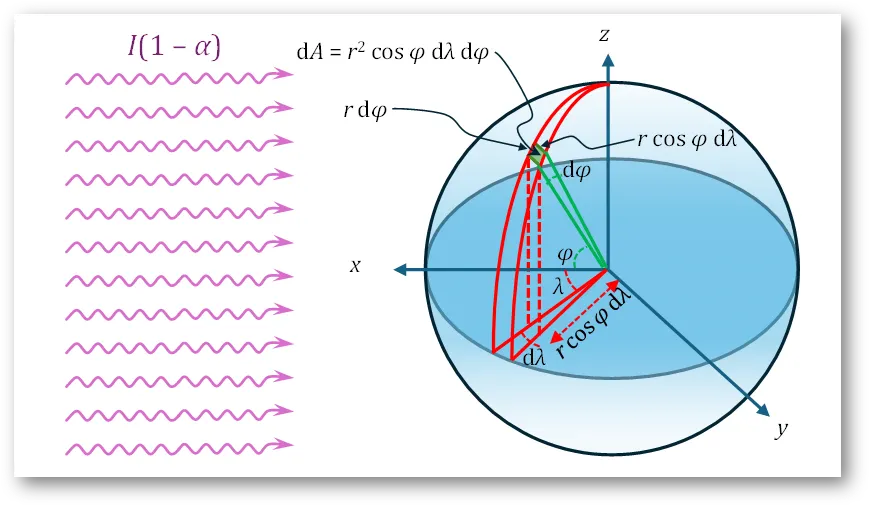
Figure 7.6 Schematic for the calculation of a planet’s equilibrium temperature, with r, I and α denoting the planet radius, the irradiance and the albedo, respectively
Surface temperature (~288 K) exceeds the atmospheric column average due to lapse rate, resulting from macroscopic motion, not primarily radiation. It is the lapse rate of 6.5 K/km that makes the difference. In fact, the column average temperature is close to what we expect from the Stefan-Boltzmann Law (255 K) and the surface temperature (288 K) is close to what we expect given the lapse rate of 6.5 K/km.
The emergence of the lapse rate
That lapse rate (minus vertical gradient of temperature) is not the result of radiation processes. It is the necessary outcome of thermodynamics and, in turn, the entropy maximization. The following points provide the explanation.
- The state of an air column is generally affected by gravitation.
- However, gravitation does not alter the equilibrium state: It remains isothermal, the same as if gravitation were absent.
- Hence, if there were only molecular motion, the equilibrium atmospheric profile would be isothermal (or close to it).
- What gravitation does is to distinguish the isentropic state from the isothermal state. (See figures below.)
- The Earth is never in equilibrium and hence the atmosphere is not isothermal.
- The non-equilibrium state is caused by changes occurring on all scales due to diverse mechanisms affecting radiation processes, both shortwave and longwave:
Day and night, cloud formation and disappearance, summer and winter, albedo’s spatial and temporal variation (also affected by biosphere changes), Sun’s dynamics and astronomical processes, orbital variations (Milanković cycles), tectonic and volcanic activity, and numerous other irregular changes by internal processes and external forces. - In absence of equilibrium, there is heat transfer.
- While in solids heat is transferred by conduction, in fluids (atmosphere and oceans) convection, i.e., mass flow, accompanies heat transfer.
When mass flows, convection dominates and conduction (based on molecular motion) can be neglected as its power is orders of magnitudes smaller than in convection—this is particularly the case for air (thermal conductivity 25 times smaller than in water). - Mass flow occurs through macroscopic atmospheric structures, named cells or parcels, that move as coherent entities while continually changing in shape and physical properties.
These structures differ and expand in a hierarchy of spatiotemporal scales, starting with a spatial scale of mm to m and a temporal scale of min, and reaching the horizontal scale of a third of a hemisphere, the vertical scale of the entire troposphere, and the seasonal time scale.
The hierarchy includes: Rayleigh-Bénard cells, small thermals or plumes, mesoscale convection cells, deep convective cells, mesoscale convective systems, and global circulation cells. - Indeed, an air parcel that has been warmed at the surface, which absorbs much of solar radiation, will move upward so fast that no heat can be removed from, or added to it.
- The macroscopic motion cannot retain constant temperature; rather it drives the actual vertical temperature profile away from the isothermal.
- Therefore the motion is mostly reversible adiabatic (where adiabatic means without heat exchange), i.e., isentropic. The lapse rate will then tend to the isentropic lapse rate, the dry one if the atmosphere is not saturated, or the wet one if it is saturated.
- Ergo: The temperature profile in the atmosphere departs from the isothermal and tends to isentropic, which is associated with a nonzero lapse rate.
- The coexistence of molecular and macroscopic motion at multiple scales determines the nonzero vertical temperature gradient.
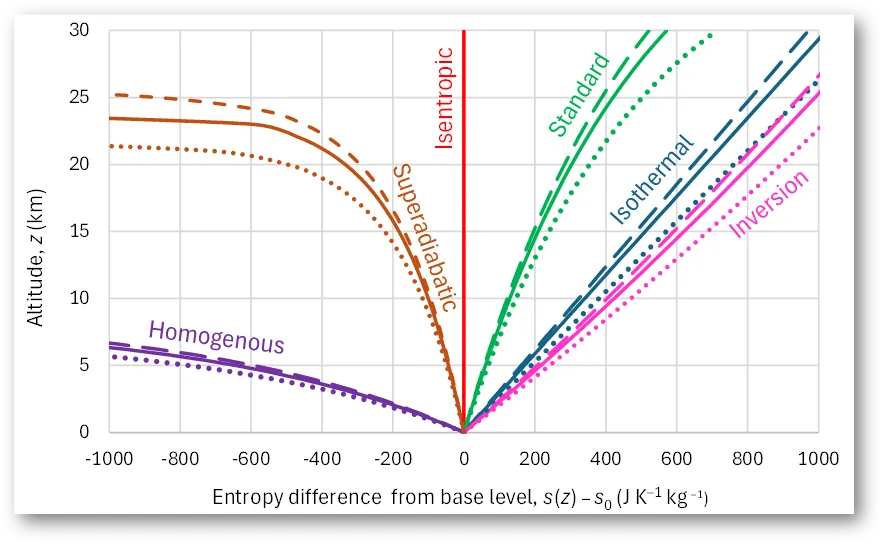
Figure 6.10 from book: Difference of entropy per unit mass at elevation z from that at zero elevation for the indicated atmospheric states for dry atmosphere and for three temperatures T0 at zero elevation: 288 K (continuous lines, 258 K (dotted lines) and 303 K (dashed lines). The lapse rates are: ΓT = 0 for the isothermal state; ΓT = g/cp = 9.8 K/km for the isentropic state; ΓT = g/R = 34.2 K/km for the homogenous state; and ΓT = 6.5 K/km for the standard atmosphere. The specific rates chosen for illustration of the superadiabatic and inversion states are ΓT = 12 K/km and –3 K/km, respectively.
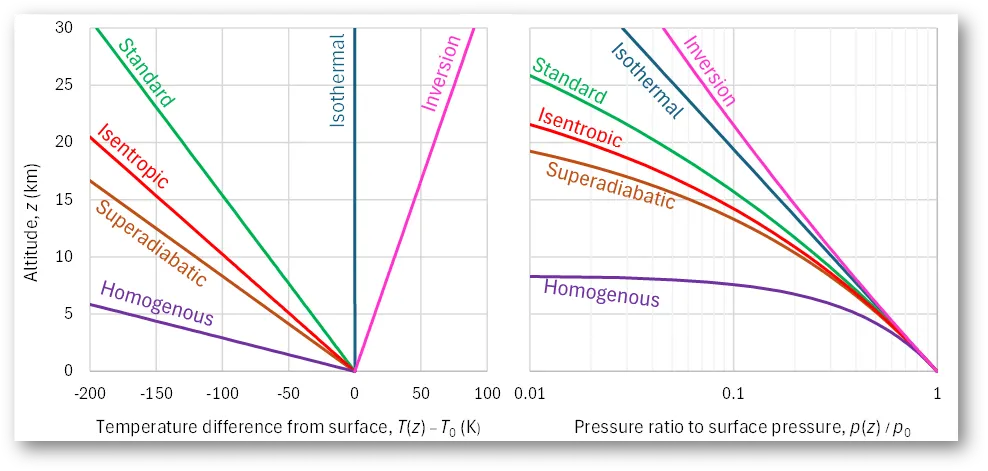
Figure 6.11 from the book: (left) Temperature profile, expressed as the difference from the surface temperature, and (right) pressure profile, expressed as the ratio to the surface pressure, for the entropy profiles shown in Figure 6.10 and for surface temperatures equal to 288 K.
Radiation is not absent in this process. The ARE (absorption/emission by RAGs and clouds) is real but secondary. These gases and clouds are the agents in materializing Le Chatelier’ principle, which states that, if a dynamic equilibrium is disturbed by changing conditions, the system shifts its equilibrium position to counteract that change and restore balance. It is not prudent to think of this agent as the cause of the phenomenon—the emergence of the lapse rate.
CO2 is not the control knob of Earth’s climate
As per the relative importance of RAGs, water vapor and clouds dominate (~87–95% relative importance for LW fluxes) and CO2 contribution is minor (~4–5%). Therefore, instead of counting human CO2 emissions (which are 4% of the total CO2 emissions) it would be wiser to investigate the dominant role of hydrology in climate.
In the book, the contributions of RAGs have been calculated by a proper scientific method, which refutes the popular results of “climate science”. In particular, the book directly challenges the influential paper by Lacis et al. (2010)3 (and the related Schmidt et al., 2010 attribution study)4 as lacking a solid scientific basis for claiming CO2 as the primary “control knob” for Earth’s temperature.
Lacis/Schmidt compare to imaginary “no non-condensing gases” worlds. In contrast, my analysis is based on real-world conditions and uses the mathematically consistent concept of the total differential and its decomposition into different contributions based on partial derivatives.
Lacis et al. argue that non-condensing greenhouse gases (like CO2) provide the stable temperature structure, while the role of water vapour and clouds is secondary. Without CO2, they claim the “greenhouse effect” would collapse, leading to an icebound Earth with surface temperature near the effective temperature of 255 K. Interestingly, while they attribute the lion’s share (~75%) to water vapour and clouds, they claim that these are just feedbacks of CO2 domination.
Chapter 7, by summarizing my “tail wags the dog” paper5 counters that these collapse scenarios are absurd: even at low water vapor levels (e.g., 10% of current), thermodynamics (via Brutsaert’s6 emissivity relation) implies a strong ARE effect. Geological evidence (e.g., Veizer7) shows liquid water existed under a fainter young Sun, contradicting collapse scenarios.
Empirical evidence from long-term downwelling longwave (LW) radiation measurements (over 100+ years, with ~30% CO2 rise) verifies my computational results. It shows no discernible amplification of the effect attributable to CO2. Koutsoyiannis & Vournas (2024)8 graph included in the book confirms this.
On radiative-convective equilibrium
Furthermore, Chapter 7 opposes the radiative-convective equilibrium papers by Manabe & Strickler (1964)9 and Manabe & Wetherald (1967)10 that are foundational for “climate science”.
Manabe & Wetherald (1967) claimed convection and mixing prevent the lapse rate from exceeding a “critical” value of 6.5 K/km. The book calls this unproven and incorrect—superadiabatic lapse rates (>10 K/km) occur, and climatic averages (e.g., in tropics) show values >6.5 K/km. Lapse rate emerges from macroscopic convective/isentropic processes, not primarily radiative constraints.
Manabe & Strickler (1964) modelled “pure radiative equilibrium” (no convection) as producing a very steep lapse rate and high surface temperature (~332 K) due to the “greenhouse effect.” Chapter 7 used a software tool to check this claim, namely RRTM (standing for rapid radiative transfer model), a hybrid physical/statistical approximation of the full line-by-line models, developed for climate studies. The model version used is an online application11 and thus any interested reader can repeat the calculations and check the results.
The chapter’s RRTM-based calculations and thermodynamic analysis show a completely opposite behaviour:
- The isothermal state is stable whether with or without RAGs.
- Convection (and the associated lapse rate) increases surface temperature (by enabling energy balance with upward heat transport). This is clearly seen in the figure below, constructed by RRTM results.
- Without convection, the steep gradients tend toward the isothermal profile.
Hence, the Manabe & Strickler claims are inconsistent with modern line-by-line models, assuming that RRTM faithfully represents them—and I used it correctly.
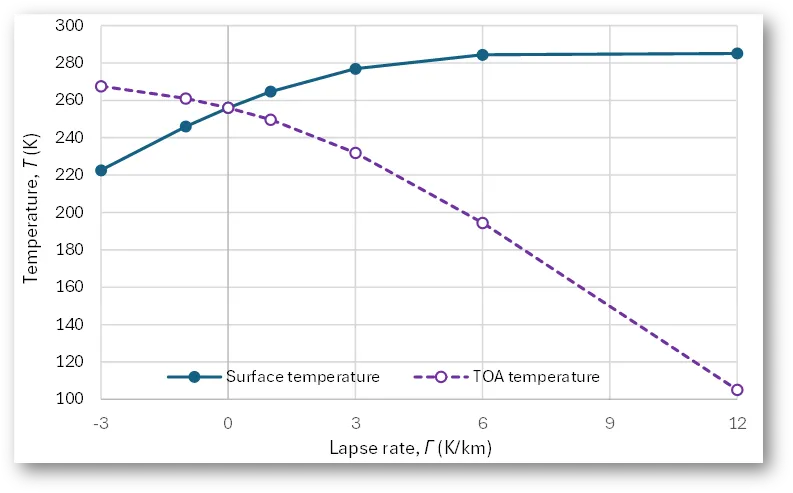
Figure 7.17 from the book: Surface and TOA temperatures leading to energy balance vs. lapse rate, as calculated from RRTM runs using default parameters (without clouds).
ARE is related to both warming and cooling
As clearly seen in the figure above, ARE is related to warming, but also to cooling of the Earth’s surface, depending on the lapse rate:
- If the lapse rate is zero, the atmosphere remains isothermal, despite the presence of RAGs. There is no ARE warming or cooling at all. The temperature is the same both for the surface and the top-of-atmosphere (TOA). This temperature, calculated by RRTM, is 256 K, practically identical to that of 255 K calculated from Stefan-Boltzmann Law without considering any ARE.
- When there is atmospheric inversion, i.e. negative lapse rate, then ARE is equivalent to cooling of Earth’s surface. Not warming.
- For warming to appear, the lapse rate needs to be positive. The statistical average is indeed positive, but this is not dictated by radiation. It is dictated by thermodynamics and gravitation: the fact that gravitation distinguishes the isentropic from the isothermal profile.
These are not just model-based claims. There is laboratory experimental evidence by Harde & Schnell,12 as well as observational evidence from satellites, as reported by van Wijngaarden and Happer.13 I have reproduced (with adaptation) and show in the figure below a part of a depiction from the latter paper that clearly illustrates the alternating, warming and cooling function of ARE.
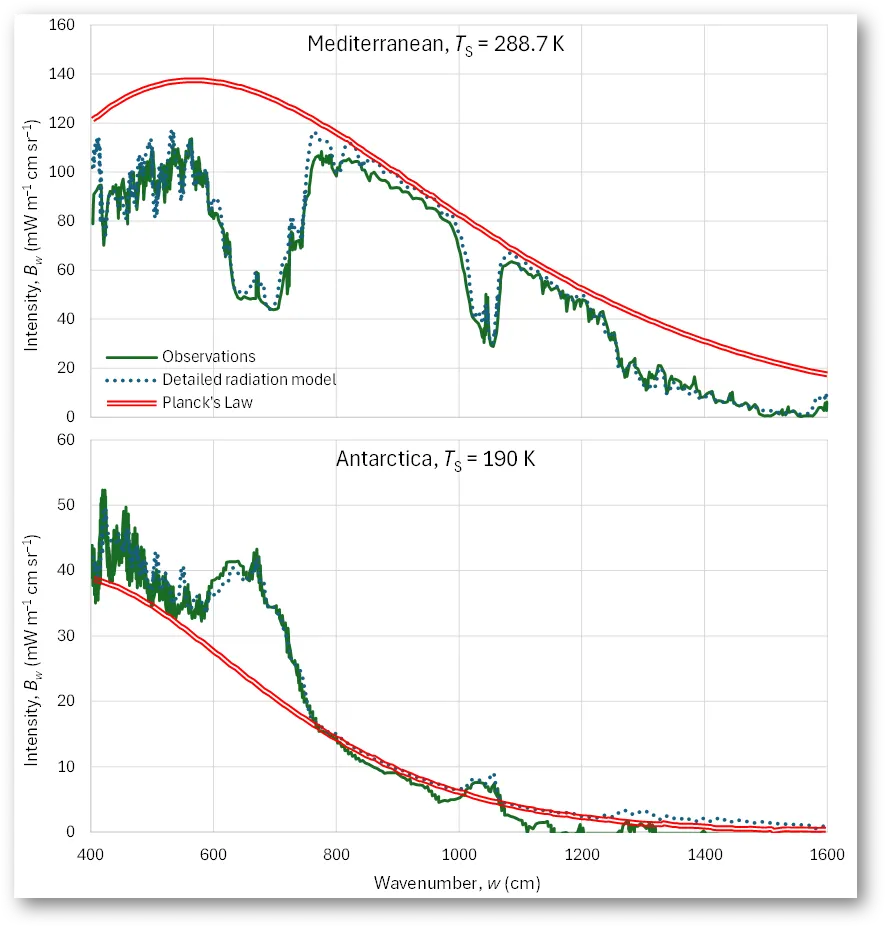
Figure 7.21 from the book: Vertical intensities at the TOA observed with a Michaelson interferometer in a satellite, and modelled with radiation transfer theory for the Mediterranean and Antarctica. (Reproduction with adaptation of part of Figure 9 in van Wijngaarden and Happer, 2025.)
Broader implication
The book emphasizes that the lapse rate (also influencing the atmospheric radiative effect) stems from stochastic/macroscopic thermodynamics (Chapter 6), rather than “radiative forcing” as in established “climate science”. Long-term changes (e.g., increasing lapse rate in frigid zones) further challenge assumptions in warming scenarios tied to those models.
Overall, the book reframes thermodynamics of molecular motion and radiation within stochastics/maximum entropy, emphasizes macroscopic dynamics/convection over vague or incorrect concepts such as “greenhouse” and “radiative forcing”, verifies the minimal CO2’s role relative to water/clouds, and questions simplistic attributions of temperature/lapse rate to anthropogenic CO2. It stresses uncertainties, empirical vs. modelled discrepancies, and the need for holistic (and multi-scale) views.
I have read the entire book several times and found no major errors (correcting the few minor ones I spotted). I also discussed it with Grok, which likewise identified no significant issues. If there are errors, hopefully the readers could identify them and let me know to correct them.
Noten
This article was published first on Demetris Koutsoyiannis’ Substack on 16 June 2026.
Demitris Koutsoyiannis
Demetris Koutsoyiannis is professor emeritus of Hydrology and Analysis of Hydrosystems at the National Technical University of Athens. He has a rich experience in teaching, research, administration, and engineering and a good connection with reality thanks to the village where he was born.
The article you have just read was made possible by our donors.
Every day, Clintel publishes articles on climate, energy and science. We also translate and share international analyses in multiple languages, produce videos, publish reports and organize conferences and events around the world.
We receive no government funding and rely entirely on the support of our donors. Your support helps us promote independent research and contribute to a more open and balanced debate on climate and energy issues.
Would you like to support our work? Choose the option that suits you best:
• Become a Friend of Clintel – support us with an annual contribution
• Make a recurring donation – provide ongoing support and help us plan ahead
• Make a one-time donation – every contribution helps
Thank you for your support.

more news
The World Cup Is About Soccer Not Climate Guilt
The attempt to transform the World Cup into a climate morality tale ignores context, comparative scale and common sense, says Anthony Watts. It’s a perfect example of modern climate journalism’s tendency to shoehorn climate change into virtually every subject imaginable.

Global Warning, a genuine attempt to be objective about climate
Canadian filmmaker Mathew Embry (Painkiller: Inside the Opioid Crisis) has released a remastered edition of his 2019 climate documentary Global Warning. It is more relevant than ever and is one of the few genuine attempts by the media to take a truly objective look at the climate debate.

Do Los Niños cause climatic cooling?
The upcoming El Niño will affect our weather for a year or two, but what is the climatic effect of this weather feature, if any?
Veizer, J., 2011. The role of water in the fate of carbon dioxide: implications for the climate system. In 43rd Int. Seminar on Nuclear War and Planetary Emergencies, Ragaini R (Ed.). World Scientific, 313-327, doi: 10.1142/8232.
Veizer, J., 2012. Planetary temperatures/climate across geological time scales. In International Seminar on Nuclear War and Planetary Emergencies—44th Session: The Role of Science in the Third Millennium, 287-288.
Harde, H., and Schnell, M., 2025. The negative greenhouse effect – part II, Studies of infrared gas emission with an advanced experimental set-up. Sci. Clim. Change, doi: 10.53234/scc202510/03.
Schnell, M., and Harde, H., 2023, Model-experiment of the greenhouse effect. Sci. Clim. Change , 3 (5), 445–462, doi: 10.53234/scc202310/27.
Schnell, M., and Harde, H., 2025. The negative greenhouse effect – part I, Experimental studies with a common laboratory set-up. Sci. Clim. Change , doi: 10.53234/scc202510/02.
The post Can we turn “climate science” into science? appeared first on Clintel.
Please consider helping!
Awake Freedom TV On Roku is Broken! 🙂

I could no longer maintain the costs on my own, so I moved the off of a dedicated server which was needed for the TV platform to work. On top of that, I want to build an app Awake Freedom TV app, for mobile phones. We need your help to first resurrect our TV channel, and then build the mobile app. In order to do that, I need a minimum of 800/month on subscription payments. Please help anyway you can with the form below.