We Passed Peak “Climate Change” Research
There is still some cachet for scientists in “climate change”, but that is obviously waning, says statistician William Briggs. Unless somebody comes up with a new angle to intrigue other scientists on how we’re all doomed, then fatigue will continue driving the numbers of climate change articles lower.


Scientists have produced an estimated 13 million articles on climate change. (Source: Shutterstock)
William Briggs
Date: 7 September 2026
Here is a graph of the yearly number of total papers that have the keyword “climate change” in them:

I got these from scholar.google.com, searching for the term “climate change” (using the quotation marks), and then searching year by year. The red dot is a linear extrapolation for 2026 from the day I did the search (10 August) to the end of the year.
Each point is itself only an estimate, and wholly reliant on Google’s method of search and storage. There is thus some plus-or-minus attached to each point to represent the actual number of “climate change” papers. I don’t know how big this should be. There is also bound to be some double counting, as I’ve noticed some papers will show up in different years. But there is also a lot of under-counting, because there was a large stretch where scientists didn’t use “climate change”, but used “global cooling” (in the mid 1970s) and later “global warming”. That latter term has fallen into disuse, given the facility of “climate change”; i.e. an untoward or unliked weather event, even cold ones, can be called “climate change”.
Thus this is only a ballpark figure. But we’re more interested in the general shape than absolute numbers.
The 13 million is the sum of all yearly articles.
Explosion
In 1960, there were 1,120 indexed papers (again, with some large +/-). Totals were similar for a few years, then slowly ramped up. Then, as you see, they exploded, peaking in 2020 with 900,000 estimated peer-reviewed papers, books, conference proceedings and other academic output.
The year 2020 was, as you sadly recall, when the covid panic hit. That may have been responsible for some of the drop off seen the following year. But it stretches the imagination to attribute the panic for the continuing fall. Most of that drop also occurred during Biden’s “climate change”-will-doom-us-all friendly Presidency. So it isn’t standard politics, either, that accounts for the plummet.
The graph is not normalized by number of scientists. In 1960, there were far fewer scientists than there are now. Which means a lot of the growth might only be the result of throwing more bodies into the publish-or-perish mill. Using the John Ioannidis et al. paper “Estimates of the Continuously Publishing Core in the Scientific Workforce“, we can get estimates of global numbers of scientists by decade:

From about 175,000 working scientists estimated in 1960 there are some 7.52 million today. All with some sizable plus-or-minus, too, because what we really want is the number of scientists who might write “climate change” papers. The total estimated scientists (in all fields) will only be a rough proxy for this. Nevertheless, we can extrapolate the numbers above for each year, and then get the per capita “climate change” number of papers by year:

In 1960, about 1 paper out of every 100 working scientists wrote a paper on “climate change”. That blew up to about 17 out of every 100 in 1990. But it’s on its way down now. And not because, as we saw above, solely for political reasons.
Meaning the drop off is likely real and not a function of the increasing numbers of people labeled “scientist.”
These are global numbers, in English anyway, and do not reflect only American politics.
Why?
The biggest reason, I say, is that the teats have been squeezed dry. There is nothing left. It’s all on repeat. Every possible aspect of “climate change” has been “researched” and there is very little new to say. Most new papers are now like Hollywood reboots.
You and I have already seen that every single subject in every single field has at least one peer-reviewed paper arguing that “climate change” will be bad for that thing if the thing is good, or good for the thing if the thing is bad. This is logically possible, but it is great nonsense.
We have also seen that every area of earth is warming at least twice as fast as every area of earth. This is not logically possible, and is also great nonsense.
You and I over the years have examined hundreds of papers like this one, which I owe to Retard Finder on Twitter (and the Daily Mail):

This asininity arose from the peer-reviewed paper “Childhood nature connection and constructive hope: A review of research on connecting with nature and coping with environmental loss” by Louise Chawla in People in Nature, a real journal that sounds made up but isn’t. The paper is solely about feelings. Irrelevant feelings about “threats” like “climate change.” According to the Abstract:
Young people’s emotions of worry, frustration and sadness as they learn about environmental degradation also express their understanding that they are connected to the biosphere. Therefore this review includes research on how young people cope with information about large-scale environmental problems, and it identifies practices to sustain hope.
This is not research, nor science. It is self-indulgent twaddle masquerading as seriousness. Which, as you and I have seen, is the great bulk of papers counted above. Most, admittedly, mask the silliness better than this one, using the rituals of statistics that guarantee publishing success.
What’s Next
Reality has not been generous to “climate change” research. The innumerable predictions of doom, made over decades, have failed. Not in the popular imagination, of course. “Climate change” to many in the public clearly fills a need. Many need to see their mere existence—but more frequently your mere existence—has been “harming the planet”. This is a tepid religion. As such, it is likely to remain with us for some while more.
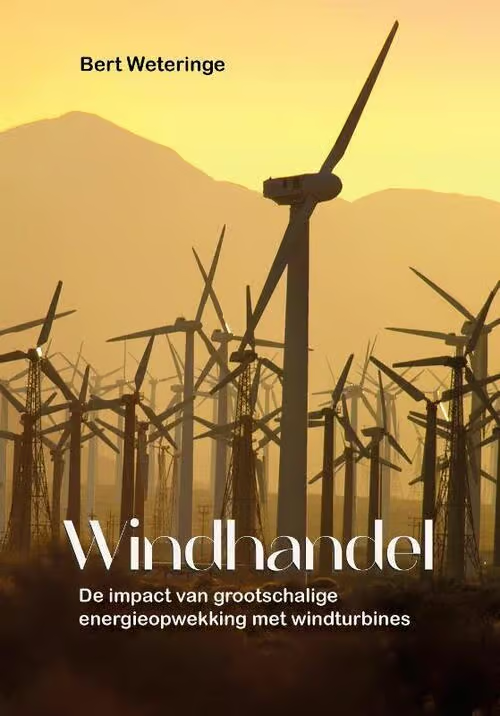
Crude extrapolations from the pictures above show we have at least another decade of too-many “climate change” papers. The timing depends on the non-scientific uses to which these papers can be put. Like selling “green” energy. But that market, as most know, is rather saturated. Most of the easy money has already been made. Anyway paving over entire states with windmills and solar panels isn’t going to work. (My recent favorite was a large energy company in the UK which warned people not to use electricity during the eclipse. You have to laugh.)
Victims will continue squeezing what they think they can get away with by crying how their suffering under “climate change” is greater than others’. Politics, because of DIE and wanton “immigration”, guarantees some of this. But my guess is that the effects of ethnic and racial bickering will be greater and we won’t need to focus on the weather to increase animosity.
Scientists mostly write about what they think other scientists will praise them for. There is still some cachet in “climate change”, but that is obviously waning. Unless somebody comes up on a new angle to intrigue other scientists on how we’re all doomed, then fatigue will continue driving the numbers lower. I can’t guess what it could be. We’ve done all common weather themes to death.
Still, unless they can find some other bandwagon on which to jump, and it would have to be as universal as “climate change” or covid, say, there is the good chance “climate change” ramps back up, not having anything better to do.
This article was published first on William Briggs’s website on 17 August 2026
William M. Briggs – the Statistician to the Stars! – has a background in philosophy, meteorology, and cryptography, with a Ph.D. in Mathematical Statistics and an MS in Atmospheric Physics. He is known for his work in the philosophy of uncertainty and science. He is the author of Uncertainty and The Price of Panic, among others.
The article you have just read was made possible by our donors.
Every day, Clintel publishes articles on climate, energy and science. We also translate and share international analyses in multiple languages, produce videos, publish reports and organize conferences and events around the world.
We receive no government funding and rely entirely on the support of our donors. Your support helps us promote independent research and contribute to a more open and balanced debate on climate and energy issues.
Would you like to support our work? Choose the option that suits you best:
• Become a Friend of Clintel – support us with an annual contribution
• Make a recurring donation – provide ongoing support and help us plan ahead
• Make a one-time donation – every contribution helps
Thank you for your support.

more news

Well-known weatherman on Dutch TV: stop eating meatballs
Gerrit Hiemstra, a well-known retired Dutch TV weatherman, was given the opportunity to ramble on for several minutes about the hot and dry summer in Europe during a highly-rated talk show on public service television. Naturally, according to him, the summer was the result of climate change, and Hiemstra also had a solution: stop filling up your car and eating meatballs. In the article below, Marcel Crok picks apart the claims made by Hiemstra.

Climate Change Will Not Starve the World
Climate change should be regarded as a manageable factor rather than an existential threat to global food supplies. Humanity has repeatedly demonstrated an ability to increase agricultural productivity faster than population growth, says Karl Iver Dahl-Madsen.

Measuring Meaningless Climate Actions
What would Americans gain from eliminating every ton of carbon dioxide emitted from the use of fossil fuels in the United States? The answer, says Vijay Jayaraj, is nothing.
The post We Passed Peak “Climate Change” Research appeared first on Clintel.
Please consider helping!
Awake Freedom TV On Roku is Broken! 🙂
I could no longer maintain the costs on my own, so I moved the off of a dedicated server which was needed for the TV platform to work. On top of that, I want to build an app Awake Freedom TV app, for mobile phones. We need your help to first resurrect our TV channel, and then build the mobile app. In order to do that, I need a minimum of 800/month on subscription payments. Please help anyway you can with the form below.