Succes of American climate sceptics is the result of hard work
The current success of the climate sceptic movement in the United States is not accidental. It is the result of several decades of deliberate work, networking, and strategic campaigning, says Craig Rucker of CFACT.

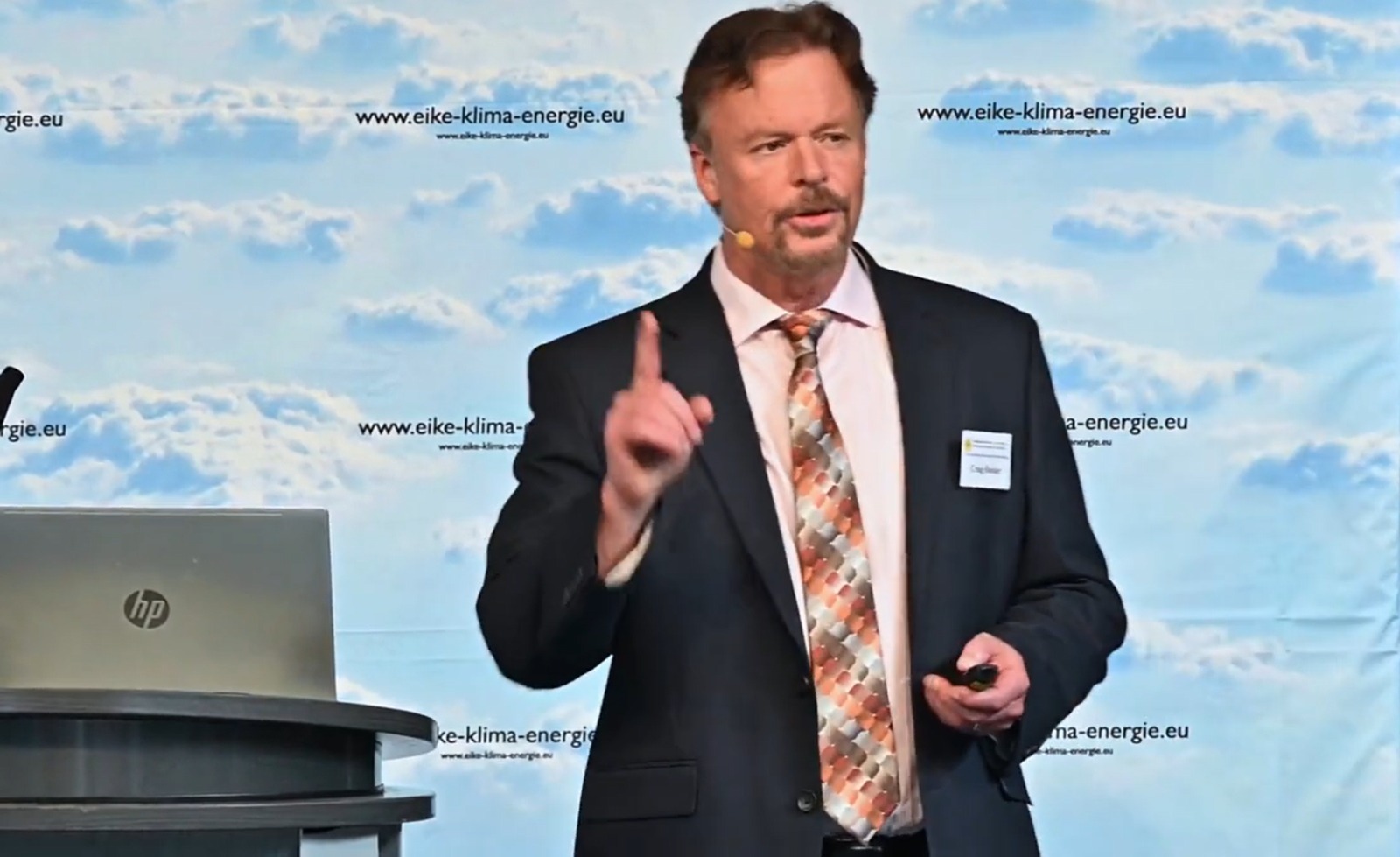
At the recent EIKE Conference in Halle (Germany), Craig Rucker presented an account of how the climate-sceptic or climate-realist movement in the United States has developed into a politically influential force. Rucker is president of the Washington, D.C.-based Committee for a Constructive Tomorrow (CFACT). Rather than focusing primarily on climate science, Rucker concentrated on political strategy, organization, communication, and activism.
You can see the entire presentation by Rucker here:
Rucker began by introducing CFACT, which he co-founded in 1985. The organization works on public policy in Washington, produces reports and studies, provides testimony, maintains relationships with scientists and academic advisers, and operates a program involving students on American college campuses. CFACT is also known for unconventional forms of activism, including public demonstrations, stunts, banners, and direct-action campaigns. Rucker jokingly described the organization as the “Greenpeace of the right.”
Historical roots
He then turned to what he sees as the current political success of climate realism in the United States. Rucker portrayed the United States as exceptionally resistant to the international climate agenda and argued that this resistance has deep historical roots. He recalled American reluctance toward international climate agreements beginning with the 1992 UN climate convention, followed by opposition to the Kyoto Protocol, resistance to subsequent international initiatives, and eventually withdrawal from the Paris Agreement. In his view, the United States has repeatedly played the role of the “stick in the mud” within international climate politics.
Rucker argued that this political resistance reflects public opinion. Referring to international polling, particularly an IPSOS survey, he claimed that the United States ranks among the most climate-sceptical countries. He emphasized that scepticism should not be defined only as outright rejection of climate change. In his interpretation, people who believe warming is primarily natural, as well as undecided respondents, should also be counted. On this basis, he argued that a majority of Americans are substantially less supportive of the dominant climate narrative than Europeans. He further contrasted the political importance of climate change in the United States and Europe, arguing that climate policy has a much smaller influence on American voting behaviour.
Trump
Rucker attributed much of the recent policy success of the movement to the political leadership of Donald Trump. He praised Trump particularly for his opposition to the Paris Agreement, his broader rejection of international climate institutions, his opposition to offshore wind, and his willingness to describe the prevailing climate agenda as a “hoax.” Rucker acknowledged that the Earth has warmed, but interpreted Trump’s language as referring to what he regards as the exaggerated political narrative surrounding climate change.
A major theme was the importance of personnel in government. Rucker argued that “people are policy,” meaning that political leaders can have a profound impact by appointing officials sympathetic to their views. He praised figures such as Energy Secretary Chris Wright and EPA Administrator Lee Zeldin for what he described as extensive deregulation and efforts to dismantle federal climate policies. Particularly significant to him was the establishment of a government climate working group involving sceptical scientists such as Judith Curry, Roy Spencer, and John Christy. Although the group’s work was subsequently withdrawn because of a filing error, Rucker regarded its existence as symbolically important because it represented an official government platform for views that had previously been largely excluded.
Rucker stressed, however, that political leadership alone does not explain the movement’s success. He argued that the foundations were laid over decades by organizations, scientists, activists, communicators, and donors. He rejected the idea that climate scepticism has succeeded because it is better funded than environmental activism. On the contrary, Rucker knows that climate-alarm organizations possess vastly greater financial resources, citing billions of dollars available to major environmental groups and foundations compared with comparatively modest resources among climate-realist organizations.
Strategy
This financial imbalance, in Rucker’s view, makes organization and strategy essential. He argued that climate-realists need resources, although they do not need resources on the same scale as their opponents. He also strongly rejected claims that the movement remains primarily funded by the fossil-fuel industry. He acknowledged that some oil and gas companies supported sceptical organizations during the early development of the movement, particularly between 1998 and 2006. According to Rucker, however, major energy companies subsequently abandoned these organizations and embraced the net-zero agenda instead. He therefore portrayed large energy corporations as increasingly unreliable or even adversarial toward the climate-realist movement.
The next major part of the presentation concerned organization and networking. Rucker described the Cooler Heads Coalition as an important example of effective coordination among organizations. Rather than concentrating on abstract disagreements over climate science, coalition members meet regularly to address specific legislation, lawsuits, regulations, and political initiatives. He argued that organizations should maintain their individual strengths while contributing to a broader coalition. In his example, different groups specialize in policy, science, state-level activism, communications, or grassroots campaigning.
The Art of War
Rucker then outlined the tactical principles that CFACT has adopted. He said the organization has drawn inspiration from both Sun Tzu’s The Art of War and Saul Alinsky’s Rules for Radicals. From these sources, he derived several principles: winning through strategy and disruption rather than direct confrontation; exploiting one’s own strengths and an opponent’s weaknesses; attacking where an opponent is unprepared; using ridicule; and exposing hypocrisy or inconsistency.
He illustrated these principles with examples from CFACT’s history. One early example involved the 1992 environmental summit and the organization’s decision to send former Washington governor and scientist Dixie Lee Ray to challenge the dominant climate message. By securing extensive radio exposure through Rush Limbaugh, Rucker argued that a very small organization was able to reach millions of Americans and influence the political atmosphere surrounding the summit.
Another tactic is to attack perceived weaknesses in the environmental movement’s promotion of renewable energy. Rucker highlighted issues such as land use, electricity costs, impacts on birds and wildlife, and opposition to wind projects. He described CFACT campaigns involving banners, billboards, rallies, boats, farmers, ranchers, and Native American groups. In his view, grassroots opposition to wind and solar projects represents an important vulnerability for the environmental movement.
Disruption
Rucker also emphasized surprise and disruption. He described protests targeting prominent climate activists and events, including Al Gore, Greenpeace, and James Hansen. The goal, he explained, is to appear in places where opponents do not expect resistance and thereby attract media attention.
Ridicule is another central component of his strategy. Rucker argued that humor can undermine an opponent more effectively than conventional argument because it is difficult to defend against mockery. He highlighted the work of CFACT communicator Mark Morano and referred to satirical campaigns, videos, and demonstrations designed to expose what Rucker considers the absurdities of climate activism.
Finally, Rucker emphasized exposing perceived hypocrisy. He cited examples of environmental celebrities or politicians whose lifestyles, travel, homes, or consumption patterns appear inconsistent with their public advocacy for reducing emissions. CFACT has used investigative videos and other media campaigns to highlight such contradictions.
Rucker concluded by insisting that the American climate-realist movement is neither accidental nor disorganized. In his characterization, it is coordinated, strategic, and built upon decades of networking between organizations, scientists, activists, communicators, and political actors. Its success, he argued, demonstrates that a relatively small movement with limited financial resources can challenge a much larger and better-funded political establishment if it combines credible scientific voices with effective organization, communication, grassroots activism, disruption, humour, and strategic political engagement.
The article you have just read was made possible by our donors.
Every day, Clintel publishes articles on climate, energy and science. We also translate and share international analyses in multiple languages, produce videos, publish reports and organize conferences and events around the world.
We receive no government funding and rely entirely on the support of our donors. Your support helps us promote independent research and contribute to a more open and balanced debate on climate and energy issues.
Would you like to support our work? Choose the option that suits you best:
• Become a Friend of Clintel – support us with an annual contribution
• Make a recurring donation – provide ongoing support and help us plan ahead
• Make a one-time donation – every contribution helps
Thank you for your support.

more news

Indonesia and India Are Jointly Planning a Hydrocarbon-Powered Future
India is the world’s most populous nation, and Indonesia the fourth. Together, they represent 1.8 billion people. At the top of their agenda is a massive expansion of energy trade.
Svensmark on Cosmic Rays, Clouds and the Politics of Climate Science
At the EIKE Conference in Halle (Germany), Willie Soon and Ronan Connolly from the CERES Team met with recently fired Danish physicist Henrik Svensmark for a wide-ranging discussion about his research into the relationship between solar activity, cosmic rays, clouds and climate. The cosmic-ray mechanism he proposes deserves to be investigated on its physical merits rather than dismissed because it does not fit comfortably into existing climate-model frameworks.

Central Banks Double Down on Climate Regulation
The ECB has quietly expanded its “climate factor”. This is a rear-guard action by a green priesthood that senses the ground shifting but cannot bring itself to abandon the climate faith, says Tilak Doshi.
The post Succes of American climate sceptics is the result of hard work appeared first on Clintel.
Please consider helping!
Awake Freedom TV On Roku is Broken! 🙂

I could no longer maintain the costs on my own, so I moved the off of a dedicated server which was needed for the TV platform to work. On top of that, I want to build an app Awake Freedom TV app, for mobile phones. We need your help to first resurrect our TV channel, and then build the mobile app. In order to do that, I need a minimum of 800/month on subscription payments. Please help anyway you can with the form below.