


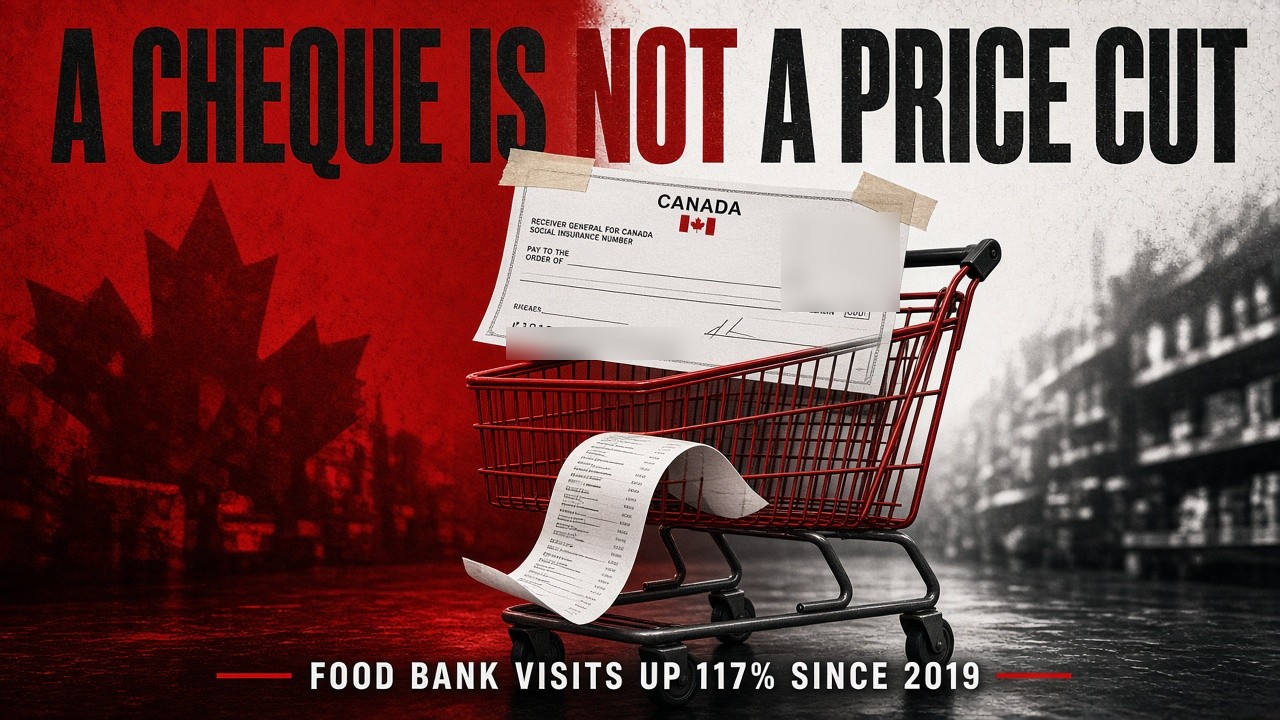
Mark Carney’s second budget had a chance to show Canadians that Ottawa understands what is happening at the checkout. Instead, the government reached for the same tool it always does: a temporary payment, mailed out on borrowed money, that does nothing to bring prices down.
The headline affordability measure in Budget 2026 is a one-time 50 per cent top-up to the Canada Groceries and Essentials Benefit, the quarterly payment for low- and modest-income households. It is worth up to $339 extra for a single person and up to $679 for a couple with two children, as The Conversation laid out. The government says the top-up puts $4.1 billion more into Canadians’ hands, according to CBC News.
That sounds generous until you look at what it is up against.
The checkout line is getting longer
Food Banks Canada’s 2026 HungerCount report found food bank visits have risen 117 per cent since 2019 and are almost nine per cent higher than last year. Toronto’s Daily Bread Food Bank has recorded a 333 per cent increase over the same period. And the Salvation Army’s national survey found 31 per cent of Canadians had skipped meals or cut portion sizes in September because they couldn’t afford groceries. All three findings are summarized in The Conversation’s budget analysis.
These aren’t people on the margins of the workforce. The main earners in two-thirds of food-insecure households hold permanent, full-time jobs. Working Canadians are lining up for food.
Against that, an extra $339 for a single person is, in the words of the same analysis, “likely enough to cover about two grocery bills.” Then it’s gone.
A cheque is not a price cut
The problem with a one-time top-up isn’t that it helps nobody. For a struggling family, a few hundred dollars matters. The problem is that it treats the symptom and leaves the disease untouched.
Even the people inclined to be kind to this budget concede the point. Oxfam Canada noted that income supports “will not bring down grocery bills or prices at the pump.” Carleton University’s Ian Lee told Yahoo News Canada the extra money is a cushion for the households least able to absorb higher food prices, not a way to bring those prices down.
When a government’s main grocery policy is to send cheques, it is admitting it has no plan for the cost of food itself. And because the payment is one-time, families will be right back where they started when it runs out, waiting to see whether Ottawa decides to do it again before the next election.
The middle class gets a speech
If you’re in the middle of the income ladder, Budget 2026 has very little for you directly. Lee put it plainly: “I don’t think it’s going to help the proverbial, the famous middle class, the people in the middle of the country.” He estimated the grocery top-up reaches “probably… the bottom 30 or 40 per cent of the population,” per Yahoo News Canada.
That leaves millions of households paying the same grocery bills, the same rent and the same mortgage renewals, with nothing but a promise that business investment will eventually lift their wages.
Canadians weren’t fooled going in. In an Abacus Data survey of 1,809 adults before the budget, only 10 per cent expected it to make things better for their household, while 30 per cent thought it would make affordability worse, CBC News reported. Almost two-thirds said affordability was one of the most important issues facing the country.
Where the real money went
The budget’s priorities show up in the numbers. The productivity mega-deduction for business investment accounts for $36 billion, compared with $22 billion for all new affordability measures combined, according to CBC News.
Economist Armine Yalnizyan summed it up for CBC: “Canadians are going to need a lot of patience because this budget is not there to support them.” Her verdict: “It’s not a bad budget for all of that, but they’ve left out the people.”
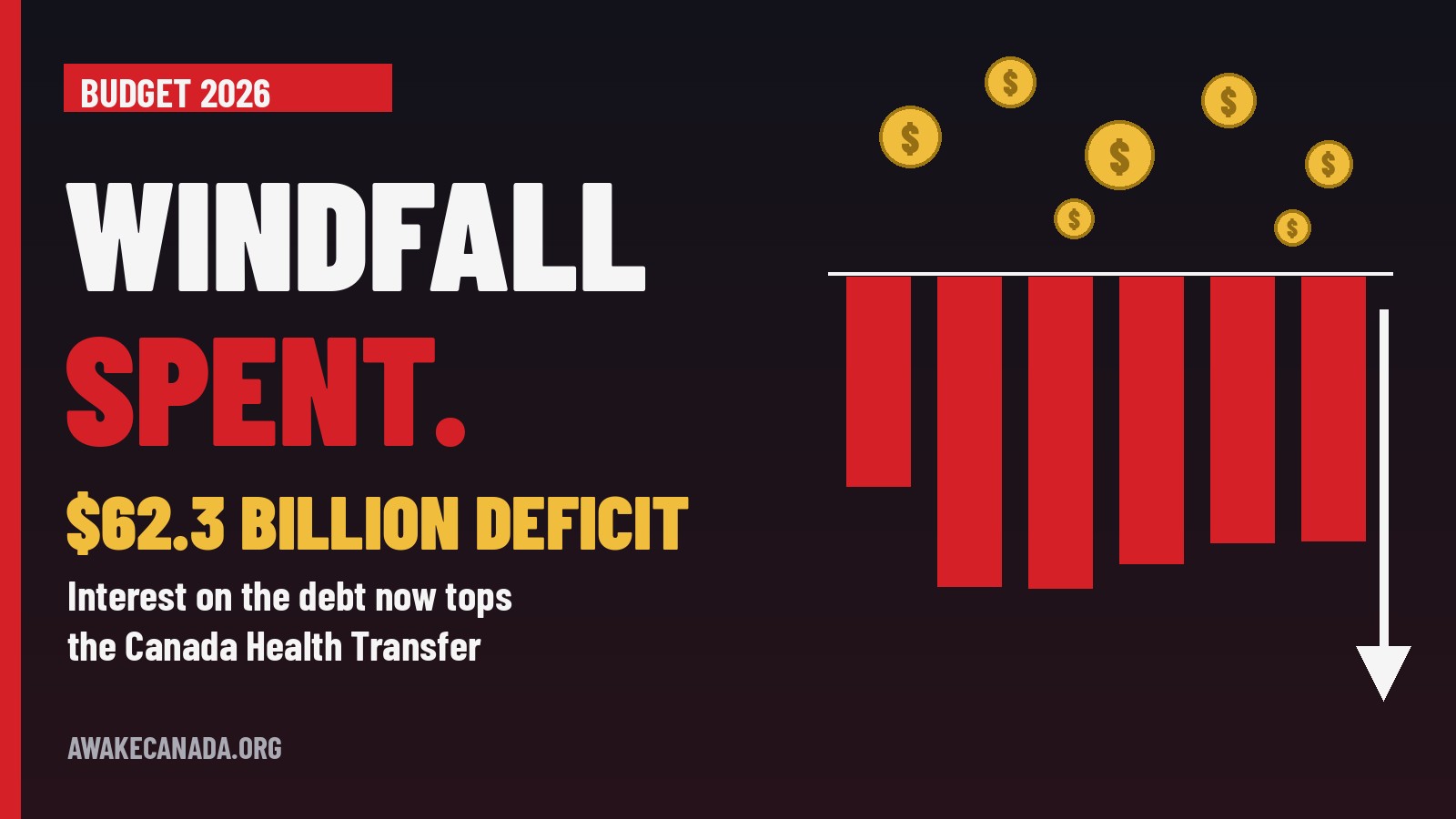
And all of it is financed with borrowed money. Before the budget, the Parliamentary Budget Officer projected a 2026-27 deficit of $63.3 billion and warned the government’s fiscal anchors “have imposed limited fiscal discipline on government spending and borrowing.” Deficits feed the very cost-of-living pressure these cheques are meant to soften. Canadians will pay for today’s top-up through tomorrow’s interest bill.
Off track on its own promise
Ottawa has a formal commitment to cut poverty in half by 2030. The National Advisory Council on Poverty’s 2026 report, Too Many Left Behind, found Canada is not on track to meet it. Poverty fell between 2015 and 2020, but has climbed steadily since 2021, as The Conversation noted.
That’s the record Carney is defending: rising hunger, a missed poverty target, and a budget whose answer is a one-time payment that runs out after a couple of trips to the store.
What a serious plan would look like
Canadians don’t need another cheque with the prime minister’s name on it. They need a government that goes after the causes of high food costs: the tax and regulatory load on the people who grow, move and sell our food, and deficits that keep adding to the pressure on prices.
Carney sold himself as the serious economist in the room. A serious economist knows a one-time transfer doesn’t fix a price problem. Budget 2026 shows he either doesn’t believe that, or doesn’t think voters will notice. The food bank lines say they already have.
Please consider helping!
Awake Freedom TV On Roku is Broken! 🙂

I could no longer maintain the costs on my own, so I moved the off of a dedicated server which was needed for the TV platform to work. On top of that, I want to build an app Awake Freedom TV app, for mobile phones. We need your help to first resurrect our TV channel, and then build the mobile app. In order to do that, I need a minimum of 800/month on subscription payments. Please help anyway you can with the form below.

Leave A Comment