


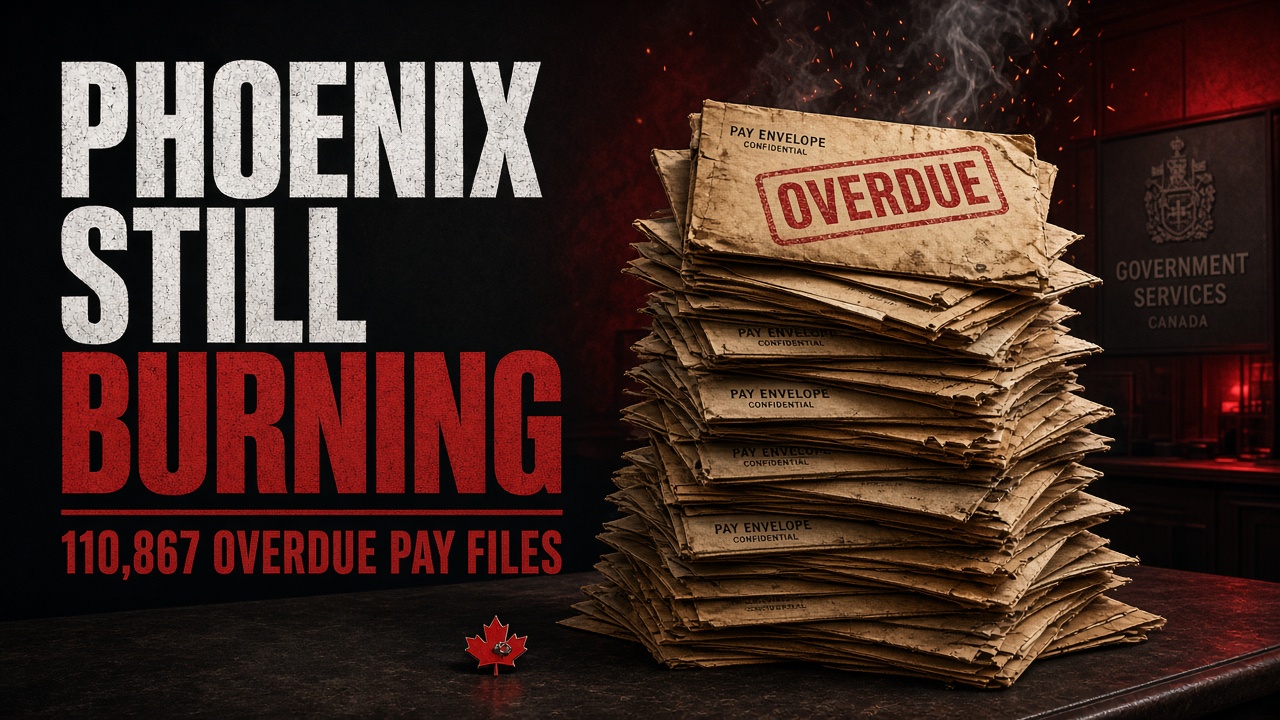
Every government says it will fix Phoenix. Mark Carney’s was handed a clear deadline, a clear target and a decade of lessons. It missed anyway.
On November 9, the Auditor General of Canada released its Commentary on the 2025–2026 Financial Audits, covering the first full fiscal year of the Carney government. Buried among the write-offs and accounting warnings is a sentence that should embarrass anyone who claims to be a competent manager: “The government did not meet its target to eliminate, by March 31, 2026, the backlog of pay transactions that were more than 1 year old.”
The deadline came and went
The target was not a surprise. According to the Auditor General’s March 2026 audit, Modernizing the Pay System, Public Services and Procurement Canada set the goal in early 2023: clear every pay transaction one year old or older by March 2026. That gave the department three years.
It also gave the department plenty of warning. The same audit found that the department’s own internal reports, through September 2025, already showed it would not hit the target. In other words, under Carney, Ottawa knew months in advance that it was going to fail, and it failed.
When the deadline arrived on March 31, 2026, the Auditor General counted 181,649 pay transactions still in the backlog, and 110,867 of them were more than a year old. The target for that second number was zero.
Some of these cases are older than six years
These are not paperwork rounding errors. Each transaction is a real pay change for a real person: a promotion, an acting assignment, a leave, a departure. According to the Auditor General’s breakdown of the backlog as of March 31, 2026:
- 13% of transactions were 3 to 4 years old
- 9% were 4 to 5 years old
- 6% were 5 to 6 years old
- 8% were more than six years old
Think about that. Some federal employees have been waiting since before the pandemic for their government to process a change to their pay.
And the errors keep coming. The Auditor General’s news release says audit tests found that 18% of employees had an error in their basic or acting pay, and 70% of those errors were caused by delays in processing pay changes. That is the backlog, doing exactly the damage it was always going to do.
A $4.2 billion replacement, with the old mess still attached
The government’s plan is to move off Phoenix and onto a new system called Dayforce, starting in July 2027. The Auditor General’s March audit put the preliminary price tag at more than $4.2 billion, and noted that the estimate “did not include important costs needed for all departments and agencies to transition.” So the real bill is higher, and nobody has told taxpayers how much.
Worse, the auditors warned that if the backlog is not cleared before the switch, “there is a risk that existing errors will carry over and undermine the effectiveness of the new system.” The audit also found that the Treasury Board Secretariat made “slow progress in simplifying pay rules,” one of the main lessons from the Phoenix disaster, so the department was proceeding with customizations to Dayforce to avoid delays. Customizing software around messy rules is exactly how Phoenix went wrong in the first place.
Then the schedule was shortened. The audit notes that after the audit period, the department moved the transition up by about three years. Faster, more customized, more expensive, and carrying a six-figure backlog into the new system. What could go wrong?
Overpayments still not recovered
The November commentary adds one more failure: “long-standing employee overpayments have yet to be recovered.” This is a government that tells Canadians it is serious about spending discipline, yet it cannot claw back money it paid out by mistake to its own staff, years after the fact.
Meanwhile, the pension fund became a piggy bank
While public servants waited on their pay, the government was moving money out of their pension plan. The Auditor General reports that for the second straight year, Ottawa cut the surplus in the Public Service Pension Fund to the legal maximum, transferring $904 million to the Consolidated Revenue Fund in 2025–26. Combined with the year before, the total is $2.8 billion.
That transfer is permitted under the law. But the optics speak for themselves: Ottawa found time to sweep surplus pension money into general revenue, and could not find a way to process 110,867 overdue pay files.
Competence was the whole pitch
Mark Carney sold himself as the grown-up in the room, the central banker who would bring private-sector discipline to Ottawa. Paying your employees correctly and on time is the most basic test of any employer. A corner store manages it. A federal government with a $38 billion annual payroll, according to the Auditor General, cannot.
This was not an inherited problem with no deadline. It was a specific, measurable target, with years of warning, internal reports flagging the miss, and a full fiscal year under Carney to fix it. The result: more than 110,000 overdue files, errors in nearly one in five employees’ pay, and a multi-billion-dollar replacement project already running on shortcuts.
If this government cannot manage its own payroll, Canadians have every reason to doubt it can manage anything bigger.
Sources: Office of the Auditor General of Canada, Commentary on the 2025–2026 Financial Audits and news release (Nov. 9, 2026); Modernizing the Pay System (March 2026); The Canadian Press via CityNews.
Please consider helping!
Awake Freedom TV On Roku is Broken! 🙂

I could no longer maintain the costs on my own, so I moved the off of a dedicated server which was needed for the TV platform to work. On top of that, I want to build an app Awake Freedom TV app, for mobile phones. We need your help to first resurrect our TV channel, and then build the mobile app. In order to do that, I need a minimum of 800/month on subscription payments. Please help anyway you can with the form below.





Leave A Comment