


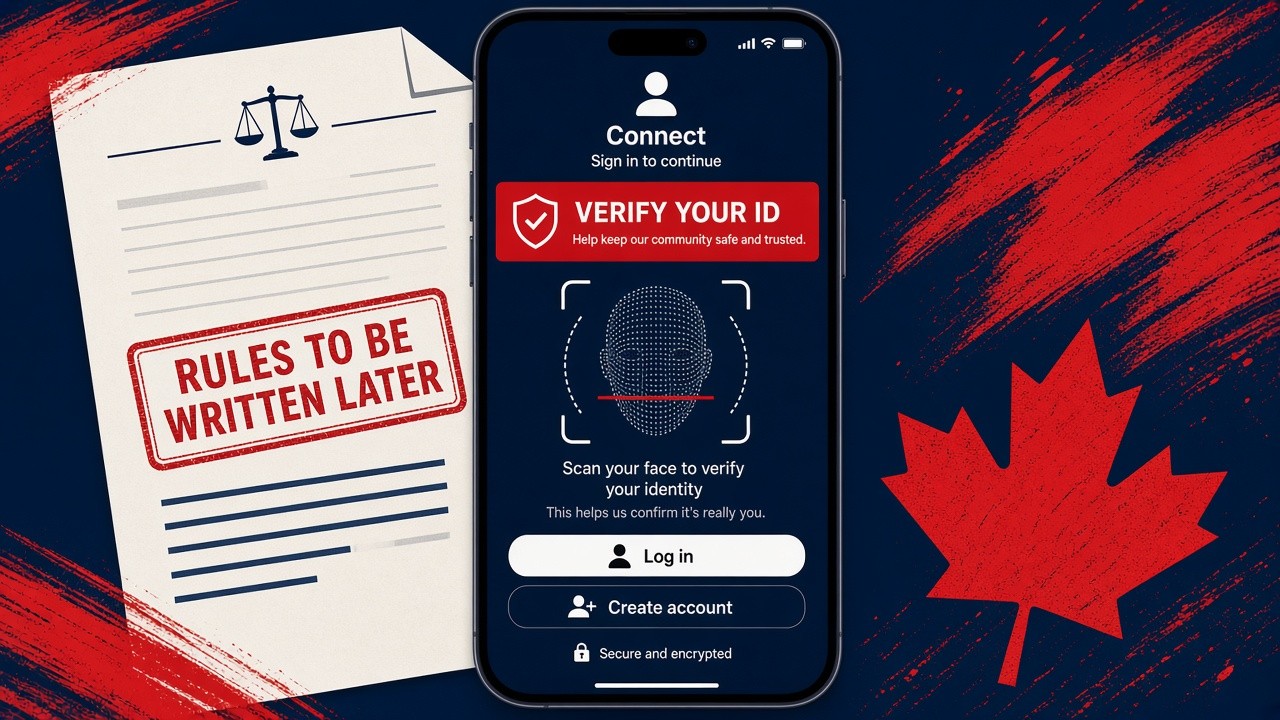
On Wednesday, Mark Carney’s government brought its Safe Social Media Act, Bill C-34, back to the House of Commons for second reading. The pitch is simple and hard to argue with: protect kids online. Keep under-16s off social media. Make platforms clean up the worst content.
Read the bill, though, and a different picture emerges. This isn’t a law so much as a blank cheque: a promise to write the real rules later, handed to a brand-new regulator with sweeping powers and very few limits.
A law with the important parts left blank
University of Ottawa law professor Michael Geist, one of the country’s leading internet law experts, went through the bill line by line. His count: 19 decision points reserved for cabinet and 31 separate regulation-making powers handed to the new Digital Safety Commission. That’s 50 key issues to be decided after Parliament votes.
What’s left out isn’t minor. Which social media services does the Safe Social Media Act actually cover? As Geist puts it, “The answer for the moment is none.” The user thresholds that make a platform “regulated,” and even the method for counting users, are left to future cabinet regulations. What counts as adequate age verification? Left to the Commission. When does the whole thing take effect? Whenever cabinet decides, by order in council.
Geist’s verdict: the government “has enacted the promise and deferred the law.”
That’s a familiar Ottawa trick. Parliament votes on a framework, and the substance gets written later by cabinet and appointed officials, away from the debate and the votes that MPs are elected to hold.
ID or a face scan just to post a comment
The under-16 ban sounds like it only affects kids. It doesn’t. To keep children off, platforms have to check everyone’s age.
The Canadian Civil Liberties Association warned that, absent exemptions, “every social media user will be required to prove their age through age-verification or age-estimation tools.” Its privacy director, Tamir Israel, called that “highly invasive.”
Geist spells out what that means in practice: an adult who wants to leave a comment on Reddit or a parent posting a family photo on Facebook would first have to verify their age by submitting government identification or undergoing a facial age scan. Who holds that data, how accurate it has to be, and what privacy protections apply are, again, for the Commission to decide.
During Wednesday’s debate, Conservative heritage critic Rachael Thomas put the obvious question to the government. “Would Canadians be asked to submit government-issued identification, biometric data or other sensitive personal information, and if so, what are the regulations that would guide that?” The bill doesn’t say.
Will it even work?
Canada’s plan follows Australia’s. According to The Globe and Mail, experts say many Australian children have gotten around that ban by moving to smaller platforms not covered by the law.
Thomas told the House that young people and parents both tell her kids will find a workaround. The CCLA goes further, citing data from other jurisdictions showing age-verification systems are ineffective. So Canadians could end up handing over ID to use the internet while the teenagers the law targets simply route around it.
A super-regulator with a one-person start
The bigger story may be the regulator itself. Geist calls the Digital Safety Commission “the most powerful Internet regulator the country has known.” Under the bill, according to his analysis:
- It “is not bound by any legal or technical rules of evidence.”
- It can hold hearings in private when it decides that serves “the public interest” or “the national interest.”
- Its inspectors can “enter” a company’s premises remotely, by accessing its systems “by a means of telecommunication,” under warrant.
- It can impose penalties of up to the greater of $10 million or 3 per cent of a company’s global revenue.
- Until at least two other members are appointed, a single cabinet-appointed chair alone “comprises the Commission” and can exercise all its powers.
The bill also scraps the independent Digital Safety Ombudsperson from the Trudeau-era online harms bill, C-63, and folds that advocacy role into the regulator. The same body that fines platforms is supposed to stand up for their users.
“A blank check for federal power”
Nobody serious argues that child sexual abuse material or non-consensual intimate images should stay online. The bill’s 24-hour takedown rule for that content is the easy part.
The problem is everything else. The CCLA notes the bill requires platforms to mitigate risks from seven categories of “harmful content,” including content that is currently legal, and warns the obligations are “so alarmingly broad” that platforms “will be tempted to over-comply at the expense of users’ freedom of expression and privacy rights.”
Executive director Howard Sapers summed it up: “A blank check for federal power is the wrong answer to a real problem.”
The bottom line
Protecting kids online is a real goal. But Carney’s approach asks Canadians to trust that cabinet and an unformed commission will get the details right later, on age verification, on what counts as harmful, on who gets exempted, with secret hearings and no rules of evidence along the way.
Canadians have seen this playbook before. Big promises up front, the fine print written behind closed doors. Before C-34 leaves committee, MPs of every party should insist that the rules be written into the law itself, where voters can see them and Parliament can vote on them. If the government can’t explain how its own law works, it isn’t ready to pass it.
Please consider helping!
Awake Freedom TV On Roku is Broken! 🙂

I could no longer maintain the costs on my own, so I moved the off of a dedicated server which was needed for the TV platform to work. On top of that, I want to build an app Awake Freedom TV app, for mobile phones. We need your help to first resurrect our TV channel, and then build the mobile app. In order to do that, I need a minimum of 800/month on subscription payments. Please help anyway you can with the form below.






Leave A Comment