Africa’s Poorest Countries Need Energy, Not Empathy
African governments should demand that the African Development Bank and World Bank restore financing for fossil fuel plants and for the infrastructure to connect them to consumers. This is the bare minimum needed for the continent’s most desperate to escape poverty, says Vijay Jayaraj.


Children who cook in the courtyard of their home in Mali. (Source: Shutterstock)
Vijay Jayaraj
Date: 5 October 2026
The mainstream media and policy analysts have been slower than sloths in displaying an understanding of how the United States’ dismantling greenhouse gas limits for power plants is a profound turning point for global energy policy. Moreover, while Washington reclaims industrial common sense, the promise of energy reformation languishes in Africa, especially in nations that sit at or near the bottom of national income.
Begin with numbers published by the World Bank. In Mozambique, 81% of people live below the line of extreme poverty, $2.15 a day. In Burundi the figure stands at 74%, and in the Central African Republic close to 72%. Malawi sits alongside them with some of the highest poverty rates on the continent, and its economy entered 2026 with inflation nearly 30% and public debt approaching 91% of gross domestic product.
South Sudan posts the lowest score on the U.N.’s Human Development Index. In 2019, more than 97% of people in the Central African Republic, South Sudan, and Burundi cooked with smoky wood, charcoal, dung, and crop waste.
The Institute for Health Metrics and Evaluation found that household smoke kills Burundians at high rates, and women and girls spend four hours daily gathering fuel. In Egypt where cooking gas is widely used, such hardships are hardly known.
Energy Access and Poverty
One of the primary reasons for these levels of poverty is lack of access to energy, especially electricity. And some of the statistics could come from societies of dark pre-industrial eras.
The Central African Republic’s electricity network runs on the hydroelectric power of one waterway. The Boali complex on the Mbali River – three units totaling less than 39 megawatts – produces far less than a single modern coal-fired plant, which typically generates 1,000 megawatts or more. Of the country’s 5 million people, 4.3 million do not have electricity.
Burundi’s entire national grid produced less than 167 megawatts in 2025, even with a recent addition of nearly 50 megawatts. The national access to electricity sits below 12%. Burundi’s 14 million people depend on a system that is barely enough for a single American shopping mall.
South Sudan’s installed capacity reached roughly 214 megawatts by 2023, of which about half worked.
Why does so little firm power exist in places that need it most? Follow the finance. The World Bank stopped financing coal more than a decade ago. It then would end upstream oil and gas lending after 2019.
In September 2019, African Development Bank President Akinwumi Adesina told the U.N. Climate Action Summit that coal belonged to the past and his bank was getting out of it, a pledge the bank never formally wrote into policy but has applied in practice.
Vijaya Ramachandran of the Breakthrough Institute says blanket bans on financing hydrocarbon projects entrench poverty. Addressing climate change and ignoring poverty is “completely immoral,” she says. “The average Ethiopian consumes only 130 kilowatt-hours of electricity per year, about the amount the average person in the United States consumes in four days.”
Ms. Ramachandran is not a climate “skeptic” but rather an economist who knows what happens at a clinic that has insufficient electricity to refrigerate its drugs.
NJ Ayuk of the African Energy Chamber makes the engineering case. Ending energy poverty, he says, requires every available resource, with coal and oil among the assets that “each have a role to play.” Telling Africans to make do with wind and solar while wealthy countries restart their own coal plants is “not just unfair (and) unjust, it is dishonest,” he says.
African governments should demand that the African Development Bank and World Bank restore financing for fossil fuel plants and for the infrastructure to connect them to consumers. This is the bare minimum needed for the continent’s most desperate to escape poverty.
This commentary was first published at PJ Media on 30 September 2026.

Vijay Jayaraj
Vijay Jayaraj is a Science and Research Associate at the CO2 Coalition, Fairfax, Virginia. He holds an M.S. in environmental sciences from the University of East Anglia and a postgraduate degree in energy management from Robert Gordon University, both in the U.K., and a bachelor’s in engineering from Anna University, India. He served as a research associate with the Changing Oceans Research Unit at University of British Columbia, Canada.
The article you have just read was made possible by our donors.
Every day, Clintel publishes articles on climate, energy and science. We also translate and share international analyses in multiple languages, produce videos, publish reports and organize conferences and events around the world.
We receive no government funding and rely entirely on the support of our donors. Your support helps us promote independent research and contribute to a more open and balanced debate on climate and energy issues.
Would you like to support our work? Choose the option that suits you best:
• Become a Friend of Clintel – support us with an annual contribution
• Make a recurring donation – provide ongoing support and help us plan ahead
• Make a one-time donation – every contribution helps
Thank you for your support.

more news

Even Tom Cruise can’t make a politically correct climate satire funny
It looks like climate activists accidentally made a $180 million dollar mass-market movie that only appeals to the doomster greenie fringe who hate old white men and Big Oil, says Jo Nova.

When Net Zero Fails, Start a War: Europe’s Descent
When all else fails, start a war. The rhetoric of imminent war with Russia has become the dominant note of European public life, displacing the language of the climate emergency, says Tilak Doshi.

Roger Pielke Jr. lectures in Driebergen on 11 October 2026
Roger Pielke Jr. will give two lectures on Sunday 11 October 2026 at Antropia in Driebergen, the Netherlands, at the invitation of the Clintel Foundation. The American researcher will discuss climate change and extreme weather, climate-related damage, climate scenarios and the politicisation of climate science. The afternoon is open to supporters, critics and anyone interested in understanding his research.
The post Africa’s Poorest Countries Need Energy, Not Empathy appeared first on Clintel.
Please consider helping!
Awake Freedom TV On Roku is Broken! 🙂
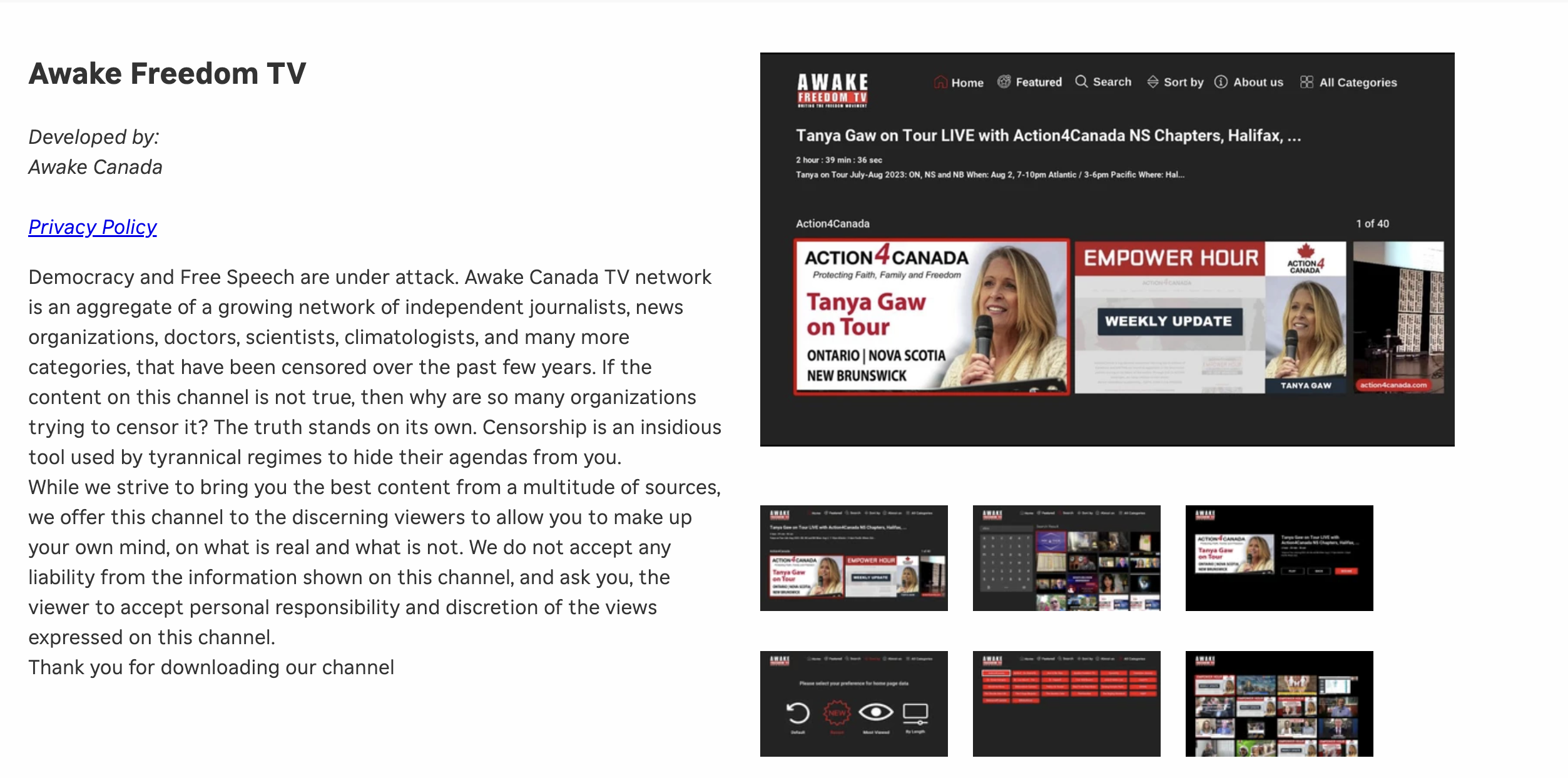
I could no longer maintain the costs on my own, so I moved the off of a dedicated server which was needed for the TV platform to work. On top of that, I want to build an app Awake Freedom TV app, for mobile phones. We need your help to first resurrect our TV channel, and then build the mobile app. In order to do that, I need a minimum of 800/month on subscription payments. Please help anyway you can with the form below.