The IPCC’s doomsday scenario is dead, but not yet buried
Finally, the IPCC’s doomsday scenario is being tossed in the trash. The Dutch newspaper De Volkskrant deemed the news important enough for the front page. Marcel Crok wrote as early as 2018 that the IPCC’s extreme scenario was untenable. However, the wheels of science turn slowly, and so it took more than eight years for this insight to be recognized by the scientific community.

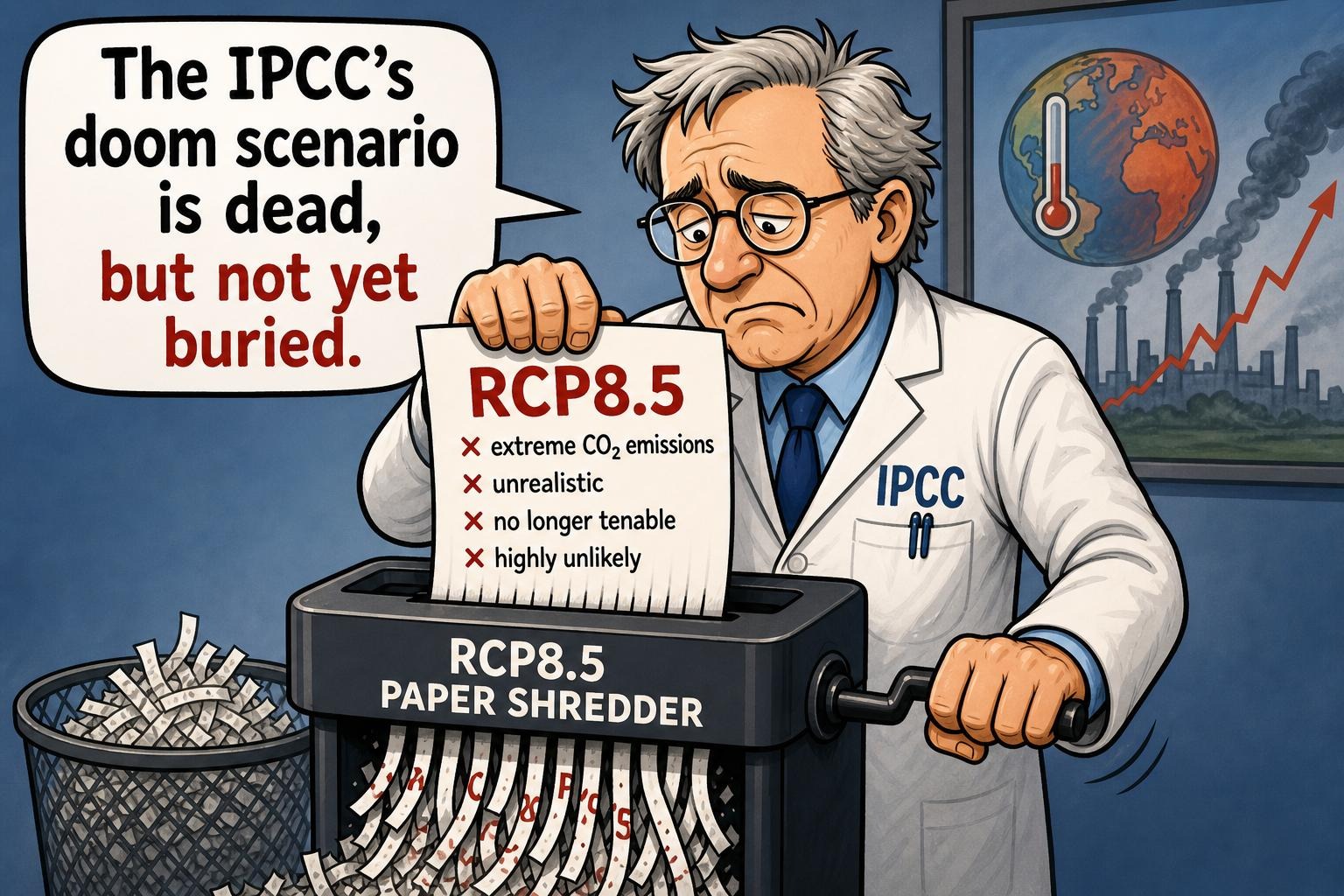
Image created with ChatGPT
Marcel Crok
Date: 6 mei 2026
“UN Climate Panel Scraps Disaster Scenario”—that’s how the Dutch daily De Volkskrant opened its front page on May 4. On X, author Maarten Keulemans writes in a long thread: “This is so huge. Mind-boggling. Insane. The IPCC acknowledges what has been circulating for a long time: The highest disaster scenario, 8.5, no longer aligns with reality. WHAT CONSEQUENCES this has. ALMOST EVERYTHING YOU’VE READ ABOUT THE CLIMATE FUTURE IS WRONG.”
Keulemans is right: it is indeed huge. And just so you know: Almost everything you’ve read in recent years about the climate future is wrong.
Also on X, Wierd Duk from another Dutch newspaper, De Telegraaf, writes in response to the article in De Volkskrant: “And who said this years and years ago already and were barred from every debate? Right, people like @marcelcrok @ClintelNED and also @Simon_Rozendaal.”
This is also true. Rob de Vos and I published a report in early 2018 (!) with the Dutch foundation de Groene Rekenkamer (the Clintel Foundation hadn’t even been founded yet) titled Why the KNMI Scenarios Won’t Come True. In it, we already wrote what was on the front page of De Volkskrant. Eight years ago, that is! That’s how slowly the wheels of science turn.
En wie zeiden dit al jaaaaaren geleden en werden uit elk debat geweerd? Juist, mensen als @marcelcrok @ClintelNED en ook @Simon_Rozendaal https://t.co/CQvFfWUqFx
— Wierd Duk ܦܝܪܬ ܕܘܟ (@wierdduk) May 4, 2026
Future
For those following the debate closely, this is old news. For those who aren’t following it as closely, here’s what’s going on. The UN climate panel, the IPCC, works with scenarios. These scenarios outline possible futures for humanity: how the world population will grow, how the economy will develop, and which energy sources we will use. Such storylines translate into greenhouse gas emissions, including CO2 and methane. Climate scientists can then feed these emission scenarios into their climate models, which yields the climate forecasts (the IPCC euphemistically calls them “projections,” because they are not true predictions like tomorrow’s weather forecast) that the IPCC prominently features in its reports.
The highest-emission scenario the IPCC has used since 2009 is called RCP8.5. In this scenario, CO2 emissions increase dramatically in the 21st century, from about 40 gigatons per year today to as much as 128 gigatons per year by 2100. This extreme increase in CO2 emissions naturally leads, in climate models (which, incidentally, overreact to CO2, but more on that another time), to a sharp rise in global temperatures, up to 5 or 6 degrees of warming by 2100.
We regularly read in the media: if we do nothing, we’ll see a 5-degree rise in temperature. Two things were wrong with those kinds of claims. The highest-emission scenario was treated as a business-as-usual scenario (what if we continue on our current path), which was incorrect, and it was also considered the most likely scenario, which was also incorrect. IPCC scenarios do not involve probabilities at all. They are merely “stories,” possible ways in which the world could develop.
In 2017, an important scientific article by energy experts was published that made it clear that RCP8.5 was completely unrealistic. At that time, Rob de Vos and I were working on a comprehensive report on the Dutch KNMI scenarios from 2014, which serve as a guide for numerous sectors in the Netherlands (such as sea-level rise). The KNMI, the Dutch Royal National Meteorological Institute, used RCP8.5 as its high-emission scenario. In the summary of our report Why the KNMI Scenarios Will Not Come True, published in January 2018, we wrote the following:
“The KNMI describes RCP8.5 as a business-as-usual scenario, but as of 2017, that is no longer tenable. RCP8.5 is much more of a worst-case scenario. One way to reach RCP8.5 by 2100, for example, is for the world to be using ten times as much coal as it does today. That is highly unlikely. A recent study therefore concludes that RCP8.5 is an implausible scenario that should no longer be used as a reference for policy studies.”
Trash
In short, it was already clear in early 2018 that RCP8.5 could be thrown in the trash. However, the IPCC was already hard at work on the sixth IPCC report, and for that, RCP8.5 was simply one of the five selected scenarios. This means that all groups around the world conducting climate simulations for the IPCC report included the scenario and published findings based on it. This scenario (which always yields extreme outcomes, such as extreme sea-level rise) consequently resulted in thousands of articles in the scientific literature, and part of the IPCC’s task is simply to report on what has appeared in the literature.
Meanwhile, one scientist in particular, the American Roger Pielke Jr., launched a crusade against the use of RCP8.5. This did not endear him to his climate colleagues, but his influence is significant enough that he cannot be ignored. The IPCC ignored his scientifically published studies on RCP8.5 in the Sixth IPCC Report but still felt compelled to say something about it in the report. It turned into a schizophrenic affair, because on the one hand, the IPCC states that the scenarios carry no probabilities (meaning the IPCC does not specify which scenario is most likely), and on the other hand, the IPCC admitted in vague language that RCP8.5 was not very likely. It wrote: “However, the likelihood of high-emission scenarios such as RCP8.5 or SSP5-8.5 is considered low in light of recent developments in the energy sector.” This sentence, however, appeared in Chapter 1 of the report and was not highlighted in the key summary for policymakers, meaning politicians are unaware of it.
The IPCC report subsequently refers more frequently (see table below) to RCP8.5 (and its newer variant, SSP5-8.5) than to any other scenarios. RCP8.5 has become a “favorite” of the climate community precisely because it yields such “spectacular” results—good for groundbreaking publications in top journals like Nature and Science, good for your citation score and thus for your scientific career, and good for sensational headlines in the media.
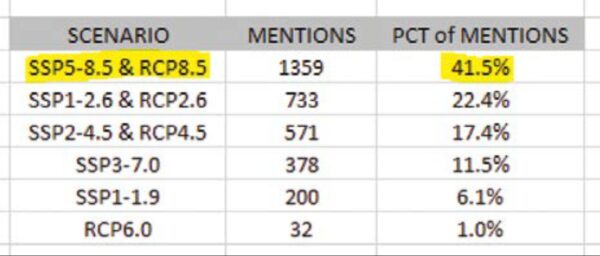
Mentions of various scenarios in the Sixth IPCC Report. Source: Roger Pielke Jr.
Credits
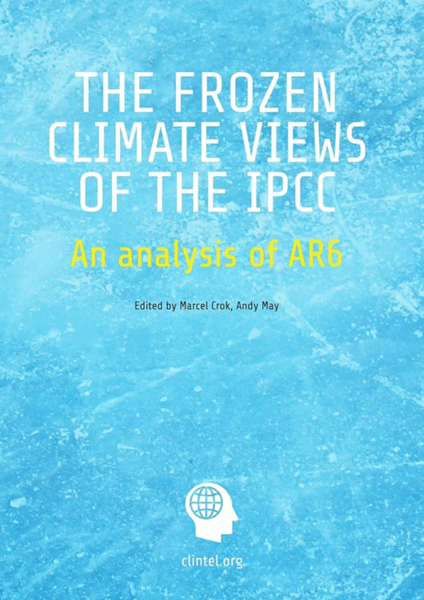
All credit goes to Roger Pielke Jr. and a few lesser-known colleagues. Once again, we—now under the Clintel banner—wrote about it as well. In 2023, Clintel conducted an extensive analysis of the sixth IPCC report in the book The Frozen Climate Views of the IPCC. One chapter was titled “Extreme Scenarios” and addresses this issue. The chapter summary read as follows:
“The biggest news in the AR6 report [Sixth IPCC report, ed.] is likely that high-end scenarios such as SSP5-8.5 and SSP3-7.0 are now considered unlikely. That is very good news, because it means that higher warming by 2100 is considered less likely than it was a few years ago. Unfortunately, this news is buried deep within the report, and few policymakers will notice it. Worse still, large sections of the report still emphasize these high-end scenarios. How could this have happened?”
Meanwhile in the Netherlands, the KNMI was working on the next generation of KNMI scenarios, and since the IPCC was still using RCP8.5 as its highest scenario, the KNMI researchers apparently thought it was a good idea to simply use RCP8.5 again. When the scenarios were published in 2023, I wrote an article that very same day with the headline Half of the new KNMI scenarios belong in the trash. The Clintel book The Frozen Climate Views of the IPCC was completely ignored by the media. Even a press release, which we wanted to distribute via the ANP for a fee, was rejected by our national press agency.
Today’s good news is that ultimately (just as recently with the KNMI’s vanished heat waves, which were partially “rediscovered” by the KNMI following criticism from Clintel), the “truth” prevails and climate science is reluctantly acknowledging that it was on the wrong track. The bad news is that it will take many years before the “oil tanker” can be steered back on course. Even now, there are numerous scientific publications in the pipeline based on RCP8.5. Will journals choose not to publish them, or will they at least include a clear disclaimer?
It was once again Roger Pielke Jr. who broke the news last week (RCP8.5 is officially dead) on his Substack page (behind a paywall) regarding the internationally revised scenarios. In that article, Pielke also points out how deeply RCP8.5 has penetrated all layers of society, for example in stress tests for banks. He is therefore holding his breath. RCP8.5 may be officially dead, but it will be a long time before it is actually buried.
This article first appeared in Dutch on 5 May 2026 on Indepen.eu
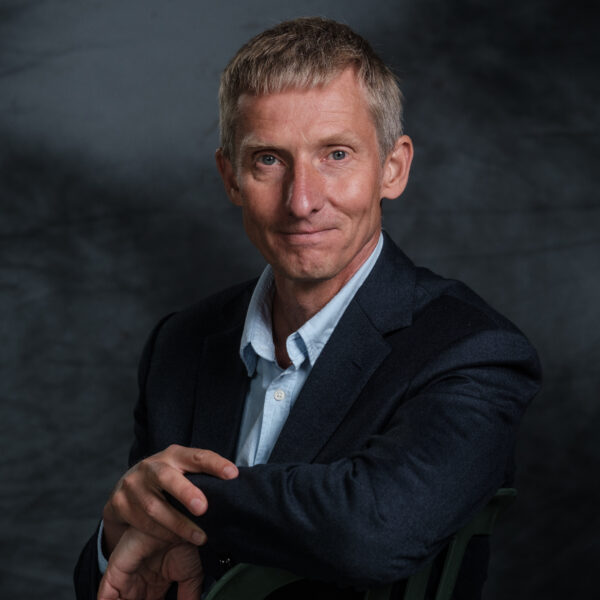
Marcel Crok
Marcel Crok is a Dutch science journalist who has been writing full-time about the climate debate and climate policy since an award winning article about the notorious hockey stick graph in 2005. He published two books in Dutch (De Staat van het Klimaat (The State of the Climate) and was co-author of the book Ecomodernisme (Ecomodernism)). With the British independent researcher Nic Lewis he wrote an extensive report about climate sensitivity, titled A Sensitive Matter. He was asked by the Dutch government to become expert reviewer of the IPCC AR5 report. Together with the Dutch climate institutes KNMI and PBL, Crok set up an international discussion platform Climate Dialogue.
In 2019, Crok and emeritus professor Guus Berkhout founded the Clintel Foundation. They published the World Climate Declaration, which has now been signed by over 2000 scientists and experts. Together with Andy May and a team of scientists from the Clintel network, Crok contributed to and edited the book The Frozen Climate Views of the IPCC.

more news
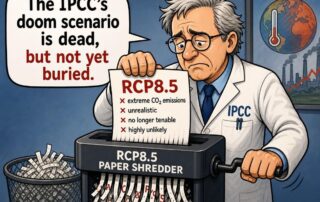
The IPCC’s doomsday scenario is dead, but not yet buried
Finally, the IPCC’s doomsday scenario is being tossed in the trash. The Dutch newspaper De Volkskrant deemed the news important enough for the front page. Marcel Crok wrote as early as 2018 that the IPCC’s extreme scenario was untenable. However, the wheels of science turn slowly, and so it took more than eight years for this insight to be recognized by the scientific community.
Samuel Furfari on COP’s and climate policy: “Just blah blah”
In a recent podcast with Tom Nelson, energy expert Prof. Samuel Furfari speaks about the nonsense of COP’s and of climate policy in general. But he is also cautiously optimistic about the future: “If the next UN leader comes from Africa or Asia rather than Europe, they may adopt a more pragmatic and ‘sober vision’ of climate policy.”
South Korea’s Net Zero Boast Crumbles
South Korea must end sacrificing growth, stability, and innovation at the altar of unverifiable climate fantasy, says Vijay Jayaraj. The country remains dependent on fossil fuels by necessity.
The post The IPCC’s doomsday scenario is dead, but not yet buried appeared first on Clintel.
Please consider helping!
Awake Freedom TV On Roku is Broken! 🙂
I could no longer maintain the costs on my own, so I moved the off of a dedicated server which was needed for the TV platform to work. On top of that, I want to build an app Awake Freedom TV app, for mobile phones. We need your help to first resurrect our TV channel, and then build the mobile app. In order to do that, I need a minimum of 800/month on subscription payments. Please help anyway you can with the form below.