


Jacob Nordangård: The Capture of Academia
In his recent presentation The Capture of Academia – The Case of Climate Change, for the Omniwar Symposium, Swedish researcher Jacob Nordangård argues that the rise of anthropogenic global warming as the dominant explanation for climate change, was shaped by influential philanthropic foundations, research institutions and political networks.

The Capture of Academia – The Case of Climate Change
Clintel Foundation
Date: 17 October 2026
Drawing on his doctoral research and books on global governance, Nordangård traces a development from the 1950s to the international sustainability agenda of 2026. His central argument is that certain networks helped determine research priorities, promote particular interpretations of climate science and marginalize alternative explanations, especially those emphasizing natural climate variability. He sees climate policy as part of a broader ambition to establish international systems for managing human and natural resources.
You can see the entire presentation below:

The Rockefeller network
Nordangård began investigating the history of climate change during his PhD studies. By examining the affiliations, funding and ideological connections of the people and institutions involved, he says he discovered that the Rockefeller philanthropic network occupied a central position.
The Rockefeller Foundation, established in 1913, and the Rockefeller Brothers Fund, founded in 1940, supported universities, research institutes, conferences and international initiatives. Nordangård argues that this extensive network enabled the foundations to influence the direction of scientific research over several decades.
He highlights a statement in the Rockefeller Brothers Fund’s 2005 annual review: “Therein lies our opportunity.” The report described climate change as an issue affecting virtually every aspect of society, from energy and investment to security and agriculture.
For Nordangård, this language reveals how climate change came to be regarded as more than an environmental problem. He argues that it offered an opportunity to reshape economic and political systems, potentially including new financial mechanisms based on carbon accounting.
From scientific hypothesis to political priority
Nordangård traces the origins of anthropogenic global warming to Swedish physicist Svante Arrhenius, who proposed that atmospheric carbon dioxide could influence global temperatures. British engineer Guy Callendar developed similar ideas in the 1930s, arguing that fossil-fuel combustion had contributed to warming since the late 19th century.
These ideas initially attracted limited attention. According to Nordangård, growing environmental concerns, military research and advances in computer technology helped bring the subject into the scientific mainstream.
Oceanographer Roger Revelle, associated with the Scripps Institution of Oceanography in California, became an important figure in this process. Physicist Gilbert Plass also attracted attention with research on the climatic effects of carbon dioxide. Meanwhile, Charles Keeling began measuring atmospheric CO2 at Hawaii’s Mauna Loa Observatory in 1958, establishing a record that documented rising concentrations.
Nordangård emphasizes the importance of institutional and military funding in these developments. He also highlights the growing role of computer models in calculating the possible effects of increasing CO2 concentrations. In his interpretation, the research agenda increasingly focused on human-induced warming, while natural explanations for climate variability received less attention.
Population and global resource management
An element of Nordangård’s presentation concerns the historical connections between environmental thinking, population policy and eugenics.
He describes a 1952 conference on population problems attended by influential scientists and advocates of population control. The discussions contributed to the establishment of the Population Council, which sought to address the relationship between population growth and available resources.
Nordangård argues that concerns about population, resource scarcity and environmental limits became intertwined with the emerging climate agenda. He also highlights the Rockefeller Brothers Fund’s Special Studies Project, conducted between 1956 and 1960, which brought together prominent figures from academia, business and government to consider the challenges facing the United States.
A key idea was that problems crossing national borders required international cooperation. Nordangård points to mathematician John von Neumann, who anticipated that intervention in atmospheric and climatic processes could eventually have consequences extending beyond individual countries.
For Nordangård, these discussions foreshadowed the development of global environmental governance. He argues that climate change became a vehicle for advancing international coordination over issues traditionally handled by national governments.
Establishing the international climate framework
During the 1960s and 1970s, climate change increasingly entered political discussions. US President Lyndon B. Johnson warned in 1965 about the possible effects of carbon dioxide emissions from fossil fuels.
Scientific opinion, however, was not yet settled. Some researchers considered whether aerosols from fossil-fuel combustion could contribute to cooling, while others emphasized the warming effects of CO2.
Nordangård argues that the balance gradually shifted towards anthropogenic warming as influential institutions coordinated research and promoted international policy responses.
The first World Climate Conference, convened in Geneva in 1979 by the World Meteorological Organization, called for efforts to anticipate and prevent potentially harmful human-induced climate change. A conference in Villach, Austria, in 1985 subsequently advanced proposals for coordinated research, contingency planning and a possible international greenhouse-gas convention.
Nordangård highlights the roles of Swedish meteorologist Bert Bolin and British ecologist Gordon Goodman, together with funding from Rockefeller philanthropic organizations. He argues that these connections helped move climate change from a scientific research topic into the political arena.
A decisive moment came in June 1988, when NASA scientist James Hansen testified before the US Senate that global warming could be attributed with 99% certainty to an increased greenhouse effect caused by human activity. Nordangård questions the circumstances surrounding the hearing, alleging that Senator Timothy Wirth deliberately arranged for it to take place on an unusually hot day and that the air conditioning was disabled to strengthen its impact.
That same year, the Intergovernmental Panel on Climate Change (IPCC) was established by the World Meteorological Organization and the United Nations Environment Programme, with Bolin as its first chairman. The UN General Assembly also declared climate protection a common concern of humankind.
Nordangård regards 1988 as the turning point when climate change became firmly established as an international policy priority. He argues that research into human-induced warming gained institutional authority while alternative explanations based on natural variability became increasingly marginalized.
From the IPCC to global governance
The international framework expanded in the 1990s. At the 1992 Earth Summit in Rio de Janeiro, 154 countries signed the United Nations Framework Convention on Climate Change, establishing a basis for international cooperation on greenhouse-gas concentrations.
Nordangård connects this development to broader initiatives for global environmental management. He highlights the Polestar project, launched in 1991 with support from the Rockefeller Foundation and the United Nations Environment Programme. It used computer-based scenarios to explore how a sustainable global civilization might be achieved through coordinated management of the Earth system.
He sees subsequent developments, including the UN’s 2030 Agenda and the Paris Agreement, as further steps towards this international framework.
The growing authority of the climate consensus is another central theme. In 2006, the Rockefeller Brothers Fund declared that the science of global warming was settled and no longer worth debating. Al Gore’s documentary An Inconvenient Truth, released that year, helped bring climate change to the forefront of international politics. Gore and the IPCC received the Nobel Peace Prize in 2007.
Nordangård argues that this growing consensus made it increasingly difficult to challenge established interpretations without being labelled a climate sceptic or denier.
He cites the 2009 Climategate controversy, involving leaked emails from the University of East Anglia’s Climatic Research Unit, as evidence of problems concerning scientific transparency and the treatment of sceptics. Critics alleged questionable research practices and attempts to obstruct dissenting researchers. Subsequent investigations did not substantiate all the allegations, but Nordangård regards the episode as indicative of deeper institutional problems.
The digital future of climate governance
In the final part of his presentation, Nordangård examines developments after 2020. He argues that climate policy is becoming increasingly connected to digital monitoring, international coordination and proposals for more comprehensive global governance.
He discusses the UN’s 2021 report Our Common Agenda, which called for stronger international cooperation in addressing global challenges, as well as the subsequent Pact for the Future. He also highlights policy briefs published in April 2026 by the Rockefeller-supported Climate Governance Commission.
These proposals include international Earth-system monitoring and mechanisms for responding to planetary emergencies. Nordangård interprets them as a continuation of a decades-long ambition to develop global systems for managing environmental and human affairs, with digital technologies potentially enabling more extensive oversight and coordination.
Conclusion
Nordangård concludes that Rockefeller-linked philanthropic and scientific networks exerted substantial influence over the development of anthropogenic climate change as a dominant research and policy concern. He argues that this influence operated through funding, institutional development, scientific conferences, media campaigns and international political initiatives.
His broader concern is that academia has become too closely aligned with a political agenda, weakening its independence and willingness to consider competing explanations. He believes the history of climate science illustrates how funding priorities and institutional networks can shape which questions receive attention and which interpretations gain authority.
The presentation raises important questions about the relationship between scientific research, philanthropy and political power. Nordangård’s central warning is that scientific institutions must remain transparent, open to criticism and receptive to competing hypotheses. In his view, preserving academic independence is essential to ensuring that science remains focused on evaluating evidence rather than serving predetermined political objectives.
The article you have just read was made possible by our donors.
Every day, Clintel publishes articles on climate, energy and science. We also translate and share international analyses in multiple languages, produce videos, publish reports and organize conferences and events around the world.
We receive no government funding and rely entirely on the support of our donors. Your support helps us promote independent research and contribute to a more open and balanced debate on climate and energy issues.
Would you like to support our work? Choose the option that suits you best:
• Become a Friend of Clintel – support us with an annual contribution
• Make a recurring donation – provide ongoing support and help us plan ahead
• Make a one-time donation – every contribution helps
Thank you for your support.

more news
Roger Pielke Jr.: A Report from the Netherlands
In this article Roger Pielke reflects on his recent presentations for Clintel and his trip to the Netherlands. “Why engagement matters to me.”
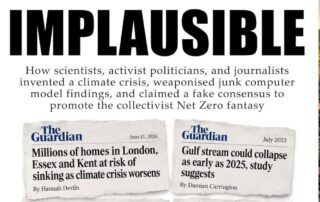
Chris Morrison’s New Book: IMPLAUSIBLE
Chris Morrison, the Environment Editor of the Daily Sceptic, has written a new book, now available on Amazon. It is called IMPLAUSIBLE: How scientists, activist politicians and journalists invented a climate crisis, weaponised junk computer model findings and claimed a fake consensus to promote the collectivist Net Zero fantasy. Below, you can read some extracts from the book.

Dozens of Climate Lawsuits in the US, None of Them Based in Reality
The apocalyptic claim of a climate emergency underlying what could become thousands of lawsuits in the US, is fearmongering with no basis in reality. says Angela Wheeler.
The post Jacob Nordangård: The Capture of Academia appeared first on Clintel.
Please consider helping!
Awake Freedom TV On Roku is Broken! 🙂
I could no longer maintain the costs on my own, so I moved the off of a dedicated server which was needed for the TV platform to work. On top of that, I want to build an app Awake Freedom TV app, for mobile phones. We need your help to first resurrect our TV channel, and then build the mobile app. In order to do that, I need a minimum of 800/month on subscription payments. Please help anyway you can with the form below.

Leave A Comment