Climate science should be less political, while climate policies should be more scientific. In particular, scientists should emphasize that their modeling output is not the result of magic: computer models are human-made. What comes out is fully dependent on what theoreticians and programmers have put in: hypotheses, assumptions, relationships, parameterizations, stability constraints, etc. Unfortunately, in mainstream climate science most of this input is undeclared.
To believe the outcome of a climate model is to believe what the model makers have put in. This is precisely the problem of today’s climate discussion to which climate models are central. Climate science has degenerated into a discussion based on beliefs, not on sound self-critical science. We should free ourselves from the naïve belief in immature climate models. In the future, climate research must give significantly more emphasis to empirical science.
Download Climate Change Apps & Share The Real Science on Climate Change Not Funded By Governments & Propagandists. The apps are free.
For Iphone
Larry Fink the founder of Google is one of the globalists, pushing for world dominance pushing the climate change narrative that has removed the app from the Google play store. However, you can still download the app here, and just choose to allow your android device to allow apps from unidentified publishers. There is no malicious files in this app, only 60 slides that sum up the whole climate change narrative lie. You will get warnings on it not being safe, but this is normal for any app downloaded from outside the play store, in which information like this is being censored.
For Android

Conveniently, once you have downloaded the app, share the individual slides to your favourite social media device.
There is no climate emergency
A global network of over 1900 scientists and professionals has prepared this urgent message. Climate science should be less political, while climate policies should be more scientific. Scientists should openly address uncertainties and exaggerations in their predictions of global warming, while politicians should dispassionately count the real costs as well as the imagined benefits of their policy measures.
Natural as well as anthropogenic factors cause warming
The geological archive reveals that Earth’s climate has varied as long as the planet has existed, with natural cold and warm phases. The Little Ice Age ended as recently as 1850. Therefore, it is no surprise that we now are experiencing a period of warming.
Warming is far slower than predicted
The world has warmed significantly less than predicted by IPCC on the basis of modeled anthropogenic forcing. The gap between the real world and the modeled world tells us that we are far from understanding climate change.
Climate policy relies on inadequate models
Climate models have many shortcomings and are not remotely plausible as global policy tools. They blow up the effect of greenhouse gases such as CO2. In addition, they ignore the fact that enriching the atmosphere with CO2 is beneficial.
CO2 is plant food, the basis of all life on Earth
CO2 is not a pollutant. It is essential to all life on Earth. Photosynthesis is a blessing. More CO2 is beneficial for nature, greening the Earth: additional CO2 in the air has promoted growth in global plant biomass. It is also good for agriculture, increasing the yields of crops worldwide.
Global warming has not increased natural disasters
There is no statistical evidence that global warming is intensifying hurricanes, floods, droughts and suchlike natural disasters, or making them more frequent. However, there is ample evidence that CO2-mitigation measures are as damaging as they are costly.
Climate policy must respect scientific and economic realities
There is no climate emergency. Therefore, there is no cause for panic and alarm. We strongly oppose the harmful and unrealistic net-zero CO2 policy proposed for 2050. If better approaches emerge, and they certainly will, we have ample time to reflect and re-adapt. The aim of global policy should be ‘prosperity for all’ by providing reliable and affordable energy at all times. In a prosperous society men and women are well educated, birthrates are low and people care about their environment.
Epilogue
The World Climate Declaration (WCD) has brought a large variety of competent scientists together from all over the world*. The considerable knowledge and experience of this group is indispensable in reaching a balanced, dispassionate and competent view of climate change.
From now onward the group is going to function as “Global Climate Intelligence Group”. The CLINTEL Group will give solicited and unsolicited advice on climate change and energy transition to governments and companies worldwide.
* It is not the number of experts but the quality of arguments that counts
World Climate Declaration plus all signatories in pdf
World Climate Declaration AMBASSADORS
NOBEL LAUREATE PROFESSOR JOHN F. CLAUSER / USA
PROFESSOR GUUS BERKHOUT / THE NETHERLANDS
DR. CORNELIS LE PAIR / THE NETHERLANDS
PROFESSOR REYNALD DU BERGER / FRENCH SPEAKING CANADA
BARRY BRILL / NEW ZEALAND
DR. PATRICK MOORE / ENGLISH SPEAKING CANADA
JENS MORTON HANSEN / DENMARK
PROFESSOR LÁSZIÓ SZARKA / HUNGARY
PROFESSOR SEOK SOON PARK / SOUTH KOREA
PROFESSOR JAN-ERIK SOLHEIM / NORWAY
DR. G.-FIVOS SARGENTIS / GREECE
FERDINAND MEEUS / DUTCH SPEAKING BELGIUM
PROFESSOR RICHARD LINDZEN / USA
HENRI A. MASSON / FRENCH SPEAKING BELGIUM
PROFESSOR INGEMAR NORDIN / SWEDEN
JIM O’BRIEN / REPUBLIC OF IRELAND
PROFESSOR IAN PLIMER / AUSTRALIA
DOUGLAS POLLOCK / CHILE
DR. PETER STALLINGA / PORTUGAL
DR. BLANCA PARGA LANDA / SPAIN
PROFESSOR ALBERTO PRESTININZI / ITALY
PROFESSOR BENOÎT RITTAUD / FRANCE
DR. THIAGO MAIA / BRAZIL
PROFESSOR FRITZ VAHRENHOLT / GERMANY
THE VISCOUNT MONCKTON OF BRENCHLEY / UNITED KINGDOM
DUŠAN BIŽIĆ / CROATIA, BOSNIA AND HERZEGOVINA, SERBIA AND MONTE NEGRO
In addition to these ambassadors, there are over 1900 scientists that have joined our organization and declare that there is no climate change emergency, and instead this is a paid and funded narrative by governments over the world looking to implement green policies to fatten their wallets, and control the populations. Be free people. You can care about the planet, live green, reduce population, but undestand one thing. Humans are not causing the climate to change. Now if you want to advocate for better polution policies, your governments are all guilty of incompetence, corruption, and bias bought and paid for by their corporate lobbyists. Yes we can do better on taking care of our planet, but nothing we are doing, is causing climate change, and CO2 has been shown in history to be 5 times the level it is right now, and the planet was flourishing. CO2 is the food for all life on our planet.
Read Our Posts to Learn More
Interview Thom Gilliam
Thom Gilliam
Name: Thom Gilliam
Country: USA
What is your background?
I am a former Professor of Accountancy and former Silicon Valley executive. I studied at Florida State University (Ph.D), Notre Dame de Namur University (MBA), and San Diego State University (BSBA).
I spent 20 years working in the semiconductor and computer industries in Silicon Valley. My last position was Director of Finance and Operations at Silicon Graphics, Inc (SGI). Jim Clark, a Stanford professor, created a three-dimensional semiconductor, which he used to form SGI. During my time there, we grew the company from $100 million in revenue to just under $4 billion in ten years.
After SGI, I left the corporate world, travelled extensively, and then returned to school at Florida State University to earn a Ph.D. Then I accepted a position with IE University/Business School in Madrid. I successfully published in the top academic journals in my field, including an article about prediction models, which are at the heart of many global warming studies. I lived in Madrid for seven years before returning to the U.S. During my work life, I travelled to 53 countries and 49 states within the U.S.
Since when and why are you interested in climate change?
Al Gore’s movie, An Inconvenient Truth, began to stir political interest. My interest grew as political interest grew. If politicians had ignored it, I probably would have too. A short time later, it became a prominent political issue in America.
President Obama spent $245 billion on solar energy to appease global alarmists. In return, we got one scandal after another. While the amount lost to fraud remains unknown, his spending only yielded 0.06% of our energy use. It would cost $410 trillion to meet our energy needs at that rate, i.e., the solution made no sense.
How did your views on climate change evolve?
As politicians and celebrities became the face of global warming and scientist remained out of sight, I took a sceptical view. Who were these modern-day prophets? How could they predict the weather 25 years out when they often fail to predict it a day in advance? And even if they were right, how could they possibly know what was causing it? Why did global warming’s biggest advocates seem to live in oceanfront mansions, fly private jets, and cruise in mega yachts that spew emissions like old factories? I lived a few feet below sea level on a barrier island and knew I would have moved if I shared their alarm.
I also spent a lot of time in California’s Sierra Nevada mountains and saw the valleys carved out by the ice age. If the globe was warming, what made the current warming different than the past?
Those were questions I asked myself before I became trained in scientific matters. I looked at the models and read the global warming studies. The models omitted a significant variable, natural warming. Researchers had a good reason for omitting the variable. They didn’t know how to measure it. But good excuses fail to justify their dramatic conclusions from their admittedly incomplete models. Then there is the anecdotal evidence, such as shrinking glaciers with old tree stumps underneath them. The faults with prediction models and so much anecdotal evidence caused me to reject global warming theories.
Is climate change a big issue in your country and how do you notice this?
Americans are deeply divided, and climate change is a significant issue. We have millions of believers and non-believers, but few have read the science. The current government is run solely by believers. And it has shut down much of our fossil fuel industry. In California, the state government announced it would ban the sale of non-electric vehicles. Then two days later, they asked people not to charge their electric cars because of a power shortage. The shortage was not an anomaly. Similarly, the state of Colorado, which pushes electric energy, shut off electricity to homes with their thermostats set below 78 degrees (F) during a heat wave.
The U.S. government is spending billions of dollars to encourage electric vehicles, yet there is no way to charge them. We neither have the electricity nor the charging stations. My city, Nashville, Tennessee, has 325 EV charging stations within 15 km of the city’s center versus 16100 petro stations. It seems like insanity.
In Texas, they built windmills to generate a significant amount of the state’s energy. Although Texas is in the south, the windmills froze during a cold week last winter, and people lost their lives. Yet, outside the U.S., only Russia and Saudi Arabia have more oil than Texas.
How would climate policy ideally look like in your view?
Ideally, we wouldn’t have a climate policy. But if we must, I would prioritize the environment today. Many alternatives that climate alarmists offer would fail our less stringent environmental standards from just twenty years ago. I would not destroy my country’s natural beauty to mollify alarmists. We know that China, India, Russia, and the African continent, which contain most of the world’s population, will continue to use coal and oil. So it makes little difference what the rest of us do.
What is your motivation to sign the Clintel World Climate Declaration?
I have travelled a lot. And during my time in Madrid, I travelled extensively throughout Europe. That was not new for me, but it had been a few years since I spent significant time in Europe. I was shocked by the windmills.
Traveling by train, I looked out over the beautiful countryside and would come upon stretches of windmills. They looked hideous and ruined the natural beauty. Windmills seemed to have spread like cancer. They even had them installed in the waters off the shores of northern Europe. In the U.S., the craziness started with solar. We have beautiful deserts stripped of all life and replaced with miles of ugly solar panels.
Now climate alarmists are pushing windmills for the U.S. I shudder to think of the consequences of covering my beautiful country with those ugly bird-killing machines that have yet to prove sufficient. But even if successful, what’s next? The raw materials needed for batteries are in Africa and China. So, we will strip mine Africa and be at the mercy of China.
How many windmills will we need to cover the energy needs of 3 billion Chinese and Indians?
Though the initial warming studies were harmless attempts to garner publications and tenure, now global warming alarmists threaten our way of life. I can no longer ignore them.
What question did we forget?
Are there any economic issues related to climate change that concerns you?
I fear that the economics of renewable energy will destroy our freedom. Currently, our energy sources are highly diversified. The U.S. has numerous oil refinery companies and separate drilling companies. Likewise, we have companies that specialize in extracting natural gas and its processing, many of them. The same is true for coal. In addition, we have numerous third-party distributions, e.g., 16000 gas stations in Nashville.
But as we move to renewable energy sources, we simultaneously move to centralization of energy production. As I observed above, the windmills off the coast of Europe and the destruction of Arizona’s deserts require the government. The government controls much of the available land, and they finance the windmills. People or companies are not building them on their own. They require government subsidies. That should be a concern in itself, but it gets much worse.
During the 1930s, fascists rose to power in Europe. They realized that it was more productive if people worked for themselves. So instead of following Stalin’s practice of dictating what each individual did or how many widgets a factory produced, they controlled the capital. That is the root of socialism and the fascism that follows. The government controls the investments and thereby regulates the economy but allows individuals to prosper somewhat. Consequently, free societies reject centralized control of the distribution of capital.
Energy is no different than capital. Modern societies can do little without power. When the government controls energy, it becomes all-powerful. Every aspect of the economy requires energy. We have seen the devastation brought by our government’s war on energy. Once the government controls energy, it controls every aspect of your life. They will decide how much to tax through pricing an essential resource. They can determine which products get resources for production and which do not. People are accustomed to having their energy use monitored for billing purposes. Controlling it will be simple. Electric vehicles even allow remote shut-off.
Our freedom is at stake. With the energy grid controlled by the government, the citizens will be at the government’s mercy, just as we would be if the government controlled capital the way fascists once did in Europe. In America, the government is dismantling the “old” economy. I fear what is replacing it.
The post Interview Thom Gilliam appeared first on Clintel.
-
The climate change premise debunked.
The whole premise of climate change is that humans, and [...]

Interview Thom Gilliam
Thom Gilliam
Name: Thom Gilliam
Country: USA
What is your background?
I am a former Professor of Accountancy and former Silicon Valley executive. I studied at Florida State University (Ph.D), Notre Dame de Namur University (MBA), and San Diego State University (BSBA).
I spent 20 years working in the semiconductor and computer industries in Silicon Valley. My last position was Director of Finance and Operations at Silicon Graphics, Inc (SGI). Jim Clark, a Stanford professor, created a three-dimensional semiconductor, which he used to form SGI. During my time there, we grew the company from $100 million in revenue to just under $4 billion in ten years.
After SGI, I left the corporate world, travelled extensively, and then returned to school at Florida State University to earn a Ph.D. Then I accepted a position with IE University/Business School in Madrid. I successfully published in the top academic journals in my field, including an article about prediction models, which are at the heart of many global warming studies. I lived in Madrid for seven years before returning to the U.S. During my work life, I travelled to 53 countries and 49 states within the U.S.
Since when and why are you interested in climate change?
Al Gore’s movie, An Inconvenient Truth, began to stir political interest. My interest grew as political interest grew. If politicians had ignored it, I probably would have too. A short time later, it became a prominent political issue in America.
President Obama spent $245 billion on solar energy to appease global alarmists. In return, we got one scandal after another. While the amount lost to fraud remains unknown, his spending only yielded 0.06% of our energy use. It would cost $410 trillion to meet our energy needs at that rate, i.e., the solution made no sense.
How did your views on climate change evolve?
As politicians and celebrities became the face of global warming and scientist remained out of sight, I took a sceptical view. Who were these modern-day prophets? How could they predict the weather 25 years out when they often fail to predict it a day in advance? And even if they were right, how could they possibly know what was causing it? Why did global warming’s biggest advocates seem to live in oceanfront mansions, fly private jets, and cruise in mega yachts that spew emissions like old factories? I lived a few feet below sea level on a barrier island and knew I would have moved if I shared their alarm.
I also spent a lot of time in California’s Sierra Nevada mountains and saw the valleys carved out by the ice age. If the globe was warming, what made the current warming different than the past?
Those were questions I asked myself before I became trained in scientific matters. I looked at the models and read the global warming studies. The models omitted a significant variable, natural warming. Researchers had a good reason for omitting the variable. They didn’t know how to measure it. But good excuses fail to justify their dramatic conclusions from their admittedly incomplete models. Then there is the anecdotal evidence, such as shrinking glaciers with old tree stumps underneath them. The faults with prediction models and so much anecdotal evidence caused me to reject global warming theories.
Is climate change a big issue in your country and how do you notice this?
Americans are deeply divided, and climate change is a significant issue. We have millions of believers and non-believers, but few have read the science. The current government is run solely by believers. And it has shut down much of our fossil fuel industry. In California, the state government announced it would ban the sale of non-electric vehicles. Then two days later, they asked people not to charge their electric cars because of a power shortage. The shortage was not an anomaly. Similarly, the state of Colorado, which pushes electric energy, shut off electricity to homes with their thermostats set below 78 degrees (F) during a heat wave.
The U.S. government is spending billions of dollars to encourage electric vehicles, yet there is no way to charge them. We neither have the electricity nor the charging stations. My city, Nashville, Tennessee, has 325 EV charging stations within 15 km of the city’s center versus 16100 petro stations. It seems like insanity.
In Texas, they built windmills to generate a significant amount of the state’s energy. Although Texas is in the south, the windmills froze during a cold week last winter, and people lost their lives. Yet, outside the U.S., only Russia and Saudi Arabia have more oil than Texas.
How would climate policy ideally look like in your view?
Ideally, we wouldn’t have a climate policy. But if we must, I would prioritize the environment today. Many alternatives that climate alarmists offer would fail our less stringent environmental standards from just twenty years ago. I would not destroy my country’s natural beauty to mollify alarmists. We know that China, India, Russia, and the African continent, which contain most of the world’s population, will continue to use coal and oil. So it makes little difference what the rest of us do.
What is your motivation to sign the Clintel World Climate Declaration?
I have travelled a lot. And during my time in Madrid, I travelled extensively throughout Europe. That was not new for me, but it had been a few years since I spent significant time in Europe. I was shocked by the windmills.
Traveling by train, I looked out over the beautiful countryside and would come upon stretches of windmills. They looked hideous and ruined the natural beauty. Windmills seemed to have spread like cancer. They even had them installed in the waters off the shores of northern Europe. In the U.S., the craziness started with solar. We have beautiful deserts stripped of all life and replaced with miles of ugly solar panels.
Now climate alarmists are pushing windmills for the U.S. I shudder to think of the consequences of covering my beautiful country with those ugly bird-killing machines that have yet to prove sufficient. But even if successful, what’s next? The raw materials needed for batteries are in Africa and China. So, we will strip mine Africa and be at the mercy of China.
How many windmills will we need to cover the energy needs of 3 billion Chinese and Indians?
Though the initial warming studies were harmless attempts to garner publications and tenure, now global warming alarmists threaten our way of life. I can no longer ignore them.
What question did we forget?
Are there any economic issues related to climate change that concerns you?
I fear that the economics of renewable energy will destroy our freedom. Currently, our energy sources are highly diversified. The U.S. has numerous oil refinery companies and separate drilling companies. Likewise, we have companies that specialize in extracting natural gas and its processing, many of them. The same is true for coal. In addition, we have numerous third-party distributions, e.g., 16000 gas stations in Nashville.
But as we move to renewable energy sources, we simultaneously move to centralization of energy production. As I observed above, the windmills off the coast of Europe and the destruction of Arizona’s deserts require the government. The government controls much of the available land, and they finance the windmills. People or companies are not building them on their own. They require government subsidies. That should be a concern in itself, but it gets much worse.
During the 1930s, fascists rose to power in Europe. They realized that it was more productive if people worked for themselves. So instead of following Stalin’s practice of dictating what each individual did or how many widgets a factory produced, they controlled the capital. That is the root of socialism and the fascism that follows. The government controls the investments and thereby regulates the economy but allows individuals to prosper somewhat. Consequently, free societies reject centralized control of the distribution of capital.
Energy is no different than capital. Modern societies can do little without power. When the government controls energy, it becomes all-powerful. Every aspect of the economy requires energy. We have seen the devastation brought by our government’s war on energy. Once the government controls energy, it controls every aspect of your life. They will decide how much to tax through pricing an essential resource. They can determine which products get resources for production and which do not. People are accustomed to having their energy use monitored for billing purposes. Controlling it will be simple. Electric vehicles even allow remote shut-off.
Our freedom is at stake. With the energy grid controlled by the government, the citizens will be at the government’s mercy, just as we would be if the government controlled capital the way fascists once did in Europe. In America, the government is dismantling the “old” economy. I fear what is replacing it.
The post Interview Thom Gilliam appeared first on Clintel.
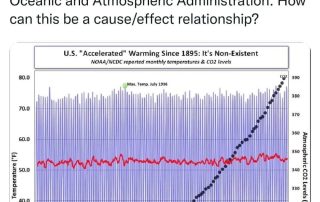
The climate change premise debunked.
The whole premise of climate change is that humans, and [...]