Climate science should be less political, while climate policies should be more scientific. In particular, scientists should emphasize that their modeling output is not the result of magic: computer models are human-made. What comes out is fully dependent on what theoreticians and programmers have put in: hypotheses, assumptions, relationships, parameterizations, stability constraints, etc. Unfortunately, in mainstream climate science most of this input is undeclared.
To believe the outcome of a climate model is to believe what the model makers have put in. This is precisely the problem of today’s climate discussion to which climate models are central. Climate science has degenerated into a discussion based on beliefs, not on sound self-critical science. We should free ourselves from the naïve belief in immature climate models. In the future, climate research must give significantly more emphasis to empirical science.
Download Climate Change Apps & Share The Real Science on Climate Change Not Funded By Governments & Propagandists. The apps are free.
For Iphone

Larry Fink the founder of Google is one of the globalists, pushing for world dominance pushing the climate change narrative that has removed the app from the Google play store. However, you can still download the app here, and just choose to allow your android device to allow apps from unidentified publishers. There is no malicious files in this app, only 60 slides that sum up the whole climate change narrative lie. You will get warnings on it not being safe, but this is normal for any app downloaded from outside the play store, in which information like this is being censored.
For Android

Conveniently, once you have downloaded the app, share the individual slides to your favourite social media device.
There is no climate emergency
A global network of over 1900 scientists and professionals has prepared this urgent message. Climate science should be less political, while climate policies should be more scientific. Scientists should openly address uncertainties and exaggerations in their predictions of global warming, while politicians should dispassionately count the real costs as well as the imagined benefits of their policy measures.
Natural as well as anthropogenic factors cause warming
The geological archive reveals that Earth’s climate has varied as long as the planet has existed, with natural cold and warm phases. The Little Ice Age ended as recently as 1850. Therefore, it is no surprise that we now are experiencing a period of warming.
Warming is far slower than predicted
The world has warmed significantly less than predicted by IPCC on the basis of modeled anthropogenic forcing. The gap between the real world and the modeled world tells us that we are far from understanding climate change.
Climate policy relies on inadequate models
Climate models have many shortcomings and are not remotely plausible as global policy tools. They blow up the effect of greenhouse gases such as CO2. In addition, they ignore the fact that enriching the atmosphere with CO2 is beneficial.
CO2 is plant food, the basis of all life on Earth
CO2 is not a pollutant. It is essential to all life on Earth. Photosynthesis is a blessing. More CO2 is beneficial for nature, greening the Earth: additional CO2 in the air has promoted growth in global plant biomass. It is also good for agriculture, increasing the yields of crops worldwide.
Global warming has not increased natural disasters
There is no statistical evidence that global warming is intensifying hurricanes, floods, droughts and suchlike natural disasters, or making them more frequent. However, there is ample evidence that CO2-mitigation measures are as damaging as they are costly.
Climate policy must respect scientific and economic realities
There is no climate emergency. Therefore, there is no cause for panic and alarm. We strongly oppose the harmful and unrealistic net-zero CO2 policy proposed for 2050. If better approaches emerge, and they certainly will, we have ample time to reflect and re-adapt. The aim of global policy should be ‘prosperity for all’ by providing reliable and affordable energy at all times. In a prosperous society men and women are well educated, birthrates are low and people care about their environment.
Epilogue
The World Climate Declaration (WCD) has brought a large variety of competent scientists together from all over the world*. The considerable knowledge and experience of this group is indispensable in reaching a balanced, dispassionate and competent view of climate change.
From now onward the group is going to function as “Global Climate Intelligence Group”. The CLINTEL Group will give solicited and unsolicited advice on climate change and energy transition to governments and companies worldwide.
* It is not the number of experts but the quality of arguments that counts
World Climate Declaration plus all signatories in pdf
World Climate Declaration AMBASSADORS
NOBEL LAUREATE PROFESSOR JOHN F. CLAUSER / USA
PROFESSOR GUUS BERKHOUT / THE NETHERLANDS
DR. CORNELIS LE PAIR / THE NETHERLANDS
PROFESSOR REYNALD DU BERGER / FRENCH SPEAKING CANADA
BARRY BRILL / NEW ZEALAND
DR. PATRICK MOORE / ENGLISH SPEAKING CANADA
JENS MORTON HANSEN / DENMARK
PROFESSOR LÁSZIÓ SZARKA / HUNGARY
PROFESSOR SEOK SOON PARK / SOUTH KOREA
PROFESSOR JAN-ERIK SOLHEIM / NORWAY
DR. G.-FIVOS SARGENTIS / GREECE
FERDINAND MEEUS / DUTCH SPEAKING BELGIUM
PROFESSOR RICHARD LINDZEN / USA
HENRI A. MASSON / FRENCH SPEAKING BELGIUM
PROFESSOR INGEMAR NORDIN / SWEDEN
JIM O’BRIEN / REPUBLIC OF IRELAND
PROFESSOR IAN PLIMER / AUSTRALIA
DOUGLAS POLLOCK / CHILE
DR. PETER STALLINGA / PORTUGAL
DR. BLANCA PARGA LANDA / SPAIN
PROFESSOR ALBERTO PRESTININZI / ITALY
PROFESSOR BENOÎT RITTAUD / FRANCE
DR. THIAGO MAIA / BRAZIL
PROFESSOR FRITZ VAHRENHOLT / GERMANY
THE VISCOUNT MONCKTON OF BRENCHLEY / UNITED KINGDOM
DUŠAN BIŽIĆ / CROATIA, BOSNIA AND HERZEGOVINA, SERBIA AND MONTE NEGRO
In addition to these ambassadors, there are over 1900 scientists that have joined our organization and declare that there is no climate change emergency, and instead this is a paid and funded narrative by governments over the world looking to implement green policies to fatten their wallets, and control the populations. Be free people. You can care about the planet, live green, reduce population, but undestand one thing. Humans are not causing the climate to change. Now if you want to advocate for better polution policies, your governments are all guilty of incompetence, corruption, and bias bought and paid for by their corporate lobbyists. Yes we can do better on taking care of our planet, but nothing we are doing, is causing climate change, and CO2 has been shown in history to be 5 times the level it is right now, and the planet was flourishing. CO2 is the food for all life on our planet.
Read Our Posts to Learn More
Interview Rick Willoughby
Rick Willoughby
Name: Rick Willoughby
Country: Australia
What is your background?
I graduated with a degree in Electrical Engineering from the University of Queensland and was employed by Conzinc Riotinto Australia (CRA); initially in the underground mine at Broken Hill. I subsequently transferred to Dampier iron ore operations where I worked on plant maintenance systems and machine automation. I then transferred to the zinc smelter in Newcastle as the site electrical engineer before moving on to the new coal terminal at Dalrymple Bay; being the third person on the payroll of that business, monitoring the terminal construction and developing the maintenance systems and plant automation.
After gaining extensive field experience in mining and port operations, I moved to the Sydney head office of CRA subsidiary AM&S Mining that was later separated from CRA and publicly listed as Pasminco. During this period I was involved in mining technology research, developing automated mining systems and new processing technology. I was instrumental in technology transfer of ultra-fine grinding mills used in the paper industry to processing zinc minerals exploited at Century Mine. I was the owner’s representative in the design office for the design of the AUD1.5bn Century Mine processing plant, 303km slurry transport pipeline and Karumba port operation.
I remained at Pasminco, often on site at Century Mine, until the mine achieved performance targets, and then joined international insurance giant AIG as an engineering risk consultant, travelling globally assessing large scale operations and construction sites for the insurer.
Since when and why are you interested in climate change?
Weather and climate are key factors in the engineering design of large mines, processing plants and industrial complexes. The ability of the built world to withstand cyclonic winds, storm surge, flooding rain, temperature extremes, earthquake, ground subsidence etc. are all factors that need to be considered and allowed for in the site and plant design. Assessing the risk and defining survivability parameters are key inputs to the design that reflect in the project cost and its operational performance to deliver economic benefit. The design envelope is highly dependent on weather and climate. Experiencing cyclones in Dampier and preparing the equipment to withstand the onslaught was the first experience connecting plant design and climate.
How did your views on climate change evolve?
Knowing how important weather is to the design envelope of large scale sites, plant and equipment, the prospect of climate change takes on new meaning in the insurance industry. It becomes very expensive to cater for changing risk once the plant is built.
To gain an understanding of how climate was changing in Australia, when I joined AIG, I looked into the temperature trend at Broken Hill. I considered Broken Hill to be the birth place of industrialisation in Australia. It has spawned two of the largest mining companies in the world and has solid engineering credentials dating back to the 19th century. It was also a remote location with little industrial change for more than a century. That temperature record revealed to me that Broken Hill was warmer in the 1890s than the early 2000s. That observation began my journey of discovery into the fabricated nonsense that CO2 induces climate change.
Is climate change a big issue in your country and how do you notice this?
Australia is now full throttle on fixing the weather with “renewables”. Australia is following Germany and the UK over the abyss.
How would climate policy ideally look like in your view?
Australia is being poorly served by three, primarily government funded, institutions:
BoM is fabricating data – they call it “homogenisation”; CSIRO have separated the business from reality – models are viewed as evidence and measurements are there to be adjusted to suit models. ABC has become a CO2 demonising propaganda machine. All these organisations should be defunded and those parts that can survive without subsidy should be left to find their niche.
Also, eliminate all subsidies on so-called “renewable” electricity and battery electric vehicles.
What is your motivation to sign the Clintel World Climate Declaration?
Humans are inevitably becoming more reliant on conserving natural resources and smart utilisation of resources. China is consuming more than 4,000,000,000 tonnes of coal each year; a good proportion to manufacture wind turbines and solar panels that cannot recover the energy that they consumed in manufacture during their operating life. It is a massive waste of natural resources.
The current crop of battery electric vehicles on offer in the developed world are an insult to the engineering profession. They are literally behemoths. Gross indulgences that depend on massive subsidies for their production.
What question did we forget?
I have a reasonable knowledge of field theory and an admiration for mathematicians and physicists who command field theory and derive observed behaviours from first principals rather than empirical fits. When I first saw James Hansen’s famous radiation diagram showing “back-radiation”, the alarm bells rang. Here was someone, who obviously had no idea of electro-magnetic radiation, producing silly diagrams that had gained wide credibility. I was buoyed to find that NASA/GISS had employed Russian physicist Michael Mishchenko to apply his knowledge of the electro-magnetic field to climate science. Michael passed away in 2020 but has produced copious papers on electro-magnetics as applied to understanding climate and has often pointed out that EMR is mono-directional. Sadly his work is not yet reflected in the IPCC reports because they are political documents – Hansen’s silly diagram persists.
The post Interview Rick Willoughby appeared first on Clintel.
Simpletons versus wicked scientists
by Judith Curry – Reposted from Climate Etc.
In which wicked scientists are the good guys.
Activism by climate scientists has been the topic of numerous prior blog posts at Climate Etc. Such activism is generally focused on eliminating fossil fuels. This post presents a new framing for the activism issue. While many scientists prefer to remain in the ivory tower, others desire to engage in the messiness of politics and policy making. Why most scientists reject admonitions to “stay in their lane,” there are more and less useful ways for scientists to engage with politics.
Simpleton climate scientists
I’m defining ‘simpleton climate scientists’ to be academics, mostly in disciplines that are far afield from the core discipline of climate dynamics, who think that both the climate problem and its solutions are simple. Their preferred modes of activism are twitter rants, demonstrations and increasingly civil disobedience.
The issue of simpleton scientists was brought to the forefront last week by a publication in Nature Climate Change entitled Civil disobedience by scientists helps press for urgent climate action. The authors are faculty members in the Tyndall Centre for Climate Change Research at the University of Cardiff:
Stuart Capstick, psychologist
Aaron Thierry, social scientist
Emily Cox, psychologist
Oscar Berglund, policy studies (U. of Bristol)
Steve Westlake, psychologist
Julia Steinberger, geography (U. of Lausanne)
The Nature article is behind paywall, but a Guardian article interviews the authors. It is clear that this is not just a scholarly article on civil disobedience. The quote that really popped out for me was by Berglund:
“We have a kind of what we call epistemic authority here: people listen to what we are saying, as scientists, and it becomes a way of showing howserious the situation is, that we see ourselves forced to go to these lengths.”
Since when do psychologists have epistemic authority to speak on climate change, its impacts and relevant policies?
Inside Climate News has another choice quote from the actual paper:
“Civil disobedience by scientists has the potential to cut through the myriad complexities and confusion surrounding the climate crisis.”
Ya think? Is this all it takes?
Also cited in this article is a statement from Peter Kalmus:
Peter Kalmus, a climate scientist for NASA’s Jet Propulsion Lab, agrees. In April, Kalmus was arrested for locking himself to the front door of a JPMorgan Chase bank branch and has since urged other scientists to join him in protest, saying it’s their duty as experts to convey the weight of their findings to the public and convince elected officials to take proper recourse.
“For the sake of our children, for the sake of the future of humanity,” Kalmus said, “you have a responsibility to do everything you can to get that information out there.”
Exactly how does civil disobedience get meaningful information out there? These scientists seem to be taking their cues from Michael Mann’s book for children entitled The Tantrum That Saved the World
Further:
Kalmus told me that he’s “disappointed” that, so far, fewer scientists than he had hoped have joined in his call to action, but he sees Monday’s article as a positive sign and believes more researchers will join the movement—especially as extreme weather and other consequences of global warming accelerate in scope and severity.
Have any of these climate scientists actually read the IPCC AR6?
So why haven’t more climate scientists joined this call to action? Maybe because they find this kind of behavior embarrassing and counterproductive.
More credible approaches to climate activism
Jim Hansen was probably the first high-profile climate activist. Has anyone ever heard Hansen claim “epistemic authority” to speak publicly on climate change? Of course not. Hansen doesn’t need to claim such authority – he has it. Hansen has worked assiduously to communicate with public. He has done the hard work to understand the economics and politics of carbon pricing and also nuclear power. He has worked closely with policy makers, most famously with Al Gore. Have some of his actions been over-the-top? Yes. Whether or not you agree with Hansen, it is undeniable that he has been effective in the political and policy arenas. Hansen is now in his 80’s, it would be interesting for him to write an essay that reflects on his activism, what worked and what didn’t, any general or specific regrets, and recommendations for current activists.
An interesting essay on this topic was written recently by Rick Pancost, entitled Climate Scientist Activism. The entire essay is well worth reading, here are some quotes:
I am not sure what sort of activism will be most effective to bring about transformative change. I certainly cannot speak to where you will be most effective in your activism. Those who do have political influence – real influence – should recognise what a rare commodity that is; they should neither casually discard it nor should they waste it. The climate movement must be a thriving mosaic of approaches, with each leveraging the successes of the others to increase cultural, popular or political capital and drive a Just Transformation.
We must find what activism is most effective, is most genuine, for each of us – but be self-critical when doing so. Some of us DO need to engage governments, some of us must be IN government. But let us not be complicit in our own deception. After all, engaging politicians is difficult but activism is hard. You sacrifice more than your time, but also your reputation, job prospects, even your freedom. Sometimes the logical choice is the right choice; sometimes it is just the easy choice.
But you do have to make a choice. We cannot have our cake and eat it too. We cannot be the vizier to the king as well as the court jester. We cannot participate in civil disobedience and still serve on government advisory boards.
Activist scientists must also be humble and remember that we are not experts on what is effective. We did not know what would be effective when we allowed ourselves to be bound by others´ rules of engagement, when we allowed ourselves to be captured by governments and by extension the lobbyists and special interests who influence them. Because we are not experts on how policy is made, we were tricked. So perhaps rather than deciding who and how to engage, we should join those who do know.
Finally and most importantly, I would urge you to consider that maybe we should stop partnering with governments and start partnering with communities. “
Pangost’s essay reflects scientists attempting to work constructively with policy makers, planners and stakeholders, primarily on the issue of mitigation (reduction of CO2 emissions) and associated societal changes. There are clearly frustrations, but this approach is far more effective than simpleton tantrums.
Wicked scientists
And finally we come to wicked scientists. As I have written in multiple previous posts, a wicked problem is characterized by multiple problem definitions, contentious methods of understanding, chronic conditions of ignorance, and lack of capacity to imagine future eventualities of both the problem and the proposed solutions. The complex web of causality may result in surprising unintended consequences of attempted solutions that generate new vulnerabilities or exacerbate the original harm. Further, wickedness makes it difficult to identify points of irrefutable failure or success in either the science or the policies. Wicked problems are both complex and political.
Although much has been written about wicked problems and the need to address them, there is not much in the way of guidance for effectively tackling wicked problems. Two recent articles have addressed this issue:
The World Needs Wicked Scientists
A Philosophy for Working on Wicked Problems .
“Wicked science” is a process that is tailored to the dual scientific and political natures of wicked societal problems. As such, wicked science is massively transdisciplinary, including natural sciences and engineering along with social sciences and humanities. Wicked science uses approaches from complexity science and systems thinking in a context that engages with the political roles and perspectives of decision makers, planners and other stakeholders. Wicked problems and the strategies devised to address them cannot be defined by scientific experts alone, but include the experiential and operational knowledge of a range of stakeholders.
Two recent papers by atmospheric/climate scientists have articulated something similar to wicked science for the climate sciences, that notably focus more on adaptation than mitigation.
Adam Sobel’s paper “Usable climate science is adaptation science” emphasizes that the localness of adaptation implies much greater uncertainty in the relevant climate science. Climate science for adaptation is more about characterizing uncertainty for robust decision making. Usable climate science requires that scientists engage in co-production of usable science with stakeholders, with a willingness to learn to understand how the human factors are manifest in a particular setting.
Regina Rodrigues and Ted Shepherd’s paper entitled “Small is beautiful: climate-change science as if people mattered” addresses strategies for grappling with the complexity of local situations. The strategies include expressing climate knowledge in conditional form in terms of scenarios developed via the storyline approach, and working with local communities to make sense of their own situations.
Combining and integrating knowledge from diverse disciplines and other sources to provide insights, explanations and solutions to wicked problems is a substantial challenge. For the solution orientation of wicked science to be meaningful, we need an overarching philosophy for navigating wicked problems. We need to acknowledge that control is limited, the future is unknown, and it is difficult to determine whether the impact you make will be positive. We need to accept that climate change will continue to disrupt natural systems and human wellbeing; this acknowledgement helps avoid the urgency trap. By acknowledging that there is no road back, we can focus on the road ahead.
Wicked scientists are willing to become embroiled in political debates and thorny social problems. As such, wicked scientists are not activists that are advocating for a preferred political/policy solution and recognize the reality of political disagreement as a key aspect for dealing with wicked problems.
Wicked scientists are needed to break the hegemony of disciplinary researchers, particularly those who are strident political activists, as being regarded as experts for solutions to the wicked problem of climate change. While the IPCC has operated via a loose cooperation between multiple disciplines, genuine transdisciplinary understanding and collaborations, across disciplines and with a broad range of stakeholders, is needed for meaningful contributions to wicked problems.
Some universities are starting to grapple with how to train wicked scientists. Working in the private weather/climate services sector provides a crash course in being a wicked scientist, in terms of becoming conversant with additional disciplines, working in transdisciplinary teams, an emphasis on uncertainty, and actually listening to and working with policy makers, planners and stakeholders. Not only is activism not needed for problem solving, but it mostly seems counterproductive to actually formulating and evaluating solutions.
The road ahead can be facilitated by broader, transdisciplinary thinking about the climate change problem and its solutions. This requires moving away from the consensus-enforcing and cancel culture approach of attempting to restrict the dialogue surrounding climate change and the policy options. We need to open up space for dissent, disagreement and discussion about scientific uncertainty and policy options, so that multiple perspectives can be considered and broader support can be built for a range of policy options. Bring on the wicked scientists.
But if a scientist is dominated by their political instincts on this issue, they will continue to take the court jester path and not contribute to solutions in a meaningful way.
The post Simpletons versus wicked scientists appeared first on Clintel.
The Greenhouse Effect, Revisited
“If it [a scientific hypothesis] disagrees with experiment, it’s WRONG.”
Nobel Prize winner Richard Feynman
As a further addendum to my series of posts in 2020 and 2021 on the CO2 global warming hypothesis, this post presents another challenge to the hypothesis central to the belief that humans make a substantial contribution to climate change. The hypothesis is that observed global warming – currently about 0.85 degrees Celsius (1.5 degrees Fahrenheit) since the preindustrial era – has been caused primarily by human emissions of CO2 and other greenhouse gases into the atmosphere.
The challenge, made in two papers published by Australian scientist Robert Holmes in 2017 and 2018 (here and here), purports to show that there is no greenhouse effect, a heretical claim that even global warming skeptics such as me find dubious. According to the paper’s author, greenhouses gases in the earth’s atmosphere have played essentially no role in heating the earth, either before or after human emissions of such gases began.
The papers are similar to one that I discussed in an earlier post in the series, by U.S. research scientists Ned Nikolov and Karl Zeller, who claim that planetary temperature is controlled by only two forcing variables. A forcing is a disturbance that alters climate, producing heating or cooling. The two forcings are the total solar irradiance, or total energy from the sun incident on the atmosphere, and the total atmospheric pressure at a planetary body’s surface.
In Nikolov and Zeller’s model, the radiative effects integral to the greenhouse effect are replaced by a previously unknown thermodynamic relationship between air temperature, solar heating and atmospheric pressure, analogous to compression heating of the atmosphere.
Their findings are illustrated in the figure below where the red line shows the modeled, and the circles the actually measured, mean surface temperature of the rocky planets and moons in the solar system that have atmospheres: Venus, Earth, Mars, our Moon, Titan (a moon of Saturn) and Triton (a moon of Neptune). Ts is the surface temperature and Tna the calculated temperature with no atmosphere.
Like Nikolov and Zeller, Holmes claims that the temperatures of all planets and moons with an atmosphere are determined only by solar insolation and surface atmospheric pressure, but with a twist. The twist, in the case of Earth, is that its temperature of -19.0 degrees Celsius (-2.2 degrees Fahrenheit) in the absence of an atmosphere is entirely due to heating by the sun, but the additional 33 degrees Celsius (59 degrees Fahrenheit) of warmth provided by the atmosphere comes solely from atmospheric compression heating.
Holmes argues that the extra 33 degrees Celsius (59 degrees Fahrenheit) of heating cannot be provided by the greenhouse effect. If it were, he says, planetary surface temperatures could not be accurately calculated using the ideal gas law, as Holmes shows that they can.
The next figure compares Holmes’ calculated temperatures for seven planets including Earth, the moon Titan and Earth’s South Pole, using the ideal gas law in the form T = PM/Rρ, where T is the near-surface temperature, M is the mean molar mass near the surface, R is the gas constant and ρ is the near-surface atmospheric density.
However, the close agreement between calculated and actual surface temperatures is not as remarkable as Holmes thinks, simply because we would expect planets and moons with an atmosphere to obey the ideal gas law. And the actual temperature he uses for Earth of 288 Kelvin (15 degrees Celsius or 59 degrees Fahrenheit) is too high and doesn’t take global warming into account – whether the warming comes from greenhouse gases or not.
Earth’s current average surface temperature is in fact only 13.9 degrees Celsius (57 degrees Fahrenheit), of which approximately 0.85 degrees Celsius (1.5 degrees Fahrenheit) is due to modern global warming as mentioned above.
In any case, the argument of both Holmes and Nikolov and Zeller that compression of the atmosphere can explain greenhouse heating has been invalidated by PhD meteorologist Roy Spencer. Spencer points out that, if atmospheric pressure causes the lower troposphere (the lowest layer of the atmosphere) to be warmer than the upper troposphere, then the same should be true of the stratosphere, where the pressure at the bottom of this atmospheric layer is about 100 times larger than that at the top.
Yet the bottom of the stratosphere is cooler than the top for all planets except Venus, as can be seen clearly from the following figure of Holmes. The vertical scale of decreasing pressure is equivalent to increasing altitude; the dotted horizontal line at 0.100 bar (10 kilopascals) marks the boundary between the troposphere and stratosphere.
Both of these farfetched claims that there is no greenhouse effect stem from misunderstandings about energy, as I discussed in my earlier post.
Next: Arctic Sea Ice Refuses to Disappear, despite Rising Arctic Temperatures
Author
Retired physicist Dr. Ralph B. Alexander is the author of Global Warming False Alarm and Science Under Attack: The Age of Unreason. He blogs at his website Science Under Attack.
With a PhD in physics from the University of Oxford, he is also the author of numerous scientific papers and reports on complex technical issues. His thesis research in the interdisciplinary area of ion-solid interactions reflected his interest in a wide range of scientific topics.
Dr. Alexander has been a researcher at major laboratories in Europe and Australia, a professor at Wayne State University in Detroit, the co-founder of an entrepreneurial materials company, and a market analyst in environmentally friendly materials for a small consulting firm.
Alexander is a USA signee of the CLINTEL World Climate Declaration.
The post The Greenhouse Effect, Revisited appeared first on Clintel.
-
A Much Larger Greenhouse Effect – But Temperatures Dominated by Cooling
Guest post by Wim Röst
Foreword Especially for Policymakers
The greenhouse effect appears to be much higher than previously assumed. However, that also means that the greenhouse effect does not determine the temperature. Earth’s temperatures are way lower. The level of Earth’s temperatures appears to be completely dependent on cooling by the H2O molecule that has been able to keep Earth’s temperatures within narrow limits for four billion years. Given the enormous power of cooling by means of water vapor, the influence of additional greenhouse gases cannot be more than zero percent. The consequence of what is set out below is that policymakers again have complete freedom in searching for the most practical, the most strategically correct, and the most inexpensive solution for the current (2022) energy problem. All options are open again.
Abstract
The Earth’s greenhouse effect is much larger than suggested so far. If surface radiation and the greenhouse effect set surface temperatures, our oceans would be boiling. Fortunately, they don’t. Water Earth has a strong water-vapor-based evaporative surface cooling mechanism that effectively sets and stabilizes surface temperatures at a much lower level than cooling by surface radiation emissions can do. Thanks to water vapor our temperature system is far more stable than admitted by the consensus, and thanks to water, water vapor, and clouds surface temperatures are favorable for present life.
Introduction
Early Earth consisted of hot molten lava covered by an extreme greenhouse atmosphere: hardly any surface radiation could reach space, if any. Nevertheless, its surface cooled. Upward convection brought sensible and latent heat from hot surfaces to elevations on the very edge of the atmosphere from where energy effectively could be radiated into space. Despite the near maximal greenhouse effect the surface of Early Earth cooled down and at a certain moment the first oceans developed. Those boiling oceans still resulted in a huge upward convective transport of energy, further cooling the surface. Until now, convective upward transport of energy plays the main role in surface cooling. Convection sets and regulates surface temperatures at actual level. Without evaporative-convective-cloud-cooling, our actual greenhouse atmosphere would theoretically result in a surface temperature of 202.3°C. On the real Earth the greenhouse effect warms the surface, but greenhouse warming does not set and control final surface temperatures. Earth’s H2O-based cooling system does.
Theoretical greenhouse effect
We can calculate the warming effect of present greenhouse atmosphere for a theoretical planet[1] in the case where its surface is cooled just by radiation. Without a greenhouse atmosphere and if optimally cooled by radiation[2] the temperature of such a theoretical planet is minus 42.3 degrees Celsius. But a greenhouse atmosphere makes a huge difference. Initially.
Present Earth’s greenhouse atmosphere is still ‘a near perfect’ greenhouse atmosphere. As shown in Figure 1, only 22 W/m2 of surface radiated energy (396 W/m2) can reach space without being absorbed. A surface cooling efficiency of only 5.556%.
Figure 1: The Earth’s radiation budget. Of all 396 W/m2 surface radiated energy 22 W/m2 reaches space without being absorbed (Added: red oval). Source Trenberth and Fasullo 2011[3]
The efficiency of cooling by surface radiation is very low: after absorption, nearly all surface emitted energy returns to the surface as downwelling radiation or (without convection) and stays as sensible heat in the lower atmosphere. Knowing the cooling efficiency of the Earth’s surface radiation, we can calculate the greenhouse surface temperature in the case where the surface of our imaginary planet is only cooled by radiation, as shown in Figure 2.
Figure 2: Surface temperature for a theoretical planet, calculated for the case of surface cooling by radiation only. Input: solar radiation absorbed by the surface and surface emitted longwave radiation of 161 W/m2, the effective emissivity is 5.556% (‘Emissivity 0.05556’). Calculation by Stefan-Boltzmann Law calculator.
With Earth’s present greenhouse effect, the surface of our imaginary planet would have had a temperature of 202.3 degrees Celsius, if only cooled by surface radiation. Total initial greenhouse warming is huge, see Table 1.
Table 1: The greenhouse warming effect per Stefan-Boltzmann for a theoretical planet only cooled by radiation. Calculated for a planet without greenhouse atmosphere and for a planet with Earth’s present greenhouse atmosphere. Radiated power equal to solar absorption 161 W/m2.
Given the high initial greenhouse warming effect, on our relatively cool Earth other factors than surface radiation must control the level of surface temperatures; probably H2O-related surface cooling.
The level of Earth’s surface temperatures
Where in the range of ‘greenhouse temperatures’ do we find Earth’s surface temperatures? On Earth, surface temperatures are best indicated by the surface temperature of ocean water, covering 71% of the Earth’s surface. The maximum average yearly temperature is 30°C while the minimum temperature is minus 1.8°C, shown in green in Figure 3.
Figure 3: The level of the Earth’s actual surface temperatures shown within the range for theoretical greenhouse warming as calculated for the theoretical situation of cooling only by surface radiation in the case of a theoretical planet. The greenhouse effect would warm the surface from – 42.3°C to + 202.3°C. Earth’s actual ocean temperatures are shown in green: from + 30°C to – 1.8°C. Blue shows the temperature range that is too cold for life, red shows the temperature range too hot for life.
‘Radiation only’ would have stopped cooling the planet’s surface at 202.3°C. Actual Earth yearly average surface temperatures are much lower, about 15°C. On real Earth, additional cooling by evaporation, conduction, convection and clouds has lowered surface temperatures far below the level ‘radiation only cooling’ would have resulted in. Why? The answer is that H2O-related cooling (evaporative, convective and tropical cloud cooling) is very strong, very dynamic, and very effective in the temperature range above 15°C.
Evaporation
Evaporation rises by 6-7% (Clausius-Clapeyron) per degree of temperature rise, a huge percentage. In the higher temperature range evaporative cooling cools extremely: think about boiling water of 100°C. In case of temperatures lower than 15 degrees Celsius, evaporative cooling diminishes by the same high percentage of 6-7%. At some point H2O related surface cooling and warming resulting from surface solar absorption came into balance at 15°C.
Convection
Convection in the atmosphere is the upward transport of latent and sensible heat from the surface to higher elevations. Convective removal of surface heat effectively cools the surface and brings energy to elevations lacking most of the main greenhouse gas, water vapor. At these elevations emission to space is more effective than surface emission. Convection is highly stimulated by the low-density water vapor molecules resulting from evaporation. Evaporative-convective cooling is huge in the higher temperature range and produces large quantities of solar reflecting tropical clouds. When tropical clouds develop, evaporative surface cooling is combined with diminished surface solar warming: very effective.
Conduction
Strong convection firmly enhances wind over the surface and brings in drier and colder air from elsewhere, resulting in higher conductive surface heat loss.
Diminishing H2O-based cooling
The whole evaporation-based cooling machine is very dynamic. All H2O-based surface cooling is fueled by rising evaporation, as temperatures rise. But evaporation also strongly diminishes when temperatures fall, even by just one degree, ending further cooling of the surface. At present, the Earth’s[4] total surface cooling and total surface warming are balanced at a yearly average of 15 degrees Celsius.
Solar radiation
The oceanic uptake of solar energy is very dependent on the presence/absence of tropical clouds. As temperatures go down, lower-level tropical clouds diminish strongly, and more solar energy is able to reach and warm the surface. Surface warming causes a rise in evaporation. Rising evaporation, thunderstorms, and related processes ending in tropical clouds soon end the extra solar warming. Hence the incredible stability of the Earth’s surface temperatures.
Balance
At 15°C there is a balance between surface warming by solar uptake and surface cooling. Any further surface cooling results in higher solar uptake, neutralizing initial cooling. And any surface warming results in higher evaporative-convective-cloud cooling, neutralizing any initial surface warming.
Initial warming by extra greenhouse gases is fully neutralized like all other surface warming. Neutralizing warming happens at different time scales, sometimes seconds (radiation) or hours, a day, or by season, but often over decades (by longer-term ocean oscillations) and sometimes over even longer periods like the recovery from the cold Little Ice Age which might take centuries.
Why 15°C and why not 202.3°C?
Radiative cooling is less dynamic than H2O based cooling. For one degree of difference in surface temperature, radiative cooling goes up or down by only 1.4%, but H2O- based cooling by 6-7%. Early Earth started hot and then cooled down after its creation. At a current surface temperature of only 15°C (the temperature level for this geological period and for this orbital setting) the H2O related surface cooling has balanced surface solar absorption.
Early Earth
Early Earth was hot and steamy. Heat of accretion did melt all the colliding material coming from space that formed the Earth. A nearly perfect sphere formed and its atmosphere was the perfect greenhouse atmosphere: an atmosphere with a superhigh water vapor content, very rich in carbon dioxide, and a sky covered by clouds. Hardly any surface radiation could reach space without being absorbed. Convection had to transport surface energy to the edge of the steamy atmosphere where spaceward emission could take place. For early Earth surface cooling depended on the strength of convection. As temperatures fell, convective cooling continued but continuously diminished in strength. Tropical cloud coverage also diminished, allowing the Sun to warm the tropical oceans. Despite Earth’s huge greenhouse effect, surface temperatures have never been dependent on the strength of the greenhouse effect but on the temperature set by where H2O-related surface cooling balances warming by rising surface solar uptake.
Intrinsic properties
The fascinating H2O molecule has many intrinsic properties. One of its properties gives the molecules a strong cohesion resulting in a strong surface tension which creates ‘tight’ surfaces some insects can even walk on. Strong surface tension makes it difficult for a surface molecule to escape into the atmosphere, which raises the temperature at which enough water vapor will be released to cause ‘super-convection’. Another intrinsic property sets the freezing temperature at zero degrees Celsius and not at +10, +20 or minus 20 degrees. Binding one oxygen atom to two low-density hydrogen atoms results in a low-density water molecule, so very humid, low density, air easily rises. H2O’s intrinsic properties determine all essential elements of Earth’s main cooling system, which is dominated by H2O. The properties are intrinsic to the molecule itself: they don’t change over time. Therefore, the surface temperature of the Earth could have remained at the same level over billions of years if Earth’s orbital settings and the distribution of oceans and continents over its surface hadn’t changed. H2O’s intrinsic properties set the level of Earth’s surface temperatures for every specific orientation and surface arrangement of the Earth. The H2O molecule, nothing else.
Faint young Sun paradox
During the first years of early Earth, the Sun’s output must have been about 30 percent less intense as nowadays. Less solar energy reached the Earth. Nevertheless, the surface of the Earth has never been much colder than present Earth. This is called the faint young Sun paradox. Knowing the role of H2O-related surface cooling, that paradox is solved. As total insolation reaching the surface is controlled by tropical clouds and the Earth’s surface temperatures are controlled by H2O-related surface cooling, the Earth’s surface temperatures don’t simply depend on the intensity of solar irradiation reaching the Earth. In the case of a faint Sun, evaporation diminishes, less tropical clouds cover tropical oceans and enable more (but weaker) solar rays to reach and warm a larger surface area. End result for tropical oceans: about the same.
No Snowball Earth
Because the quantity of insolation reaching the surface is controlled by tropical clouds and because of H2O-controlled surface cooling, no complete snowball Earth has probably existed. A slightly colder surface strongly diminishes H2O related surface cooling. Diminishing tropical clouds result in a higher uptake of solar energy by tropical oceans. The final result is tropical oceans still remaining warm. On water Earth no full snowball Earth is possible. Even when all present land (29% of the total surface) is concentrated on both poles, the result is just a partial snow- and ice-covered surface. Most of the other 71% of the surface will be covered by relatively warm oceans, oceans that are redistributing tropical absorbed solar energy over mid-latitudes, not hindered by any continent.
Conclusions
The Earth’s greenhouse effect is huge, much higher than normally assumed. If cooled by ‘surface radiation only’ the surface of a theoretical planet would have had a surface temperature of 202.3°C. But the Earth’s surface temperatures are not set by the strength of Earth’s greenhouse effect. Additional H2O-based cooling systems keep the surface at a much lower temperature, balancing rising surface radiation uptake. At present, that balance is reached at a yearly average of 15 degrees Celsius.
Thanks to H2O-related surface cooling the Earth’s surface temperatures are bound to a narrow range, at a temperature level well suited for life on Earth. Due to its stability, life developed over many hundreds of millions of years.
Temperature regulates the cooling system; the cooling system regulates temperature.
####
With regards to commenting, please adhere to the rules known for this site: quote and react, not personal. And when commenting, please don’t use abbreviations but words
About the author: Wim Röst studied geography in Utrecht, the Netherlands. The above is his personal view. He is not connected to firms or NGO’s or funded by government(s).
Andy May was so kind to correct and improve the English text where necessary or helpful. Thanks!
Footnotes
Calculations are for a theoretical planet fully responding to Stefan-Boltzmann Law. The theoretical planet is a perfect absorber/emitter (blackbody) and consists of an ‘infinitely thin shell’ not able to store any energy. Its surface is superconducting, resulting in the lowest emission temperature possible.
Calculated for actual solar surface absorbed (161 W/m2) assuming maximal absorption and maximal emission and assuming all surface radiation is directly radiated to space, meaning: without being absorbed. Efficiency of surface emission is 100% or an effective emissivity of ‘1’. Calculation by Stefan-Boltzmann calculator.
This 2011 version of the graphic is the corrected one. The caption on the image: “The global annual mean earth’s energy budget for 2000–2005 (W m−2). The broad arrows indicate the schematic flow of energy in proportion to their importance. Adapted from Trenberth et al. (2009) with changes noted in the text”.
The present state of the Earth includes the Earth’s orbital configuration and the location, size, and topography of continents and oceans. The total state results in a specific distribution and redistribution of solar energy over latitudes. Weather patterns depend on the distribution and redistribution of solar energy. Climate by definition is the average of 30 years of weather. Changes in climate are the result of changes in the distribution and redistribution of solar energy over the Earth’s surface.
Author
Biography
Wim Röst studied geography in Utrecht, the Netherlands. The above is entirely and exclusively his own personal view. He is not affiliated with companies, NGO’s or other organizations, nor is he dependent on government funds. For 10 years he has intensively studied the climate problem. After discovering that water vapor is not only the main greenhouse gas but also the main cooler of the Earth’s surface, he has come to understand the role of water, water vapor and cloud cover. The discovery that the greenhouse effect is actually much greater than previously assumed has put all discoveries in the right place. This article is the direct result.
The post A Much Larger Greenhouse Effect – But Temperatures Dominated by Cooling appeared first on Clintel.
Interview George Sowers
George Sowers
Name: George Sowers
Country: USA
What is your background?
I was born in Atlanta in 1958. My father was a professor of Civil Engineering at Georgia Tech and was eventually inducted into the National Academy of Engineering.
My university training is in physics. I have a bachelor’s degree in physics from Georgia Tech and a PhD in physics from the University of Colorado in Boulder. I’ve lived in Colorado since 1981. My thesis research was in numerical simulations of quarks under the influence of the strong nuclear force using the techniques of lattice gauge theory. This work first exposed me to large scale numerical modelling: its utility and its limitations.
My 30+ years of work experience were entirely within the aerospace industry, starting at Martin Marietta which became Lockheed Martin. I rose through the engineering ranks, working on the Titan and Atlas space launch vehicles. I was the Chief System Engineer for the development of the Atlas V launch vehicle, still active. Atlas V has launched spacecraft to Pluto and Mars as well as dozens of commercial, military and intelligence satellites into Earth orbit. Countless computer models are used in the development of a launch system, but extraordinary care is taken to validate these models given the enormous stakes involved.
In 2006, Lockheed Martin and Boeing formed a joint venture called United Launch Alliance (ULA). I became the Vice President of Business Development and Advanced Programs. I was also responsible for the company’s Washington DC operations that included regular interactions with Congress and the Executive Branch agencies dealing in space activities. I became the Vice President of a newly formed human spaceflight division of ULA that included a human rated version of Atlas to carry the Boeing Starliner capsule and the upper stage of NASA’s SLS rocket whose first launch is imminent.
I ended my ULA career as Chief Scientist and Vice President of Advanced Programs. In that role, I started the Vulcan rocket development program and orchestrated a partnership with Jeff Bezos’ Blue Origin to develop the BE-4 engine. My group developed concepts for fully reusable in space vehicles designed to be refuelled with propellant sourced from space.
In 2017, I retired from ULA and joined the faculty of the Colorado School of Mines. I am part of the world’s first and only graduate program in space resources, devoted to harnessing the vast resources of space for the benefit of humankind. I teach systems engineering and a projects course. My research interest is in developing the water resources of the Moon and asteroids to produce and distribute liquid oxygen, liquid hydrogen propellants. Water is the oil of space!
Since when and why are you interested in climate change?
I have had an intellectual interest in the science of climate change for many decades. As a teenager, I remember the global cooling scare. While a young adult, that morphed into global warming and eventually climate change. From the first, I was sceptical that catastrophic consequences could arise from relatively modest increases in the trace gas CO2. For many years, the climate scare advocates could be dismissed as unserious and relatively harmless. But as their political influence increased, I became more alarmed. Their policy recommendations, if pursued, would destroy the economic foundation that has led to the incredible increase in human flourishing experienced since the Industrial Revolution. That is frankly insane.
In the 2000’s, I began to educate myself on the actual science behind the climate catastrophe claims. I studied climate history over human and geologic scales and read several books on climate modelling. I investigated the actual data on severe weather. In no case did the facts support the catastrophic claims. Nevertheless, many countries are now starting down the path of economic destruction. It must be stopped, and soon.
How did your views on climate change evolve?
I have always been sceptical of climate catastrophe claims. However, it did not really matter so long as those making the claims were on the fringe with little political power. One could laugh it off, like the predictions of mass famine made by Paul Ehrlich and the Club of Rome.
However, over the past decades, the political power of the climate catastrophe movement has grown to the point where it has taken over international organizations like the UN and many of the highest government offices in affluent nations in Europe, North America, and Australia.
My aha moment came when I realized that most of those in positions of power were not particularly worried about the climate crisis per se but saw it as an opportunity to implement socialist/Marxist policies, i.e., complete government control of the economy, to save us from the claimed climate crisis.
Over time, many of these politicians have become quite open about their aims. For example, Christiana Figueres, former executive secretary of U.N.’s Framework Convention on Climate Change, stated that “this is the first time in the history of mankind that we are setting ourselves the task of intentionally, within a defined period of time, change the economic development model that has been reigning for at least 150 years, since the Industrial Revolution.” A top aide to socialist US Congresswoman Alexandria Ocasio-Cortez admitted that the Green New Deal was not conceived as an effort to deal with climate change, but instead a “how-do-you-change-the-entire economy thing.”
As a scientist by education, I am deeply disappointed by the willingness of the science community to be an accomplice to the takeover. I have no doubt that many scientists really believe that increasing CO2 poses a danger to the climate, but the community has completely abandoned cherished principles of scientific practice and discovery. Honest debate regarding data and research is suppressed and those expressing contrary views are vilified as deniers. Grants for contrary research are denied and papers describing contrary results are refused publication. Even worse, data are manipulated, e.g., the US temperature records, to exaggerate evidence of warming.
Perhaps most egregious, as a long-time developer and user of scientific and engineering models, is the indiscriminate use of unvalidated, even falsified, climate models to predict a crisis in the future. I am a firm believer in the maxim “all models are wrong, but some are useful.” For a model to be useful in a particular domain, it must be validated. Validation is a rigorous process of proving that a model provides a faithful representation of the relevant aspects of the real world. In engineering applications, this usually entails anchoring the model to test data obtained under carefully controlled conditions. This is clearly not possible for climate models.
Furthermore, the usefulness of a model resides in its ability to make accurate predictions. Again, climate models fall short. Current models greatly overestimate the amount of warming experienced over the past 20 years. This problem is finally being recognized within the climate modelling community, who now admit their models “run hot.”
Is climate change a big issue in your country and how do you notice this?
The political left has made climate change a huge issue within the US. Now controlling the White House and both branches of Congress, they have been able to pass harmful and wasteful legislation suppressing the use of fossil fuels and supporting unreliable solar and wind. Many more destructive policies have also been pursued via executive action. Most media in the US are “all in” with the climate crisis narrative. Every adverse weather event is claimed to be due to climate change. It doesn’t matter whether it’s a cold snap, a heat wave, floods or drought, frequent storms, or a lack of storms (like the current lack of Atlantic hurricanes), it’s all due to climate change.
There are still some media that remain skeptical, but they are under increasing attack.
How would climate policy ideally look like in your view (suppose you are the minister for climate)?
I would first eliminate the position of climate minister!
Fundamentally, there is no climate crisis. Any policy that purports to address climate change should be eliminated. Most importantly, we should stop the war against fossil fuels (and nuclear power) and return to a free market approach to energy. In a free market, coal, oil, and natural gas will continue to provide very low cost, efficient, and convenient energy. Abundant, low-cost energy is the key to lifting billions of people out of poverty. We need to return to the trajectory of ever-increasing abundance that has dramatically enhanced human flourishing over the past 150 years. Keeping the climate change boot on the necks of the developing world countries is grossly immoral.
Since climate is always changing regardless of what humans do, we should continue to invest in technologies and infrastructure that enhance resilience to weather events. This policy has resulted in a 50-fold reduction in weather related deaths over the past century.
What is your motivation to sign the Clintel World Climate Declaration?
The current political trajectory in the western world is deeply alarming. It has resulted in the current energy disaster in Europe and the looming one in the US, Canada and Australia. The time is now to reverse course. Ordinary people are waking up. The Covid experience revealed the corruption and ineptitude of so-called experts. The same corruption and ineptitude lie behind “climate science.”
The Clintel Declaration is a small step toward eliminating the “science” justification from the ongoing destructive and immoral economic transition.
What question did we forget?
The following is a short summary of what we know about the real science of climate change and CO2. Each of these statements is well supported by data and analysis:
Throughout the history of the Earth, the climate has always changed. Climate change observed over the past century is well within that seen in recorded history and geologic history.
Severe weather has not increased in either frequency or severity over the past century.
The 1 degree C warming experienced in the past century has been overall beneficial to human flourishing.
An order of magnitude more people die each year due to extreme cold than to extreme heat.
Overall per capita weather deaths have decreased 50-fold.
The increase in CO2 observed over the past century has resulted in an increase in both the amount of the Earth’s surface covered by plants and overall plant biomass.
Food productivity and drought tolerance of food crops has been enhanced.
Climate models cannot be used to accurately predict the future effects of increased CO2.
Climate models have not and cannot be validated.
Climate models cannot accurately simulate clouds or model the hydrological cycle that are so important in regulating the temperature of the Earth.
Most climate models run hot, overestimating global temperature rise over the past 20-40 years.
The following is a short summary of what we know about the engineering of the world’s energy system. Again, each statement is well supported by facts and analysis:
Over 80% of the world’s energy comes from fossil fuels: coal, oil, and natural gas.
Fossil fuels are abundant, low cost, transportable, and have high energy density. They are well suited for all the energy needs of advanced society: electricity generation, transportation, and heavy industry.
Fossil fuels have enabled the astonishing increase inhuman flourishing (wealth, health, technology, etc.) experienced over the past 150 years.
Other energy sources: nuclear, solar, wind, hydro, geothermal, etc.) each have drawbacks compared to fossil fuels.
Nuclear is excellent for electricity generation but has been wrongly vilified. It is the safest and cleanest of all energy options.
Solar and wind are intermittent, unreliable, and of very low energy density. They currently supply around 3% of the world’s energy despite trillions of dollars in subsidies in the past several decades. Reliability can be improved by including enormous storage capacity, but the necessary technologies don’t exist.
Hydro and geothermal are geographically limited to regions with fast moving rivers or volcanic regions, respectively.
A transition to “green” energy is impossible without economic collapse, misery, and death.
Expanded use of fossil fuels can lift the developing world out of poverty and continue the trajectory of ever-increasing human flourishing. Eventually, other energy sources will be developed like nuclear fusion and space based solar power that will eliminate energy scarcity forever.
The post Interview George Sowers appeared first on Clintel.
-
New peer reviewed paper: climate sensitivity a third lower
Official IPCC estimates of future global warming may be overstated
Press Release by GWPF
A new paper reduces the estimate of climate sensitivity – the amount of warming expected for a doubling of carbon dioxide concentrations – by one third. The results therefore suggest that future global warming will be much less than expected.
The paper, by independent scientist Nic Lewis, has just appeared in the journal Climate Dynamics. It is an important challenge to the official view of the Intergovernmental Panel on Climate Change (IPCC).
Lewis has critiqued a 2020 assessment of climate sensitivity by Sherwood et al., which strongly influenced the IPCC’s Sixth Assessment Report, in 2021. Lewis commented:
“It is unfortunate that Sherwood et al.’s assessment of climate sensitivity, which underpinned the UN Framework Convention on Climate Change, contained such serious errors, inconsistencies and deficiencies in its methods”.
After correcting the Sherwood et al. methods and revising key input data to reflect, primarily, more recent evidence, the central estimate for climate sensitivity comes down from 3.1°C per doubling of CO2 concentration in the original study to 2.16°C in the new paper.
This large reduction shows how sensitive climate sensitivity estimates still are to input assumptions, and that values between 1.5°C and 2°C remain quite plausible.
Climate sensitivity represents the long-term global temperature increase caused by a doubling of atmospheric CO2 concentration. There are different measures of climate sensitivity. Both the Sherwood and Lewis papers estimate the so-called ‘effective’ climate sensitivity, which reflects a new equilibrium state projected from centennial changes after a doubling of the CO2 concentration. This measure is considered the most relevant one for predicting climate change in the coming two centuries.
Climate sensitivity has always been a very important, but also highly uncertain, parameter in the climate change discourse. Earlier IPCC reports assessed its value as likely to be somewhere between 1.5°C and 4.5°C, with a best estimate of 3°C. However, prompted by the Sherwood paper, the 2021 Sixth Assessment Report moved that range upwards, to 2.5 to 4°C. Although for outsiders this might sound boring, for insiders it was a revolutionary change.
Lewis’s corrections and revisions lead to a likely range of 1.75 to 2.7°C, which is not only lower but is also much less uncertain than either the 2021 official IPCC assessment or the very similar Sherwood et al. estimate (2.6 to 3.9°C).
Nic Lewis is the lead or sole author of ten peer-reviewed papers on climate sensitivity. He was a participant in the 2015 workshop that kicked off the World Climate Research Programme project that led to the Sherwood et al. 2020 paper, but he was not a co-author of that paper.
Lewis commented:
“The substantial reduction in assessed climate sensitivity upon updating key input data suggests that the increase in the bottom of the climate sensitivity range in the IPCC Sixth Assessment Report was unjustified”.
Lewis’s paper is entitled ‘Objectively combining climate sensitivity evidence’. It can be freely downloaded here. A detailed explanatory article about the paper is available here.
The post New peer reviewed paper: climate sensitivity a third lower appeared first on Clintel.
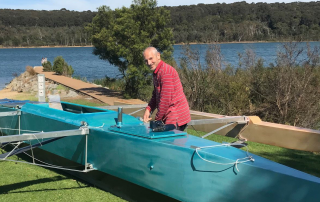
Interview Rick Willoughby
Rick Willoughby
Name: Rick Willoughby
Country: Australia
What is your background?
I graduated with a degree in Electrical Engineering from the University of Queensland and was employed by Conzinc Riotinto Australia (CRA); initially in the underground mine at Broken Hill. I subsequently transferred to Dampier iron ore operations where I worked on plant maintenance systems and machine automation. I then transferred to the zinc smelter in Newcastle as the site electrical engineer before moving on to the new coal terminal at Dalrymple Bay; being the third person on the payroll of that business, monitoring the terminal construction and developing the maintenance systems and plant automation.
After gaining extensive field experience in mining and port operations, I moved to the Sydney head office of CRA subsidiary AM&S Mining that was later separated from CRA and publicly listed as Pasminco. During this period I was involved in mining technology research, developing automated mining systems and new processing technology. I was instrumental in technology transfer of ultra-fine grinding mills used in the paper industry to processing zinc minerals exploited at Century Mine. I was the owner’s representative in the design office for the design of the AUD1.5bn Century Mine processing plant, 303km slurry transport pipeline and Karumba port operation.
I remained at Pasminco, often on site at Century Mine, until the mine achieved performance targets, and then joined international insurance giant AIG as an engineering risk consultant, travelling globally assessing large scale operations and construction sites for the insurer.
Since when and why are you interested in climate change?
Weather and climate are key factors in the engineering design of large mines, processing plants and industrial complexes. The ability of the built world to withstand cyclonic winds, storm surge, flooding rain, temperature extremes, earthquake, ground subsidence etc. are all factors that need to be considered and allowed for in the site and plant design. Assessing the risk and defining survivability parameters are key inputs to the design that reflect in the project cost and its operational performance to deliver economic benefit. The design envelope is highly dependent on weather and climate. Experiencing cyclones in Dampier and preparing the equipment to withstand the onslaught was the first experience connecting plant design and climate.
How did your views on climate change evolve?
Knowing how important weather is to the design envelope of large scale sites, plant and equipment, the prospect of climate change takes on new meaning in the insurance industry. It becomes very expensive to cater for changing risk once the plant is built.
To gain an understanding of how climate was changing in Australia, when I joined AIG, I looked into the temperature trend at Broken Hill. I considered Broken Hill to be the birth place of industrialisation in Australia. It has spawned two of the largest mining companies in the world and has solid engineering credentials dating back to the 19th century. It was also a remote location with little industrial change for more than a century. That temperature record revealed to me that Broken Hill was warmer in the 1890s than the early 2000s. That observation began my journey of discovery into the fabricated nonsense that CO2 induces climate change.
Is climate change a big issue in your country and how do you notice this?
Australia is now full throttle on fixing the weather with “renewables”. Australia is following Germany and the UK over the abyss.
How would climate policy ideally look like in your view?
Australia is being poorly served by three, primarily government funded, institutions:
BoM is fabricating data – they call it “homogenisation”; CSIRO have separated the business from reality – models are viewed as evidence and measurements are there to be adjusted to suit models. ABC has become a CO2 demonising propaganda machine. All these organisations should be defunded and those parts that can survive without subsidy should be left to find their niche.
Also, eliminate all subsidies on so-called “renewable” electricity and battery electric vehicles.
What is your motivation to sign the Clintel World Climate Declaration?
Humans are inevitably becoming more reliant on conserving natural resources and smart utilisation of resources. China is consuming more than 4,000,000,000 tonnes of coal each year; a good proportion to manufacture wind turbines and solar panels that cannot recover the energy that they consumed in manufacture during their operating life. It is a massive waste of natural resources.
The current crop of battery electric vehicles on offer in the developed world are an insult to the engineering profession. They are literally behemoths. Gross indulgences that depend on massive subsidies for their production.
What question did we forget?
I have a reasonable knowledge of field theory and an admiration for mathematicians and physicists who command field theory and derive observed behaviours from first principals rather than empirical fits. When I first saw James Hansen’s famous radiation diagram showing “back-radiation”, the alarm bells rang. Here was someone, who obviously had no idea of electro-magnetic radiation, producing silly diagrams that had gained wide credibility. I was buoyed to find that NASA/GISS had employed Russian physicist Michael Mishchenko to apply his knowledge of the electro-magnetic field to climate science. Michael passed away in 2020 but has produced copious papers on electro-magnetics as applied to understanding climate and has often pointed out that EMR is mono-directional. Sadly his work is not yet reflected in the IPCC reports because they are political documents – Hansen’s silly diagram persists.
The post Interview Rick Willoughby appeared first on Clintel.

Simpletons versus wicked scientists
by Judith Curry – Reposted from Climate Etc.
In which wicked scientists are the good guys.
Activism by climate scientists has been the topic of numerous prior blog posts at Climate Etc. Such activism is generally focused on eliminating fossil fuels. This post presents a new framing for the activism issue. While many scientists prefer to remain in the ivory tower, others desire to engage in the messiness of politics and policy making. Why most scientists reject admonitions to “stay in their lane,” there are more and less useful ways for scientists to engage with politics.
Simpleton climate scientists
I’m defining ‘simpleton climate scientists’ to be academics, mostly in disciplines that are far afield from the core discipline of climate dynamics, who think that both the climate problem and its solutions are simple. Their preferred modes of activism are twitter rants, demonstrations and increasingly civil disobedience.
The issue of simpleton scientists was brought to the forefront last week by a publication in Nature Climate Change entitled Civil disobedience by scientists helps press for urgent climate action. The authors are faculty members in the Tyndall Centre for Climate Change Research at the University of Cardiff:
Stuart Capstick, psychologist Aaron Thierry, social scientist Emily Cox, psychologist Oscar Berglund, policy studies (U. of Bristol) Steve Westlake, psychologist Julia Steinberger, geography (U. of Lausanne)The Nature article is behind paywall, but a Guardian article interviews the authors. It is clear that this is not just a scholarly article on civil disobedience. The quote that really popped out for me was by Berglund:
“We have a kind of what we call epistemic authority here: people listen to what we are saying, as scientists, and it becomes a way of showing howserious the situation is, that we see ourselves forced to go to these lengths.”
Since when do psychologists have epistemic authority to speak on climate change, its impacts and relevant policies?
Inside Climate News has another choice quote from the actual paper:
“Civil disobedience by scientists has the potential to cut through the myriad complexities and confusion surrounding the climate crisis.”
Ya think? Is this all it takes?
Also cited in this article is a statement from Peter Kalmus:
Peter Kalmus, a climate scientist for NASA’s Jet Propulsion Lab, agrees. In April, Kalmus was arrested for locking himself to the front door of a JPMorgan Chase bank branch and has since urged other scientists to join him in protest, saying it’s their duty as experts to convey the weight of their findings to the public and convince elected officials to take proper recourse.
“For the sake of our children, for the sake of the future of humanity,” Kalmus said, “you have a responsibility to do everything you can to get that information out there.”
Exactly how does civil disobedience get meaningful information out there? These scientists seem to be taking their cues from Michael Mann’s book for children entitled The Tantrum That Saved the World
Further:
Kalmus told me that he’s “disappointed” that, so far, fewer scientists than he had hoped have joined in his call to action, but he sees Monday’s article as a positive sign and believes more researchers will join the movement—especially as extreme weather and other consequences of global warming accelerate in scope and severity.
Have any of these climate scientists actually read the IPCC AR6?
So why haven’t more climate scientists joined this call to action? Maybe because they find this kind of behavior embarrassing and counterproductive.
More credible approaches to climate activism
Jim Hansen was probably the first high-profile climate activist. Has anyone ever heard Hansen claim “epistemic authority” to speak publicly on climate change? Of course not. Hansen doesn’t need to claim such authority – he has it. Hansen has worked assiduously to communicate with public. He has done the hard work to understand the economics and politics of carbon pricing and also nuclear power. He has worked closely with policy makers, most famously with Al Gore. Have some of his actions been over-the-top? Yes. Whether or not you agree with Hansen, it is undeniable that he has been effective in the political and policy arenas. Hansen is now in his 80’s, it would be interesting for him to write an essay that reflects on his activism, what worked and what didn’t, any general or specific regrets, and recommendations for current activists.
An interesting essay on this topic was written recently by Rick Pancost, entitled Climate Scientist Activism. The entire essay is well worth reading, here are some quotes:
I am not sure what sort of activism will be most effective to bring about transformative change. I certainly cannot speak to where you will be most effective in your activism. Those who do have political influence – real influence – should recognise what a rare commodity that is; they should neither casually discard it nor should they waste it. The climate movement must be a thriving mosaic of approaches, with each leveraging the successes of the others to increase cultural, popular or political capital and drive a Just Transformation.
We must find what activism is most effective, is most genuine, for each of us – but be self-critical when doing so. Some of us DO need to engage governments, some of us must be IN government. But let us not be complicit in our own deception. After all, engaging politicians is difficult but activism is hard. You sacrifice more than your time, but also your reputation, job prospects, even your freedom. Sometimes the logical choice is the right choice; sometimes it is just the easy choice.
But you do have to make a choice. We cannot have our cake and eat it too. We cannot be the vizier to the king as well as the court jester. We cannot participate in civil disobedience and still serve on government advisory boards.
Activist scientists must also be humble and remember that we are not experts on what is effective. We did not know what would be effective when we allowed ourselves to be bound by others´ rules of engagement, when we allowed ourselves to be captured by governments and by extension the lobbyists and special interests who influence them. Because we are not experts on how policy is made, we were tricked. So perhaps rather than deciding who and how to engage, we should join those who do know.
Finally and most importantly, I would urge you to consider that maybe we should stop partnering with governments and start partnering with communities. “
Pangost’s essay reflects scientists attempting to work constructively with policy makers, planners and stakeholders, primarily on the issue of mitigation (reduction of CO2 emissions) and associated societal changes. There are clearly frustrations, but this approach is far more effective than simpleton tantrums.
Wicked scientists
And finally we come to wicked scientists. As I have written in multiple previous posts, a wicked problem is characterized by multiple problem definitions, contentious methods of understanding, chronic conditions of ignorance, and lack of capacity to imagine future eventualities of both the problem and the proposed solutions. The complex web of causality may result in surprising unintended consequences of attempted solutions that generate new vulnerabilities or exacerbate the original harm. Further, wickedness makes it difficult to identify points of irrefutable failure or success in either the science or the policies. Wicked problems are both complex and political.
Although much has been written about wicked problems and the need to address them, there is not much in the way of guidance for effectively tackling wicked problems. Two recent articles have addressed this issue:
The World Needs Wicked Scientists A Philosophy for Working on Wicked Problems .“Wicked science” is a process that is tailored to the dual scientific and political natures of wicked societal problems. As such, wicked science is massively transdisciplinary, including natural sciences and engineering along with social sciences and humanities. Wicked science uses approaches from complexity science and systems thinking in a context that engages with the political roles and perspectives of decision makers, planners and other stakeholders. Wicked problems and the strategies devised to address them cannot be defined by scientific experts alone, but include the experiential and operational knowledge of a range of stakeholders.
Two recent papers by atmospheric/climate scientists have articulated something similar to wicked science for the climate sciences, that notably focus more on adaptation than mitigation.
Adam Sobel’s paper “Usable climate science is adaptation science” emphasizes that the localness of adaptation implies much greater uncertainty in the relevant climate science. Climate science for adaptation is more about characterizing uncertainty for robust decision making. Usable climate science requires that scientists engage in co-production of usable science with stakeholders, with a willingness to learn to understand how the human factors are manifest in a particular setting.
Regina Rodrigues and Ted Shepherd’s paper entitled “Small is beautiful: climate-change science as if people mattered” addresses strategies for grappling with the complexity of local situations. The strategies include expressing climate knowledge in conditional form in terms of scenarios developed via the storyline approach, and working with local communities to make sense of their own situations.
Combining and integrating knowledge from diverse disciplines and other sources to provide insights, explanations and solutions to wicked problems is a substantial challenge. For the solution orientation of wicked science to be meaningful, we need an overarching philosophy for navigating wicked problems. We need to acknowledge that control is limited, the future is unknown, and it is difficult to determine whether the impact you make will be positive. We need to accept that climate change will continue to disrupt natural systems and human wellbeing; this acknowledgement helps avoid the urgency trap. By acknowledging that there is no road back, we can focus on the road ahead.
Wicked scientists are willing to become embroiled in political debates and thorny social problems. As such, wicked scientists are not activists that are advocating for a preferred political/policy solution and recognize the reality of political disagreement as a key aspect for dealing with wicked problems.
Wicked scientists are needed to break the hegemony of disciplinary researchers, particularly those who are strident political activists, as being regarded as experts for solutions to the wicked problem of climate change. While the IPCC has operated via a loose cooperation between multiple disciplines, genuine transdisciplinary understanding and collaborations, across disciplines and with a broad range of stakeholders, is needed for meaningful contributions to wicked problems.
Some universities are starting to grapple with how to train wicked scientists. Working in the private weather/climate services sector provides a crash course in being a wicked scientist, in terms of becoming conversant with additional disciplines, working in transdisciplinary teams, an emphasis on uncertainty, and actually listening to and working with policy makers, planners and stakeholders. Not only is activism not needed for problem solving, but it mostly seems counterproductive to actually formulating and evaluating solutions.
The road ahead can be facilitated by broader, transdisciplinary thinking about the climate change problem and its solutions. This requires moving away from the consensus-enforcing and cancel culture approach of attempting to restrict the dialogue surrounding climate change and the policy options. We need to open up space for dissent, disagreement and discussion about scientific uncertainty and policy options, so that multiple perspectives can be considered and broader support can be built for a range of policy options. Bring on the wicked scientists.
But if a scientist is dominated by their political instincts on this issue, they will continue to take the court jester path and not contribute to solutions in a meaningful way.
The post Simpletons versus wicked scientists appeared first on Clintel.

The Greenhouse Effect, Revisited
“If it [a scientific hypothesis] disagrees with experiment, it’s WRONG.”
Nobel Prize winner Richard Feynman
As a further addendum to my series of posts in 2020 and 2021 on the CO2 global warming hypothesis, this post presents another challenge to the hypothesis central to the belief that humans make a substantial contribution to climate change. The hypothesis is that observed global warming – currently about 0.85 degrees Celsius (1.5 degrees Fahrenheit) since the preindustrial era – has been caused primarily by human emissions of CO2 and other greenhouse gases into the atmosphere.
The challenge, made in two papers published by Australian scientist Robert Holmes in 2017 and 2018 (here and here), purports to show that there is no greenhouse effect, a heretical claim that even global warming skeptics such as me find dubious. According to the paper’s author, greenhouses gases in the earth’s atmosphere have played essentially no role in heating the earth, either before or after human emissions of such gases began.
The papers are similar to one that I discussed in an earlier post in the series, by U.S. research scientists Ned Nikolov and Karl Zeller, who claim that planetary temperature is controlled by only two forcing variables. A forcing is a disturbance that alters climate, producing heating or cooling. The two forcings are the total solar irradiance, or total energy from the sun incident on the atmosphere, and the total atmospheric pressure at a planetary body’s surface.
In Nikolov and Zeller’s model, the radiative effects integral to the greenhouse effect are replaced by a previously unknown thermodynamic relationship between air temperature, solar heating and atmospheric pressure, analogous to compression heating of the atmosphere.
Their findings are illustrated in the figure below where the red line shows the modeled, and the circles the actually measured, mean surface temperature of the rocky planets and moons in the solar system that have atmospheres: Venus, Earth, Mars, our Moon, Titan (a moon of Saturn) and Triton (a moon of Neptune). Ts is the surface temperature and Tna the calculated temperature with no atmosphere.
Like Nikolov and Zeller, Holmes claims that the temperatures of all planets and moons with an atmosphere are determined only by solar insolation and surface atmospheric pressure, but with a twist. The twist, in the case of Earth, is that its temperature of -19.0 degrees Celsius (-2.2 degrees Fahrenheit) in the absence of an atmosphere is entirely due to heating by the sun, but the additional 33 degrees Celsius (59 degrees Fahrenheit) of warmth provided by the atmosphere comes solely from atmospheric compression heating.
Holmes argues that the extra 33 degrees Celsius (59 degrees Fahrenheit) of heating cannot be provided by the greenhouse effect. If it were, he says, planetary surface temperatures could not be accurately calculated using the ideal gas law, as Holmes shows that they can.
The next figure compares Holmes’ calculated temperatures for seven planets including Earth, the moon Titan and Earth’s South Pole, using the ideal gas law in the form T = PM/Rρ, where T is the near-surface temperature, M is the mean molar mass near the surface, R is the gas constant and ρ is the near-surface atmospheric density.
However, the close agreement between calculated and actual surface temperatures is not as remarkable as Holmes thinks, simply because we would expect planets and moons with an atmosphere to obey the ideal gas law. And the actual temperature he uses for Earth of 288 Kelvin (15 degrees Celsius or 59 degrees Fahrenheit) is too high and doesn’t take global warming into account – whether the warming comes from greenhouse gases or not.
Earth’s current average surface temperature is in fact only 13.9 degrees Celsius (57 degrees Fahrenheit), of which approximately 0.85 degrees Celsius (1.5 degrees Fahrenheit) is due to modern global warming as mentioned above.
In any case, the argument of both Holmes and Nikolov and Zeller that compression of the atmosphere can explain greenhouse heating has been invalidated by PhD meteorologist Roy Spencer. Spencer points out that, if atmospheric pressure causes the lower troposphere (the lowest layer of the atmosphere) to be warmer than the upper troposphere, then the same should be true of the stratosphere, where the pressure at the bottom of this atmospheric layer is about 100 times larger than that at the top.
Yet the bottom of the stratosphere is cooler than the top for all planets except Venus, as can be seen clearly from the following figure of Holmes. The vertical scale of decreasing pressure is equivalent to increasing altitude; the dotted horizontal line at 0.100 bar (10 kilopascals) marks the boundary between the troposphere and stratosphere.
Both of these farfetched claims that there is no greenhouse effect stem from misunderstandings about energy, as I discussed in my earlier post.
Next: Arctic Sea Ice Refuses to Disappear, despite Rising Arctic Temperatures
Author
Retired physicist Dr. Ralph B. Alexander is the author of Global Warming False Alarm and Science Under Attack: The Age of Unreason. He blogs at his website Science Under Attack.
With a PhD in physics from the University of Oxford, he is also the author of numerous scientific papers and reports on complex technical issues. His thesis research in the interdisciplinary area of ion-solid interactions reflected his interest in a wide range of scientific topics.
Dr. Alexander has been a researcher at major laboratories in Europe and Australia, a professor at Wayne State University in Detroit, the co-founder of an entrepreneurial materials company, and a market analyst in environmentally friendly materials for a small consulting firm.
Alexander is a USA signee of the CLINTEL World Climate Declaration.
The post The Greenhouse Effect, Revisited appeared first on Clintel.

A Much Larger Greenhouse Effect – But Temperatures Dominated by Cooling
Guest post by Wim Röst
Foreword Especially for Policymakers
The greenhouse effect appears to be much higher than previously assumed. However, that also means that the greenhouse effect does not determine the temperature. Earth’s temperatures are way lower. The level of Earth’s temperatures appears to be completely dependent on cooling by the H2O molecule that has been able to keep Earth’s temperatures within narrow limits for four billion years. Given the enormous power of cooling by means of water vapor, the influence of additional greenhouse gases cannot be more than zero percent. The consequence of what is set out below is that policymakers again have complete freedom in searching for the most practical, the most strategically correct, and the most inexpensive solution for the current (2022) energy problem. All options are open again.
Abstract
The Earth’s greenhouse effect is much larger than suggested so far. If surface radiation and the greenhouse effect set surface temperatures, our oceans would be boiling. Fortunately, they don’t. Water Earth has a strong water-vapor-based evaporative surface cooling mechanism that effectively sets and stabilizes surface temperatures at a much lower level than cooling by surface radiation emissions can do. Thanks to water vapor our temperature system is far more stable than admitted by the consensus, and thanks to water, water vapor, and clouds surface temperatures are favorable for present life.
Introduction
Early Earth consisted of hot molten lava covered by an extreme greenhouse atmosphere: hardly any surface radiation could reach space, if any. Nevertheless, its surface cooled. Upward convection brought sensible and latent heat from hot surfaces to elevations on the very edge of the atmosphere from where energy effectively could be radiated into space. Despite the near maximal greenhouse effect the surface of Early Earth cooled down and at a certain moment the first oceans developed. Those boiling oceans still resulted in a huge upward convective transport of energy, further cooling the surface. Until now, convective upward transport of energy plays the main role in surface cooling. Convection sets and regulates surface temperatures at actual level. Without evaporative-convective-cloud-cooling, our actual greenhouse atmosphere would theoretically result in a surface temperature of 202.3°C. On the real Earth the greenhouse effect warms the surface, but greenhouse warming does not set and control final surface temperatures. Earth’s H2O-based cooling system does.
Theoretical greenhouse effect
We can calculate the warming effect of present greenhouse atmosphere for a theoretical planet[1] in the case where its surface is cooled just by radiation. Without a greenhouse atmosphere and if optimally cooled by radiation[2] the temperature of such a theoretical planet is minus 42.3 degrees Celsius. But a greenhouse atmosphere makes a huge difference. Initially.
Present Earth’s greenhouse atmosphere is still ‘a near perfect’ greenhouse atmosphere. As shown in Figure 1, only 22 W/m2 of surface radiated energy (396 W/m2) can reach space without being absorbed. A surface cooling efficiency of only 5.556%.
Figure 1: The Earth’s radiation budget. Of all 396 W/m2 surface radiated energy 22 W/m2 reaches space without being absorbed (Added: red oval). Source Trenberth and Fasullo 2011[3]
The efficiency of cooling by surface radiation is very low: after absorption, nearly all surface emitted energy returns to the surface as downwelling radiation or (without convection) and stays as sensible heat in the lower atmosphere. Knowing the cooling efficiency of the Earth’s surface radiation, we can calculate the greenhouse surface temperature in the case where the surface of our imaginary planet is only cooled by radiation, as shown in Figure 2.
Figure 2: Surface temperature for a theoretical planet, calculated for the case of surface cooling by radiation only. Input: solar radiation absorbed by the surface and surface emitted longwave radiation of 161 W/m2, the effective emissivity is 5.556% (‘Emissivity 0.05556’). Calculation by Stefan-Boltzmann Law calculator.
With Earth’s present greenhouse effect, the surface of our imaginary planet would have had a temperature of 202.3 degrees Celsius, if only cooled by surface radiation. Total initial greenhouse warming is huge, see Table 1.
Table 1: The greenhouse warming effect per Stefan-Boltzmann for a theoretical planet only cooled by radiation. Calculated for a planet without greenhouse atmosphere and for a planet with Earth’s present greenhouse atmosphere. Radiated power equal to solar absorption 161 W/m2.
Given the high initial greenhouse warming effect, on our relatively cool Earth other factors than surface radiation must control the level of surface temperatures; probably H2O-related surface cooling.
The level of Earth’s surface temperatures
Where in the range of ‘greenhouse temperatures’ do we find Earth’s surface temperatures? On Earth, surface temperatures are best indicated by the surface temperature of ocean water, covering 71% of the Earth’s surface. The maximum average yearly temperature is 30°C while the minimum temperature is minus 1.8°C, shown in green in Figure 3.
Figure 3: The level of the Earth’s actual surface temperatures shown within the range for theoretical greenhouse warming as calculated for the theoretical situation of cooling only by surface radiation in the case of a theoretical planet. The greenhouse effect would warm the surface from – 42.3°C to + 202.3°C. Earth’s actual ocean temperatures are shown in green: from + 30°C to – 1.8°C. Blue shows the temperature range that is too cold for life, red shows the temperature range too hot for life.
‘Radiation only’ would have stopped cooling the planet’s surface at 202.3°C. Actual Earth yearly average surface temperatures are much lower, about 15°C. On real Earth, additional cooling by evaporation, conduction, convection and clouds has lowered surface temperatures far below the level ‘radiation only cooling’ would have resulted in. Why? The answer is that H2O-related cooling (evaporative, convective and tropical cloud cooling) is very strong, very dynamic, and very effective in the temperature range above 15°C.
Evaporation
Evaporation rises by 6-7% (Clausius-Clapeyron) per degree of temperature rise, a huge percentage. In the higher temperature range evaporative cooling cools extremely: think about boiling water of 100°C. In case of temperatures lower than 15 degrees Celsius, evaporative cooling diminishes by the same high percentage of 6-7%. At some point H2O related surface cooling and warming resulting from surface solar absorption came into balance at 15°C.
Convection
Convection in the atmosphere is the upward transport of latent and sensible heat from the surface to higher elevations. Convective removal of surface heat effectively cools the surface and brings energy to elevations lacking most of the main greenhouse gas, water vapor. At these elevations emission to space is more effective than surface emission. Convection is highly stimulated by the low-density water vapor molecules resulting from evaporation. Evaporative-convective cooling is huge in the higher temperature range and produces large quantities of solar reflecting tropical clouds. When tropical clouds develop, evaporative surface cooling is combined with diminished surface solar warming: very effective.
Conduction
Strong convection firmly enhances wind over the surface and brings in drier and colder air from elsewhere, resulting in higher conductive surface heat loss.
Diminishing H2O-based cooling
The whole evaporation-based cooling machine is very dynamic. All H2O-based surface cooling is fueled by rising evaporation, as temperatures rise. But evaporation also strongly diminishes when temperatures fall, even by just one degree, ending further cooling of the surface. At present, the Earth’s[4] total surface cooling and total surface warming are balanced at a yearly average of 15 degrees Celsius.
Solar radiation
The oceanic uptake of solar energy is very dependent on the presence/absence of tropical clouds. As temperatures go down, lower-level tropical clouds diminish strongly, and more solar energy is able to reach and warm the surface. Surface warming causes a rise in evaporation. Rising evaporation, thunderstorms, and related processes ending in tropical clouds soon end the extra solar warming. Hence the incredible stability of the Earth’s surface temperatures.
Balance
At 15°C there is a balance between surface warming by solar uptake and surface cooling. Any further surface cooling results in higher solar uptake, neutralizing initial cooling. And any surface warming results in higher evaporative-convective-cloud cooling, neutralizing any initial surface warming.
Initial warming by extra greenhouse gases is fully neutralized like all other surface warming. Neutralizing warming happens at different time scales, sometimes seconds (radiation) or hours, a day, or by season, but often over decades (by longer-term ocean oscillations) and sometimes over even longer periods like the recovery from the cold Little Ice Age which might take centuries.
Why 15°C and why not 202.3°C?
Radiative cooling is less dynamic than H2O based cooling. For one degree of difference in surface temperature, radiative cooling goes up or down by only 1.4%, but H2O- based cooling by 6-7%. Early Earth started hot and then cooled down after its creation. At a current surface temperature of only 15°C (the temperature level for this geological period and for this orbital setting) the H2O related surface cooling has balanced surface solar absorption.
Early Earth
Early Earth was hot and steamy. Heat of accretion did melt all the colliding material coming from space that formed the Earth. A nearly perfect sphere formed and its atmosphere was the perfect greenhouse atmosphere: an atmosphere with a superhigh water vapor content, very rich in carbon dioxide, and a sky covered by clouds. Hardly any surface radiation could reach space without being absorbed. Convection had to transport surface energy to the edge of the steamy atmosphere where spaceward emission could take place. For early Earth surface cooling depended on the strength of convection. As temperatures fell, convective cooling continued but continuously diminished in strength. Tropical cloud coverage also diminished, allowing the Sun to warm the tropical oceans. Despite Earth’s huge greenhouse effect, surface temperatures have never been dependent on the strength of the greenhouse effect but on the temperature set by where H2O-related surface cooling balances warming by rising surface solar uptake.
Intrinsic properties
The fascinating H2O molecule has many intrinsic properties. One of its properties gives the molecules a strong cohesion resulting in a strong surface tension which creates ‘tight’ surfaces some insects can even walk on. Strong surface tension makes it difficult for a surface molecule to escape into the atmosphere, which raises the temperature at which enough water vapor will be released to cause ‘super-convection’. Another intrinsic property sets the freezing temperature at zero degrees Celsius and not at +10, +20 or minus 20 degrees. Binding one oxygen atom to two low-density hydrogen atoms results in a low-density water molecule, so very humid, low density, air easily rises. H2O’s intrinsic properties determine all essential elements of Earth’s main cooling system, which is dominated by H2O. The properties are intrinsic to the molecule itself: they don’t change over time. Therefore, the surface temperature of the Earth could have remained at the same level over billions of years if Earth’s orbital settings and the distribution of oceans and continents over its surface hadn’t changed. H2O’s intrinsic properties set the level of Earth’s surface temperatures for every specific orientation and surface arrangement of the Earth. The H2O molecule, nothing else.
Faint young Sun paradox
During the first years of early Earth, the Sun’s output must have been about 30 percent less intense as nowadays. Less solar energy reached the Earth. Nevertheless, the surface of the Earth has never been much colder than present Earth. This is called the faint young Sun paradox. Knowing the role of H2O-related surface cooling, that paradox is solved. As total insolation reaching the surface is controlled by tropical clouds and the Earth’s surface temperatures are controlled by H2O-related surface cooling, the Earth’s surface temperatures don’t simply depend on the intensity of solar irradiation reaching the Earth. In the case of a faint Sun, evaporation diminishes, less tropical clouds cover tropical oceans and enable more (but weaker) solar rays to reach and warm a larger surface area. End result for tropical oceans: about the same.
No Snowball Earth
Because the quantity of insolation reaching the surface is controlled by tropical clouds and because of H2O-controlled surface cooling, no complete snowball Earth has probably existed. A slightly colder surface strongly diminishes H2O related surface cooling. Diminishing tropical clouds result in a higher uptake of solar energy by tropical oceans. The final result is tropical oceans still remaining warm. On water Earth no full snowball Earth is possible. Even when all present land (29% of the total surface) is concentrated on both poles, the result is just a partial snow- and ice-covered surface. Most of the other 71% of the surface will be covered by relatively warm oceans, oceans that are redistributing tropical absorbed solar energy over mid-latitudes, not hindered by any continent.
Conclusions
The Earth’s greenhouse effect is huge, much higher than normally assumed. If cooled by ‘surface radiation only’ the surface of a theoretical planet would have had a surface temperature of 202.3°C. But the Earth’s surface temperatures are not set by the strength of Earth’s greenhouse effect. Additional H2O-based cooling systems keep the surface at a much lower temperature, balancing rising surface radiation uptake. At present, that balance is reached at a yearly average of 15 degrees Celsius.
Thanks to H2O-related surface cooling the Earth’s surface temperatures are bound to a narrow range, at a temperature level well suited for life on Earth. Due to its stability, life developed over many hundreds of millions of years.
Temperature regulates the cooling system; the cooling system regulates temperature.
####
With regards to commenting, please adhere to the rules known for this site: quote and react, not personal. And when commenting, please don’t use abbreviations but words
About the author: Wim Röst studied geography in Utrecht, the Netherlands. The above is his personal view. He is not connected to firms or NGO’s or funded by government(s).
Andy May was so kind to correct and improve the English text where necessary or helpful. Thanks!
Footnotes
Calculations are for a theoretical planet fully responding to Stefan-Boltzmann Law. The theoretical planet is a perfect absorber/emitter (blackbody) and consists of an ‘infinitely thin shell’ not able to store any energy. Its surface is superconducting, resulting in the lowest emission temperature possible. Calculated for actual solar surface absorbed (161 W/m2) assuming maximal absorption and maximal emission and assuming all surface radiation is directly radiated to space, meaning: without being absorbed. Efficiency of surface emission is 100% or an effective emissivity of ‘1’. Calculation by Stefan-Boltzmann calculator. This 2011 version of the graphic is the corrected one. The caption on the image: “The global annual mean earth’s energy budget for 2000–2005 (W m−2). The broad arrows indicate the schematic flow of energy in proportion to their importance. Adapted from Trenberth et al. (2009) with changes noted in the text”. The present state of the Earth includes the Earth’s orbital configuration and the location, size, and topography of continents and oceans. The total state results in a specific distribution and redistribution of solar energy over latitudes. Weather patterns depend on the distribution and redistribution of solar energy. Climate by definition is the average of 30 years of weather. Changes in climate are the result of changes in the distribution and redistribution of solar energy over the Earth’s surface.Author
Biography
Wim Röst studied geography in Utrecht, the Netherlands. The above is entirely and exclusively his own personal view. He is not affiliated with companies, NGO’s or other organizations, nor is he dependent on government funds. For 10 years he has intensively studied the climate problem. After discovering that water vapor is not only the main greenhouse gas but also the main cooler of the Earth’s surface, he has come to understand the role of water, water vapor and cloud cover. The discovery that the greenhouse effect is actually much greater than previously assumed has put all discoveries in the right place. This article is the direct result.
The post A Much Larger Greenhouse Effect – But Temperatures Dominated by Cooling appeared first on Clintel.

Interview George Sowers
George Sowers
Name: George Sowers
Country: USA
What is your background?
I was born in Atlanta in 1958. My father was a professor of Civil Engineering at Georgia Tech and was eventually inducted into the National Academy of Engineering.
My university training is in physics. I have a bachelor’s degree in physics from Georgia Tech and a PhD in physics from the University of Colorado in Boulder. I’ve lived in Colorado since 1981. My thesis research was in numerical simulations of quarks under the influence of the strong nuclear force using the techniques of lattice gauge theory. This work first exposed me to large scale numerical modelling: its utility and its limitations.
My 30+ years of work experience were entirely within the aerospace industry, starting at Martin Marietta which became Lockheed Martin. I rose through the engineering ranks, working on the Titan and Atlas space launch vehicles. I was the Chief System Engineer for the development of the Atlas V launch vehicle, still active. Atlas V has launched spacecraft to Pluto and Mars as well as dozens of commercial, military and intelligence satellites into Earth orbit. Countless computer models are used in the development of a launch system, but extraordinary care is taken to validate these models given the enormous stakes involved.
In 2006, Lockheed Martin and Boeing formed a joint venture called United Launch Alliance (ULA). I became the Vice President of Business Development and Advanced Programs. I was also responsible for the company’s Washington DC operations that included regular interactions with Congress and the Executive Branch agencies dealing in space activities. I became the Vice President of a newly formed human spaceflight division of ULA that included a human rated version of Atlas to carry the Boeing Starliner capsule and the upper stage of NASA’s SLS rocket whose first launch is imminent.
I ended my ULA career as Chief Scientist and Vice President of Advanced Programs. In that role, I started the Vulcan rocket development program and orchestrated a partnership with Jeff Bezos’ Blue Origin to develop the BE-4 engine. My group developed concepts for fully reusable in space vehicles designed to be refuelled with propellant sourced from space.
In 2017, I retired from ULA and joined the faculty of the Colorado School of Mines. I am part of the world’s first and only graduate program in space resources, devoted to harnessing the vast resources of space for the benefit of humankind. I teach systems engineering and a projects course. My research interest is in developing the water resources of the Moon and asteroids to produce and distribute liquid oxygen, liquid hydrogen propellants. Water is the oil of space!
Since when and why are you interested in climate change?
I have had an intellectual interest in the science of climate change for many decades. As a teenager, I remember the global cooling scare. While a young adult, that morphed into global warming and eventually climate change. From the first, I was sceptical that catastrophic consequences could arise from relatively modest increases in the trace gas CO2. For many years, the climate scare advocates could be dismissed as unserious and relatively harmless. But as their political influence increased, I became more alarmed. Their policy recommendations, if pursued, would destroy the economic foundation that has led to the incredible increase in human flourishing experienced since the Industrial Revolution. That is frankly insane.
In the 2000’s, I began to educate myself on the actual science behind the climate catastrophe claims. I studied climate history over human and geologic scales and read several books on climate modelling. I investigated the actual data on severe weather. In no case did the facts support the catastrophic claims. Nevertheless, many countries are now starting down the path of economic destruction. It must be stopped, and soon.
How did your views on climate change evolve?
I have always been sceptical of climate catastrophe claims. However, it did not really matter so long as those making the claims were on the fringe with little political power. One could laugh it off, like the predictions of mass famine made by Paul Ehrlich and the Club of Rome.
However, over the past decades, the political power of the climate catastrophe movement has grown to the point where it has taken over international organizations like the UN and many of the highest government offices in affluent nations in Europe, North America, and Australia.
My aha moment came when I realized that most of those in positions of power were not particularly worried about the climate crisis per se but saw it as an opportunity to implement socialist/Marxist policies, i.e., complete government control of the economy, to save us from the claimed climate crisis.
Over time, many of these politicians have become quite open about their aims. For example, Christiana Figueres, former executive secretary of U.N.’s Framework Convention on Climate Change, stated that “this is the first time in the history of mankind that we are setting ourselves the task of intentionally, within a defined period of time, change the economic development model that has been reigning for at least 150 years, since the Industrial Revolution.” A top aide to socialist US Congresswoman Alexandria Ocasio-Cortez admitted that the Green New Deal was not conceived as an effort to deal with climate change, but instead a “how-do-you-change-the-entire economy thing.”
As a scientist by education, I am deeply disappointed by the willingness of the science community to be an accomplice to the takeover. I have no doubt that many scientists really believe that increasing CO2 poses a danger to the climate, but the community has completely abandoned cherished principles of scientific practice and discovery. Honest debate regarding data and research is suppressed and those expressing contrary views are vilified as deniers. Grants for contrary research are denied and papers describing contrary results are refused publication. Even worse, data are manipulated, e.g., the US temperature records, to exaggerate evidence of warming.
Perhaps most egregious, as a long-time developer and user of scientific and engineering models, is the indiscriminate use of unvalidated, even falsified, climate models to predict a crisis in the future. I am a firm believer in the maxim “all models are wrong, but some are useful.” For a model to be useful in a particular domain, it must be validated. Validation is a rigorous process of proving that a model provides a faithful representation of the relevant aspects of the real world. In engineering applications, this usually entails anchoring the model to test data obtained under carefully controlled conditions. This is clearly not possible for climate models.
Furthermore, the usefulness of a model resides in its ability to make accurate predictions. Again, climate models fall short. Current models greatly overestimate the amount of warming experienced over the past 20 years. This problem is finally being recognized within the climate modelling community, who now admit their models “run hot.”
Is climate change a big issue in your country and how do you notice this?
The political left has made climate change a huge issue within the US. Now controlling the White House and both branches of Congress, they have been able to pass harmful and wasteful legislation suppressing the use of fossil fuels and supporting unreliable solar and wind. Many more destructive policies have also been pursued via executive action. Most media in the US are “all in” with the climate crisis narrative. Every adverse weather event is claimed to be due to climate change. It doesn’t matter whether it’s a cold snap, a heat wave, floods or drought, frequent storms, or a lack of storms (like the current lack of Atlantic hurricanes), it’s all due to climate change.
There are still some media that remain skeptical, but they are under increasing attack.
How would climate policy ideally look like in your view (suppose you are the minister for climate)?
I would first eliminate the position of climate minister!
Fundamentally, there is no climate crisis. Any policy that purports to address climate change should be eliminated. Most importantly, we should stop the war against fossil fuels (and nuclear power) and return to a free market approach to energy. In a free market, coal, oil, and natural gas will continue to provide very low cost, efficient, and convenient energy. Abundant, low-cost energy is the key to lifting billions of people out of poverty. We need to return to the trajectory of ever-increasing abundance that has dramatically enhanced human flourishing over the past 150 years. Keeping the climate change boot on the necks of the developing world countries is grossly immoral.
Since climate is always changing regardless of what humans do, we should continue to invest in technologies and infrastructure that enhance resilience to weather events. This policy has resulted in a 50-fold reduction in weather related deaths over the past century.
What is your motivation to sign the Clintel World Climate Declaration?
The current political trajectory in the western world is deeply alarming. It has resulted in the current energy disaster in Europe and the looming one in the US, Canada and Australia. The time is now to reverse course. Ordinary people are waking up. The Covid experience revealed the corruption and ineptitude of so-called experts. The same corruption and ineptitude lie behind “climate science.”
The Clintel Declaration is a small step toward eliminating the “science” justification from the ongoing destructive and immoral economic transition.
What question did we forget?
The following is a short summary of what we know about the real science of climate change and CO2. Each of these statements is well supported by data and analysis:
The following is a short summary of what we know about the engineering of the world’s energy system. Again, each statement is well supported by facts and analysis:
Over 80% of the world’s energy comes from fossil fuels: coal, oil, and natural gas. Fossil fuels are abundant, low cost, transportable, and have high energy density. They are well suited for all the energy needs of advanced society: electricity generation, transportation, and heavy industry. Fossil fuels have enabled the astonishing increase inhuman flourishing (wealth, health, technology, etc.) experienced over the past 150 years. Other energy sources: nuclear, solar, wind, hydro, geothermal, etc.) each have drawbacks compared to fossil fuels. Nuclear is excellent for electricity generation but has been wrongly vilified. It is the safest and cleanest of all energy options. Solar and wind are intermittent, unreliable, and of very low energy density. They currently supply around 3% of the world’s energy despite trillions of dollars in subsidies in the past several decades. Reliability can be improved by including enormous storage capacity, but the necessary technologies don’t exist. Hydro and geothermal are geographically limited to regions with fast moving rivers or volcanic regions, respectively. A transition to “green” energy is impossible without economic collapse, misery, and death. Expanded use of fossil fuels can lift the developing world out of poverty and continue the trajectory of ever-increasing human flourishing. Eventually, other energy sources will be developed like nuclear fusion and space based solar power that will eliminate energy scarcity forever.The post Interview George Sowers appeared first on Clintel.
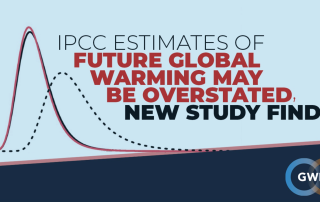
New peer reviewed paper: climate sensitivity a third lower
Official IPCC estimates of future global warming may be overstated
Press Release by GWPF
A new paper reduces the estimate of climate sensitivity – the amount of warming expected for a doubling of carbon dioxide concentrations – by one third. The results therefore suggest that future global warming will be much less than expected.
The paper, by independent scientist Nic Lewis, has just appeared in the journal Climate Dynamics. It is an important challenge to the official view of the Intergovernmental Panel on Climate Change (IPCC).
Lewis has critiqued a 2020 assessment of climate sensitivity by Sherwood et al., which strongly influenced the IPCC’s Sixth Assessment Report, in 2021. Lewis commented:
“It is unfortunate that Sherwood et al.’s assessment of climate sensitivity, which underpinned the UN Framework Convention on Climate Change, contained such serious errors, inconsistencies and deficiencies in its methods”.
After correcting the Sherwood et al. methods and revising key input data to reflect, primarily, more recent evidence, the central estimate for climate sensitivity comes down from 3.1°C per doubling of CO2 concentration in the original study to 2.16°C in the new paper.
This large reduction shows how sensitive climate sensitivity estimates still are to input assumptions, and that values between 1.5°C and 2°C remain quite plausible.
Climate sensitivity represents the long-term global temperature increase caused by a doubling of atmospheric CO2 concentration. There are different measures of climate sensitivity. Both the Sherwood and Lewis papers estimate the so-called ‘effective’ climate sensitivity, which reflects a new equilibrium state projected from centennial changes after a doubling of the CO2 concentration. This measure is considered the most relevant one for predicting climate change in the coming two centuries. Climate sensitivity has always been a very important, but also highly uncertain, parameter in the climate change discourse. Earlier IPCC reports assessed its value as likely to be somewhere between 1.5°C and 4.5°C, with a best estimate of 3°C. However, prompted by the Sherwood paper, the 2021 Sixth Assessment Report moved that range upwards, to 2.5 to 4°C. Although for outsiders this might sound boring, for insiders it was a revolutionary change. Lewis’s corrections and revisions lead to a likely range of 1.75 to 2.7°C, which is not only lower but is also much less uncertain than either the 2021 official IPCC assessment or the very similar Sherwood et al. estimate (2.6 to 3.9°C). Nic Lewis is the lead or sole author of ten peer-reviewed papers on climate sensitivity. He was a participant in the 2015 workshop that kicked off the World Climate Research Programme project that led to the Sherwood et al. 2020 paper, but he was not a co-author of that paper.Lewis commented:
“The substantial reduction in assessed climate sensitivity upon updating key input data suggests that the increase in the bottom of the climate sensitivity range in the IPCC Sixth Assessment Report was unjustified”.
Lewis’s paper is entitled ‘Objectively combining climate sensitivity evidence’. It can be freely downloaded here. A detailed explanatory article about the paper is available here.
The post New peer reviewed paper: climate sensitivity a third lower appeared first on Clintel.