Mathew Good’s Controversial Speech on Unvaccinated People.
Please watch this whole video so you have all the [...]

Please watch this whole video so you have all the [...]
November 15th is National Clean Out Your Fridge Day this [...]
Hans Hofmann-Reinecke
Name: Hans Hofmann-Reinecke
Country: South Africa
What is your background?
I was born in Germany towards the end of the Second World War. I grew up there and spent a major part of my life. I studied physics at the Technical University in Munich (TUM) in the 1960s/70s, when science, contrary to now, enjoyed a certain prestige. Munich was home to a number of scientific celebrities, among them none other than Werner Heisenberg. It was a carefree period with the first fruits of the German economic miracle becoming available and whiffs of hippy-atmosphere arriving from America. Most of us students worked after hours to be able to afford a third hand car – mine turned out to be a Volkswagen Beetle from 1949.
During doctoral work at the Physics Department of the TUM, I had my first encounter with the nuclear world in the form of our own research reactor, the first one in Germany. Due to its shape it was called the Atomic Egg.
Research and teaching took me to different places, in particular to the US and to South America. I left science in my forties and ended up as a freelance consultant for the management of research projects with mainly pharmaceutical and automotive clients in my portfolio. My last assignment of this kind was in 2017, at the age of 72. I now live next to Cape Town and write books and posts – mostly about the drama on global warming.
I’ve been a pilot for most of my adult life which helped me discover the magic of South Africa, her people, her landscape and her wildlife.
Since when and why are you interested in climate change?
The green movements were probably more pronounced in Germany than in any other country in the world. Debates about the ozone hole and forest dieback were as intrusive as they were irrational. With the advent of global warming, it all took on a new order of magnitude and I was sceptical from the start.
How did your views on climate change evolve?
After a few years had passed without measurable increase in average global temperature, the disaster was renamed from global warming to climate change. This was an excellent move in marketing, but it exposed the true motives of the protagonists that the show must go on regardless of how temperature evolves.
Is climate change a big issue in your country and how do you notice this?
In German politics and media there has not been a more dominant topic during the past decades than climate change – it only took a temporary back seat during the corona hype. It’s an issue that not only dominates politics, but permeates society as a whole and which breaks friendships.
In South Africa, where I live now, people have other concerns. And, if you don’t mind me saying so, they’re less neurotic.
How would climate policy ideally look like in your view?
All politics must follow the same principle that medicine follows: primum non nocere – above all do no harm. Measures related to climate change must be in accordance with systematic risk management. Costs and benefits, scope and probabilities must be quantified as best as possible.
And if I were Germany’s climate minister, I would stop the expansion of wind energy and photovoltaics today and would build up nuclear energy instead, with France as a role model. I know that nukes are not dangerous. Working for a year as a nuclear watchdog with the IAEA, I spent plenty of time in the close vicinity of all sorts of nuclear monsters – and I’m still alive.
What is your motivation to sign the Clintel World Climate Declaration?
The general population, including the educated part, is surprisingly ignorant when it comes to climate and energy issues. In my books and posts I try to offer appropriate enlightenment. Perhaps Clintel is a platform for such endeavour as well.
The post Interview Hans Hofmann-Reinecke appeared first on Clintel.
Did you know that more than 2.2 million tonnes of [...]
This holiday season, gather your loved ones and your poor [...]
As a member of the allium family (along with garlic, [...]
A nice bowl of homemade soup is my favourite comfort [...]
The addition of lemon juice to recipes builds a zesty [...]
In this video I cite criminal code section 83.1, and [...]
This year marks the 56th anniversary of the Seasonal Agricultural [...]
We grow beautiful leaf lettuces in Ontario, but our growing [...]
by Nicola Scafetta reposted from Climate Etc.
Two publications examining the equilibrium climate sensitivity (ECS) have recently been published in Climate Dynamics:
Scafetta, N. (2022a). CMIP6 GCM ensemble members versus global surface temperatures.
Lewis, N. (2022). Objectively combining climate sensitivity evidence.
These two papers are significant because they take different but complimentary approaches and achieve the same result – ECS <3°C. Scafetta (2022a) extends and confirm Scafetta (2022b) previously published in GRL.
Lewis study was discussed in a previous post, let us here briefly present the main findings of Scafetta (2022).
The Coupled Model Intercomparison Project (phase 6) (CMIP6) global circulation (GCM) models project equilibrium climate sensitivity (ECS) values ranging from 1.8 to 5.7°C. To reduce this range, the 38 GCM were divided into low (1.5<ECS<3.0 °C), medium (3.0<ECS<4.5°C), and high (4.5<ECs<6.0°C) ECS subgroups and their accuracy and precision were evaluated in hindcasting the average global surface warming observed from 1980-1990 to 2011-2021. The study used global surface temperature records are ERA5-T2m, HadCRUT5, GISTEMP v4, NOAAGlobTemp v5, and the satellite-based lower troposphere global temperature UAH-MSU lt v6 record was added as well.
The satellite-based record was added since surface-based records are susceptible to many biases, including urban heat, among others (Connolly et al., 2021; Scafetta, 2021a). The validation tests were conducted using 688 GCM member simulations, 143 average GCM ensemble simulations, and Monte Carlo modeling of internal GCM variability in compliance with three alternative model accuracy requirements.
The period from 1980 to 2021 was chosen because it is when the global temperature records are believed to be affected by the least uncertainty. Moreover, the same time period is also covered by satellite measurements that offer an independent estimate.
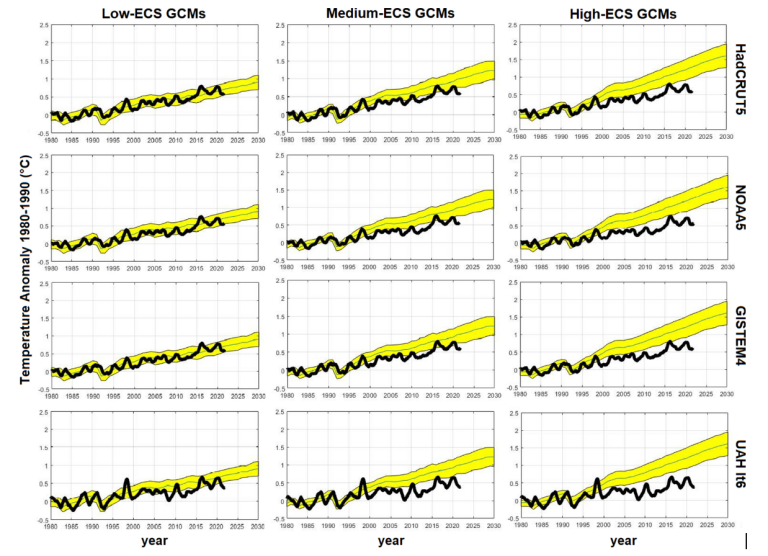
The paper’s key finding was that the vast majority of the simulations by the medium and high-ECS GCMs run too hot. From 1980–1990 to 2011–2021, only the simulation of the low ECS GCM group seems to have accurately predicted the warming shown by the surface-based records. For instance, while all temperature data show a warming below 0.6 °C, all GCM averages from the medium and high ECS group forecast a warming over 0.6 °C up to 1.3 °C. These are plainly visible in Figures 1 and 2.
Figure 1: GCM global surface temperature ensembles (yellow area, ±1σ) versus HadCRUT5 (infilled data), GISTEMP v4, NOAAGlobTemp v5, and UAH-MSU-lt v6 temperature records (black, 12-month moving average).
Figure 2: Average temperature changes (2011–2021 minus 1980–1990) hindcasted by 38 CMIP6 GCMs mean simulations. The blue vertical lines represent the temperature change measured by HadCRUT5 (infilled data), ERA5-T2m, GISTEMP v4, NOAAGlobTemp v5, and UAH-MSU-lt v6 temperature records.
If internal model variability is also considered, the conclusion remains unchanged because, as the research clearly shows, 95% and 97%, respectively, of the medium and high ECS ensemble member simulations run hotter than all temperature records. These findings are summarized in Figure 3.
Figure 3: Boxplots of the CMIP6 ensemble members for each CMIP6 GCM; # represents the number of the available simulations for each GCM. The horizontal blue lines represent the global surface warming from 1980–1990 to 2011–2021 reported by HadCRUT5 (infilled data), ERA5-T2m, GISTEMP v4, NOAAGlobTemp v5, and UAH-MSU-lt v6 temperature records, respectively.
Figures 1-3 make it abundantly evident that the warming hindcast by the GCM grows as the ECS increases and that only the low-ECS GCM group can be regarded as being consistent with the data. The research also demonstrates that the outcome holds true regardless of how statistically the internal variability of the models is modeled. Moreover, it is statistically insignificant that a small number of simulations of the medium and high ECS GCMs would seem to coincide with the evidence. Therefore, it follows that the actual ECS should be lower than 3 °C, as Lewis (2022) also found.
However, Figures 1-3 also show that if the actual warming from 1980-1990 to 2011-2021 is better represented by the UAH-MSU-lt v6 temperature record, also the low-ECS GCM would be running too hot. In fact, while the various available surface-based temperature records show a warming roughly ranging between 0.5 and 0.6 °C, the UAH-MSU-lt v6 temperature record show a warming of about 0.4 °C while the low-ECS GCMs show a warming of 0.6±0.1°C. It is worth mentioning that according to the GCMs, the troposphere should experience a greater warming trend than the surface (Mitchell et al., 2020) so that the UAH-MSU-lt v6 might even be overestimating the surface warming. The low-ECM GCMs would therefore need to be scaled down by roughly 33%, assuming that the warming of UAH-MSU-lt v6 is accurate and representative of the warming at the surface. This should imply that the actual ECS might likewise be between 1 and 2 °C.
Future warming would be moderate and not particularly concerning if the actual ECS was between 1.5 and 3.0°C. The IPCC’s predictions of future climate catastrophes if CO2 emissions are not severely cut to essentially zero would be unfounded if the actual ECS is considerably lower, which is 1-2°C. As a result, it’s critical to assess if a warming bias, as multiple studies have already revealed, may be affecting surface-based temperature data.
To check the last point, the work adds an extended section where the observed and GCM modelled warming over the land and over the ocean are compared. As a result, the land has warmed 2.0–2.3 times faster than the ocean according to surface-based temperature records, 1.5 times faster according to satellite-based temperature records, and somewhere in the middle according to the GCMs: 1.75±0.20. In addition, the surface-based temperature records over land show a warming that is around 0.4°C more than the satellite readings, whereas the surface-based temperature records over the ocean show a warming that is just slightly larger (up to 0.1°C) than the satellite observations. These results suggest that the warming reported by the surface-based temperature records, especially over land, is too large and incompatible both with the satellite measurements and the land/ocean ratio prediction of the models. These findings imply that the warming indicated by surface-based temperature records, particularly over land, is excessive and inconsistent with both satellite observations and theoretical model predictions of the land/ocean ratio.
Based on the aforementioned findings, it was determined that the surface-based temperature records may be at least 10% off when it comes to actual warming. By reducing the ECS of the low-ECS GCMs by 10%, the ECS range changes from 1.8-3.0°C to 1.6-2.7°C, which is in good agreement with Lewis’s conclusion (1.7-2.7 °C).
However, if the real warming is closer to that indicated by the UAH-MSU-lt v6 temperature record, or if the climate system is controlled by multidecadal and millennial natural oscillations that the GCMs are unable to replicate, it is possible that the ECS may be much lower (for example, 1-2°C). For example, Scafetta (2013, 2021b) deduced an ECS between 1.0 and 2.3 °C by assuming (solar-astronomically induced) natural climatic oscillations of quasi 20, 60, 115 and 1000 years, which are observed in many climatic data throughout the Holocene but not reproduced by the GCMs. The same result is obtain using solar records showing a large secular variability, while the GCMs use solar forcings taken from the solar proxy reconstructions that show the least secular variability (Connolly et al., 2021).
Because they imply that anthropogenic global warming for the upcoming decades will inevitably be moderate, the results by Scafetta (2022a) and Lewis (2022) cast serious doubts on climatic alarmism.
Bibliography
Connolly R, Soon W, Connolly M et al. (2021). How much has the Sun influenced Northern hemisphere temperature trends? An ongoing debate. Res Astron Astrophys 21:131. https://doi.org/10.1088/1674-4527/21/6/131
Lewis, N. (2022). Objectively combining climate sensitivity evidence. Climate Dynamics https://doi.org/10.1007/s00382-022-06468-x
Mitchell DM, Lo YTE, Seviour WJM, Haimberger L, Polvani LM (2020). The vertical profile of recent tropical temperature trends: persistent model biases in the context of internal variability. Environ Res Lett 15:1040b4. https://doi.org/10.1088/1748-9326/ab9af7
Scafetta N (2013). Discussion on climate oscillations: CMIP5 general circulation models versus a semiempirical harmonic model based on astronomical cycles. Earth Sci Rev 126:321–357. https://doi.org/10.1016/j.earscirev.2013.08.008
Scafetta N (2021a). Detection of non-climatic biases in land surface temperature records by comparing climatic data and their model simulations. Clim Dyn 56:2959–2982. https://doi.org/10.1007/s00382-021-05626-x
Scafetta N (2021b). Reconstruction of the interannual to millennial scale patterns of the global surface temperature. Atmosphere 12:147. https://doi.org/10.3390/atmos12020147
Scafetta, N. (2022a). CMIP6 GCM ensemble members versus global surface temperatures. Climate Dynamics. https://doi.org/10.1007/s00382-022-06493-w
Scafetta N (2022b). Advanced testing of low, medium, and high ECS CMIP6 GCM simulations versus ERA5-T2m. Geophys Res Lett 49:e2022GL097716. https://doi.org/10.1029/2022GL097716
The post Models versus global surface temperatures: ECS discussion appeared first on Clintel.