


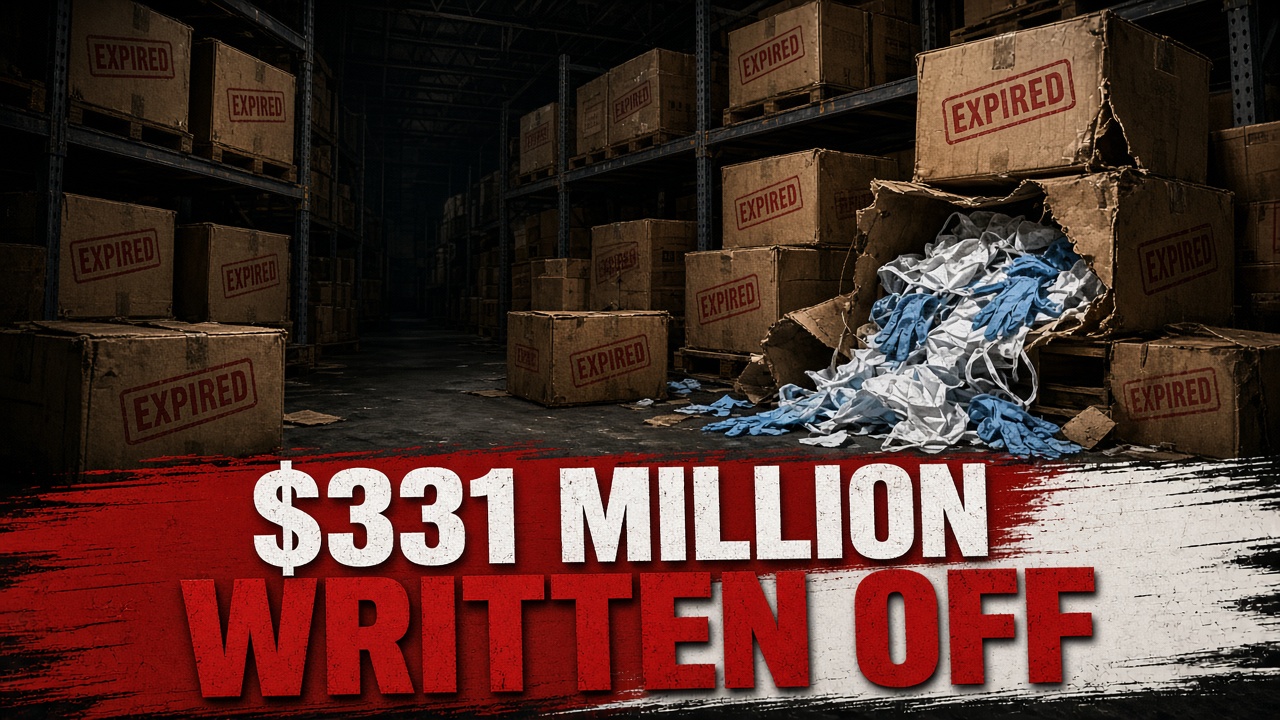
When the next pandemic, wildfire evacuation or mass-casualty event hits, provinces turn to one federal backstop: the National Emergency Strategic Stockpile. It’s supposed to be Canada’s insurance policy. According to the Auditor General, it’s being run like a forgotten storage locker.
In a report tabled in the House of Commons on October 29, Auditor General Karen Hogan concluded that the Public Health Agency of Canada “did not effectively manage” the stockpile and had “significant and persistent weaknesses” in how it ran it. The period audited runs straight through the Carney government’s watch, ending March 31, 2026.
A quarter of the stockpile, written off in one year
The most jaw-dropping figure is the loss. In the 2025–26 fiscal year, the agency wrote off $331 million in medical supplies because of expiry and damage. The audit describes that as about one quarter of the stockpile’s value, which fell from $1.27 billion on April 1, 2025, to $1.07 billion a year later.
Compare that to what actually went out the door to help people. Over the same year, the agency distributed just $27 million in supplies to provinces, territories and federal organizations. It wrote off more than twelve times what it handed out. As The Hill Times reported, the audit found persistent problems in both how Ottawa decides what to keep on hand and how those supplies are stored.
84 million expired items, and a billion more on the way
As of March 31, 2026, the stockpile held about 84 million expired items, 97% of them personal protective equipment, much of it bought during COVID-19. Simply storing that expired gear over the last two years cost taxpayers $6.3 million.
It gets worse. The Auditor General’s own data shows about 75% of the PPE inventory was set to expire by March 31, 2027, with expired units projected to climb past one billion. The audit found the agency “lacked a strategy to manage excess and expired inventory.” In plain terms, a mountain of masks and gloves was aging out, and there was no plan for it.
Way too much of some things, almost none of others
You might assume a stockpile that big would at least be full of the right things. It isn’t. The audit found the agency exceeded most of its own inventory targets for protective equipment and medical gear, sometimes absurdly:
- N95 respirators at 2,708% of target, or 162.5 million units against a goal of 6 million.
- Ventilators at 1,007% of target, or 10,679 units against a goal of 1,060.
- Gloves at 1,002% of target, or 942 million units.
Meanwhile, face shields sat at 0.12% of target: 1,200 units against a goal of 1 million.
And for whole categories, nobody had done the math at all. The agency did not conduct needs assessments or set inventory targets for any of the 15 types of social service supplies, such as cots and blankets, or for 80% of its medical equipment, such as defibrillators and ultrasound machines. Those are exactly the supplies an evacuation centre needs when a town burns.
$20 million in drugs thrown out over freezer problems they already knew about
The stockpile is the sole source of some specialized, hard-to-get drugs. So you’d expect the freezers to be the one thing that works. Instead, in 2025, more than $20 million in pharmaceuticals had to be discarded because of deficiencies including a lack of preventative freezer maintenance, insufficient freezer space and inadequate temperature monitoring. Warehouse staff also weren’t following procedures for repacking products.
Here’s the damning part: those deficiencies had been identified in 2022 and 2023. They weren’t fixed before the loss happened.
Five out of fourteen
This isn’t the first warning. After the Auditor General’s 2021 audit of PPE procurement, the agency drew up a stockpile management plan in 2024 with 14 actions to fix long-standing problems. As of March 2026, it had implemented 5 of them.
Hogan tied this directly to a pattern. In her opening statement to the Public Accounts committee, she said that for both the medical stockpile and military ammunition, “problems that had been identified through previous audits had not been fully addressed, raising concerns about preparedness for future needs.” The agency, she said, “did not know the types and quantities of many supplies it needed to respond to major public health events in the future.”
Credit where it’s due, and why it isn’t enough
To be fair, the audit found the agency did respond to all 81 requests for supplies it received from provinces, territories and federal organizations over the last two fiscal years. Front-line staff got things where they were asked to go.
But that’s the floor, not the ceiling. Hogan’s point was that “responding to immediate needs is important, but so is being prepared for future challenges.” A stockpile that answers routine requests while hundreds of millions of dollars rot on the shelves, with no targets for cots and defibrillators, is not ready for the big one.
Accepting recommendations isn’t a plan
The government’s answer is the same one it gives every audit. In a joint statement, Health Minister Marjorie Michel and four cabinet colleagues said “the Government accepts all the recommendations” and promised the agency would improve “documentation consistency, timeliness of corrective actions and performance measurement.” The same statement found room to call the stockpile’s request record “of great benefit to Canadians.” Not a word about the $331 million. Accepting recommendations costs nothing.
Mark Carney sold himself as the manager who would bring discipline to Ottawa’s spending. Yet on his watch, a public health agency wrote off a quarter of the national stockpile in a single year, threw out millions in drugs over freezer problems flagged years earlier, and finished barely a third of its own repair plan. Canadians paid for that insurance policy. They deserve a government that can tell them what’s actually in it.
Please consider helping!
Awake Freedom TV On Roku is Broken! 🙂
I could no longer maintain the costs on my own, so I moved the off of a dedicated server which was needed for the TV platform to work. On top of that, I want to build an app Awake Freedom TV app, for mobile phones. We need your help to first resurrect our TV channel, and then build the mobile app. In order to do that, I need a minimum of 800/month on subscription payments. Please help anyway you can with the form below.





Leave A Comment