


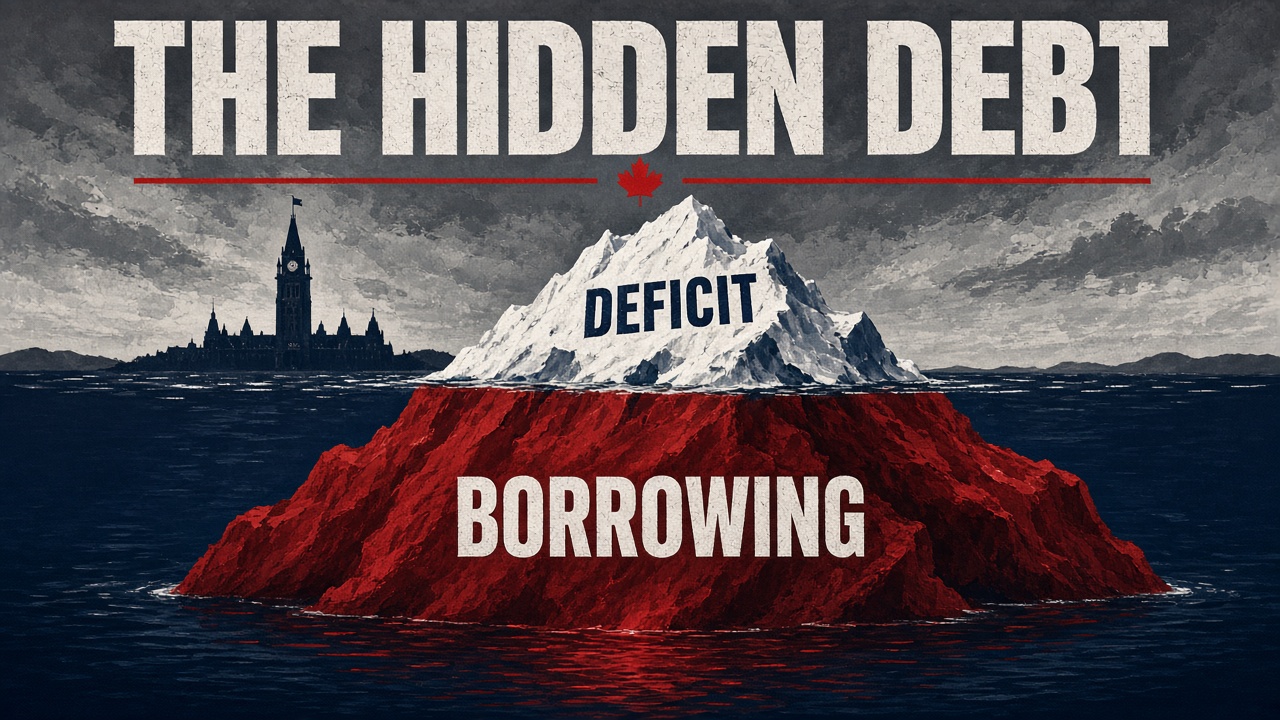
Mark Carney likes to talk about discipline. Two fiscal anchors, a balanced “operating budget,” spending less so Canada can invest more. On Tuesday, Parliament’s independent budget watchdog put a number on how much that discipline is actually worth, and it isn’t flattering.
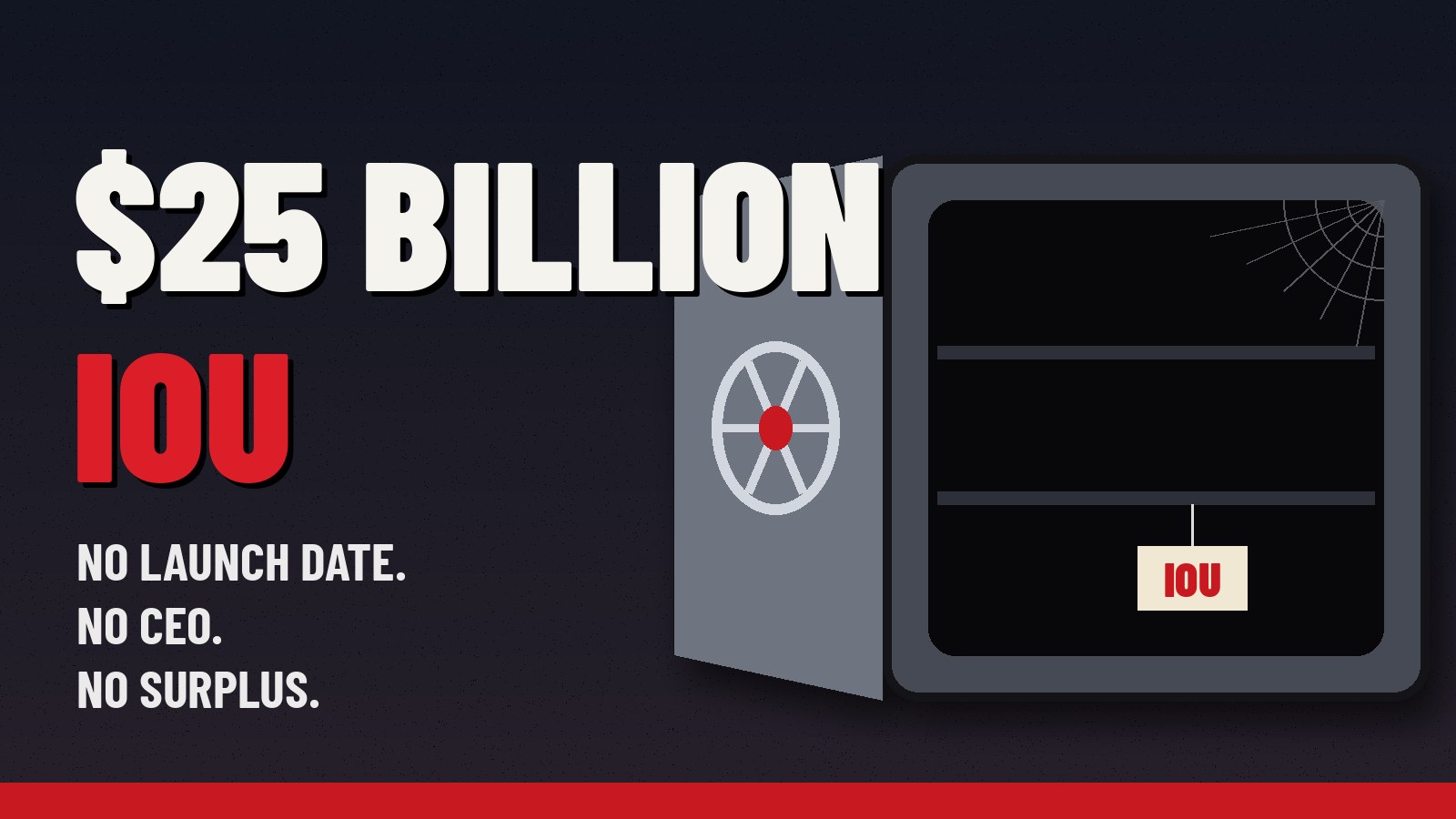
The Parliamentary Budget Officer’s Economic and Fiscal Outlook for October 2026 projects cumulative federal deficits of $333.3 billion over the next five years. Federal borrowing over the same five years? $732.9 billion. More than double.
That gap is the story the Liberals would rather you didn’t read.
How you borrow $733 billion and report $333 billion
The difference comes down to accounting. Under accrual rules, when Ottawa lends money to a Crown corporation, the loan is recorded as an asset, not an expense, so it doesn’t show up in the deficit. Big capital purchases, like military equipment, are paid for up front with borrowed money but only expensed slowly as they are amortized.
The cash still goes out the door. The debt is still real. The interest still gets paid. It just doesn’t land in the headline number politicians quote.
Parliamentary Budget Officer Annette Ryan didn’t mince words. “This obscures the realities of cash debt and raises questions about whether the current fiscal framework provides a complete and transparent picture of Canada’s fiscal sustainability,” she said, as reported by The Globe and Mail.
Governing through Crown corporations
This isn’t an accident of bookkeeping. It’s a choice about how to govern.
The Globe notes that under Carney, Ottawa has increasingly turned to Crown corporations to deliver its priorities: Build Canada Homes, the Canada Strong Fund, and the recently proposed Canadian Corporation for Defence Investment. Every one of those vehicles can be financed with borrowed money that sits outside the deficit Canadians hear about.
The PBO flags the risk directly. Loans and advances to enterprise Crown corporations reached $141.5 billion in 2025, nearly triple their 2016 level, exposing the federal balance sheet to credit, market and operational risk. And it offers a reminder of how these things go: the Trans Mountain Expansion Pipeline ultimately cost over $34 billion, more than six times the initial private sector estimate.
An anchor that doesn’t hold anything
Carney’s government set two fiscal anchors: balance day-to-day operating spending by 2028-29, and keep the deficit-to-GDP ratio falling.
The PBO says the second one fails. The deficit-to-GDP ratio is projected to rise in 2027-28 and again, marginally, in 2029-30. The watchdog also points out that, absent new measures announced since June, the ratio would have declined every year. In other words, the government’s own new spending is what breaks its own rule.
The first anchor survives, barely, and mostly because it is built to. Of the $52.6 billion in new measures announced since June, $43.8 billion, more than 80 per cent, is classified as capital and therefore excluded from the operating balance entirely. The PBO’s verdict on both anchors: they “have imposed limited fiscal discipline on government spending and borrowing.”
Even the near-balance in 2027-28 leans on tariff countermeasure revenue, which the PBO assumes will bring in $5.3 billion that year. Without it, the operating deficit would be $5.6 billion.
The windfall that vanished
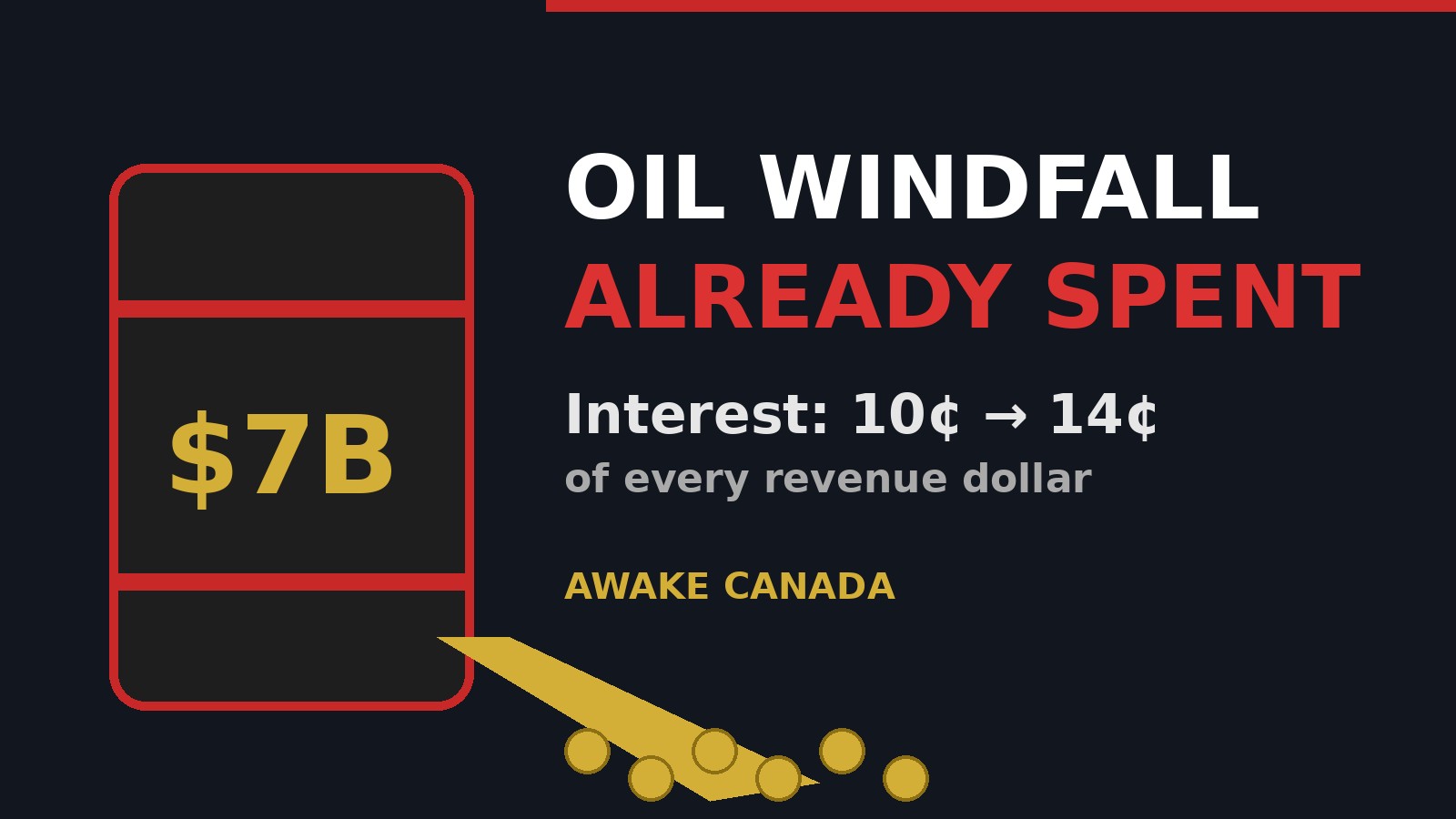
This should have been a good-news report for Ottawa. Higher oil and commodity prices pushed up nominal GDP and revenues, giving the government $37.4 billion in extra fiscal room over five years compared with June.
New measures announced since then cost $52.6 billion over the same period. The single biggest item, the Productivity Mega Deduction, accounts for $36 billion on its own and was announced outside the normal budget cycle. The result: deficits are $3.0 billion higher per year on average than the PBO projected in June, staying above $63 billion through 2030-31 and peaking at $70.2 billion in 2027-28.
Meanwhile the real economy is weakening. The PBO cut its real growth forecast to 0.9 per cent for 2026 and 1.5 per cent for 2027, citing U.S. tariffs and Canadian countermeasures. Higher revenue came from higher prices, not from a stronger economy, and the PBO expects that energy boost to fade after 2027.
Who pays
Interest. Public debt charges are the fastest-growing expense in the federal budget, according to the PBO. They more than doubled from $24.5 billion in 2021-22 to $59.3 billion in 2026-27, and are projected to hit $83.0 billion by 2030-31.
Per person, that is $1,419 in debt charges this year, rising to $1,952 by 2030-31. Federal debt per Canadian is projected to climb from $33,436 this year to $39,191 by 2030-31. By then, 13.6 per cent of every federal revenue dollar is projected to go to debt service, up from 10.5 per cent in 2025-26.
And the PBO’s outlook doesn’t even include Canada’s NATO commitment to reach 5 per cent of GDP on defence by 2035, which the watchdog estimates could require core defence spending of $163.6 billion by 2035-36.
The bottom line
The PBO has said for a while that the debt-to-GDP ratio is the real test of fiscal health. The IMF has recommended Ottawa make it the primary anchor again. Carney’s government has declined, choosing a framework that lets debt-to-GDP rise from 40.8 per cent to 42.6 per cent over the forecast.
A former central banker should know better than anyone that markets, and taxpayers, eventually look at cash, not labels. Moving borrowing into Crown corporations and calling spending “capital” doesn’t make the debt smaller. It just makes it harder to see.
Budget 2026 is expected soon. Canadians should judge it on one number above all: how much Ottawa plans to borrow. Not how much it says it will lose.
Please consider helping!
Awake Freedom TV On Roku is Broken! 🙂
I could no longer maintain the costs on my own, so I moved the off of a dedicated server which was needed for the TV platform to work. On top of that, I want to build an app Awake Freedom TV app, for mobile phones. We need your help to first resurrect our TV channel, and then build the mobile app. In order to do that, I need a minimum of 800/month on subscription payments. Please help anyway you can with the form below.


Leave A Comment