


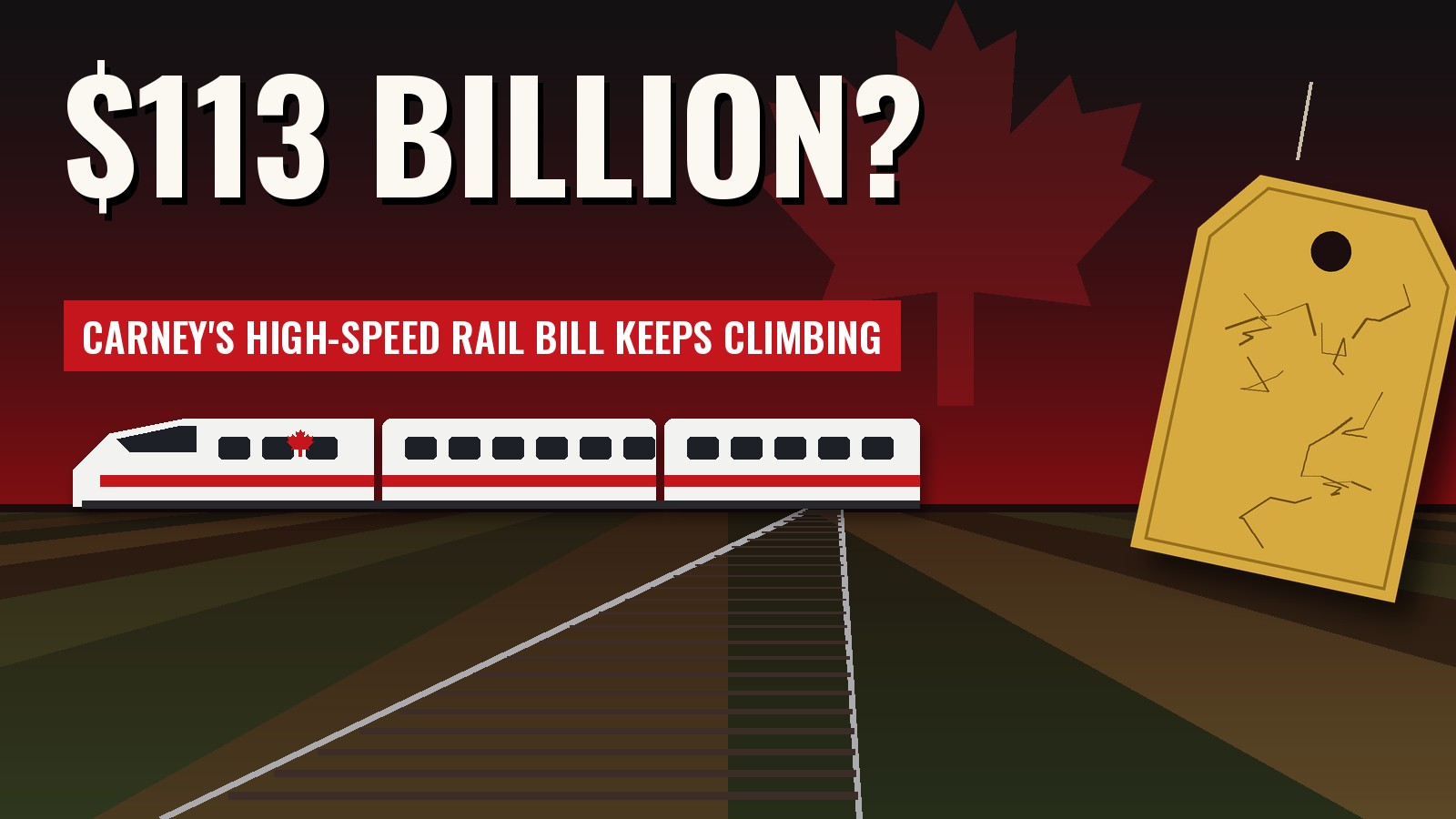
Mark Carney’s government likes to sell Alto, the proposed high-speed rail line between Toronto and Quebec City, as a nation-building project. Fast trains, shorter trips, a modern Canada.
What it hasn’t been able to sell is a credible price tag. And now Parliament’s own budget watchdog has put a number on the table that should worry every taxpayer: as much as $113 billion.
The Watchdog’s Number Is Bigger Than Ottawa’s
On October 1, the Parliamentary Budget Officer released a cost analysis of the Alto corridor, prepared at the request of the Senate finance committee. Using data from 94 high-speed rail projects around the world, the PBO estimated the baseline route would cost between $75 billion and $113 billion to build (in 2024 dollars).
The government’s own preliminary estimate was $60 billion to $90 billion, as the PBO’s news release notes. That means the watchdog’s high-end figure sits $23 billion above Ottawa’s own high end, and its low-end figure is $15 billion above the government’s.
That’s before anyone has broken ground. According to CBC News, construction isn’t expected to begin until 2030.
And It Could Get Worse
The PBO’s range already leans toward overruns, and the report spells out several ways the bill could climb even higher:
- Every year of delay adds about $1.5 billion. The PBO found that each later start year is associated with roughly $1.5 billion in higher costs.
- Tunnels are expensive. Each additional kilometre of tunnel adds an estimated $169 million, and each kilometre of elevated track adds about $153 million. BNN Bloomberg reports that a proposed 15-kilometre tunnel into Montreal is among the biggest risks.
- The Canadian Shield is hard ground. Building between Ottawa and Peterborough through difficult terrain could drive costs up further.
- Kingston isn’t even in the number. The analysis excludes the potential Kingston stop. BNN Bloomberg reports that if that change becomes part of the final plan, costs are expected to rise.
The estimate also covers construction only. It doesn’t include what it will cost to run the trains once they exist.
Canada Has the Wrong Track Record for This
Here’s the part of the report that should end any talk of “it’ll come in on budget.” The PBO looked at high-speed rail around the world and found that projects in the United Kingdom and the United States generally cost much more than those in continental Europe and often ran far over budget.
Then it drew the obvious conclusion: “Given the institutional similarities between the U.K., U.S. and Canada, an HSR project in Canada may be at risk of similar cost escalation pressures. Construction costs for certain infrastructure projects in Canada have been observed to rise at a faster rate than in comparator countries.”
In plain terms, the watchdog is warning that Canada builds big projects more like Britain and America than like continental Europe, and those are exactly the places where high-speed rail budgets have tended to balloon.
The PBO even judged that, because this is a new build for Canada, “the risk is more likely that the project will go over budget rather than under.”
Rural Canadians Are Being Asked to Pay Twice
The money is only half the problem. The route would cut through farmland in eastern Ontario and Quebec, and the government has admitted it won’t rely only on willing sellers.
Transport Minister Steven MacKinnon said the government’s “obvious preference” is to buy land from willing sellers but that it will have to expropriate property from owners in some cases, CBC reported.
The backlash is real. The Canadian Press, via The Trillium, reported that farmers, municipalities and landowners have taken their protests to the lawn of Parliament Hill. In July, 11 eastern Ontario MPPs put out a statement saying, “In the case of Alto, too many questions remain unanswered. Too many voices have been ignored.” In Quebec, hundreds gathered in Rigaud to push back, with strong support from the farming community.
So rural residents may lose their land, and they’ll also help pay for a megaproject whose cost estimate keeps creeping upward.
Ottawa’s Answer Is a Feeling, Not a Plan
How has the government responded to the watchdog’s warning? With sentiment.
MacKinnon told reporters: “I’m very confident as we move on — not that there won’t be controversy, not that there won’t be concerns, of course — but that this is a project that makes Canadians dream, that will improve their life.”
Canadians don’t need to dream. They need to know what this will cost, who will pay for overruns, and whose farms will be taken to build it. The PBO’s report gives the opposite of reassurance: a wide cost range, a long list of risks that push it higher, and a warning that countries like ours tend to blow their budgets.
Conservative transport critic Dan Albas, quoted by CBC News, put it bluntly: Alto “will come late, go over budget and leave taxpayers stuck with the bill, if it even gets built at all.”
The Bottom Line
A government that claims to be disciplined with money would treat the PBO’s report as a stop sign: pause, publish a full business case, and prove the numbers before committing billions more. Instead, the Carney government is pressing ahead on confidence and slogans while the price estimate climbs past $100 billion.
If Ottawa can’t tell Canadians what Alto will really cost before construction starts, Canadians have every reason to doubt it will be any more honest once the overruns begin.
Please consider helping!
Awake Freedom TV On Roku is Broken! 🙂

I could no longer maintain the costs on my own, so I moved the off of a dedicated server which was needed for the TV platform to work. On top of that, I want to build an app Awake Freedom TV app, for mobile phones. We need your help to first resurrect our TV channel, and then build the mobile app. In order to do that, I need a minimum of 800/month on subscription payments. Please help anyway you can with the form below.

Leave A Comment