


COP31: After 31 Climate Summits, Failure Is Always an Option
COP31 didn’t merely fail to produce an agreement. After 31 meetings, it provided a remarkably clear demonstration of the futility of the entire exercise, says Anthony Watts.

An absolute classic: CO2 concentration in the atmosphere versus COPs
Anthony Watts
Date: 27 November 2026
After two weeks of climate urgency speeches, warnings, negotiations, protests, draft agreements, revised draft agreements, and more than two days of overtime, COP31 ended in Antalya, Turkey, without an overarching agreement. Nearly 200 countries couldn’t agree on the central issue supposedly bringing them together in the first place: fossil fuels. If the purpose of these annual United Nations climate conferences is to demonstrate a unified global commitment to transforming the world’s energy system, COP31 demonstrated precisely the opposite.
Even The New York Times couldn’t sugarcoat the outcome. Its headline read, “U.N. Climate Talks Collapse in a Bitter Clash Over Fossil Fuels.” The NYT reported that the negotiations broke down with no final agreement after tensions paralyzed the talks. European nations and smaller countries demanding stronger climate action rejected the proposed agreement, while Saudi Arabia, Russia, and other fossil fuel-producing nations resisted language calling for a transition away from coal, oil, and natural gas.
That is quite a result for the 31st annual Conference of the Parties.
The failure was historically unusual. COP31 was the first UN climate summit since COP15 in Copenhagen in 2009 to fail to adopt a final consensus agreement. Negotiators spent two days beyond the scheduled conclusion trying to find language everyone could tolerate. Flights were rebooked. Closed-door meetings dragged on. Diplomats bargained through the night. COP31 eventually became the longest UN climate summit on record.
And after all that, they couldn’t agree to say “fossil fuels.”
Only 14 percent
The failure was telegraphed before negotiations even got serious. The heads of state or government of the world’s five largest carbon dioxide emitters, China, the United States, India, Russia, and Japan, didn’t attend the leaders’ summit. According to The Guardian’s analysis, countries whose national leaders attended represented just 14 percent of global carbon dioxide emissions. Only two of the world’s 10 largest emitters, Saudi Arabia and Iran, were represented by their national leaders. Think about what that says.
For decades, we have been told climate change is an existential crisis requiring immediate, coordinated global action. Yet when the world’s leaders had an opportunity to demonstrate that urgency, the leaders representing the vast majority of global emissions had more important things to do. Their negotiating delegations may have been present, but their leaders weren’t. That is hardly the picture of a world mobilizing to confront an imminent planetary emergency. Then things got worse.
Before COP31 collapsed, climate activist organization 350.org complained that the near-final draft had eliminated all language about transitioning away from fossil fuels. Not weakened it. Not postponed the deadline. Eliminated it. The organization called the development an “outrage” and complained that the summit was sidelining efforts to phase out coal, oil, and natural gas.
This wasn’t climate skeptics mocking the process from outside. These were climate activists inside the tent admitting that the central objective of decades of climate diplomacy had effectively disappeared from the document.
A later draft still failed to mention fossil fuels. The European Union, United Kingdom, Panama, vulnerable island nations, and others refused to accept it. Ireland’s climate minister Darragh O’Brien, speaking for the European Union, said it was “unconscionable” to have a climate pact that didn’t mention fossil fuels. So there was no pact.
There is a larger lesson here that climate activists and much of the media seem reluctant to acknowledge. Fossil fuels aren’t some optional accessories that governments can eliminate with the stroke of a diplomatic pen. Coal, oil, and natural gas remain deeply embedded in transportation, electricity generation, agriculture, manufacturing, fertilizer production, construction, and modern living standards. Developing countries need affordable and reliable energy to grow. Industrialized nations need it to maintain their economies. Governments ultimately must answer to citizens who care about electricity bills, gasoline prices, food prices, jobs, and whether the lights stay on.
That reality eventually walks into every COP conference, no matter how much rhetoric precedes it.
Irony
The irony is that just days before COP31 collapsed, The New York Times was telling readers that “shocking” signs of climate change were adding urgency to the negotiations. Yet the countries doing the negotiating apparently couldn’t translate that alleged urgency into a consensus agreement. If the climate warning lights were flashing as brightly as the NYT claimed, the people sitting around the negotiating table certainly had an odd way of demonstrating it.
But perhaps the clearest measure of the futility of the entire COP process comes not from what happened inside the conference hall, but from a simple atmospheric carbon dioxide graph maintained by the National Oceanic and Atmospheric Administration.
The first COP was held in Berlin in 1995. At that time, NOAA’s global atmospheric carbon dioxide record stood at about 360 parts per million. Thirty-one COP conferences later, the 2025 global annual average exceeded 425 ppm, an increase of roughly 18 percent. NOAA’s 2026 measurements show atmospheric CO2 continuing to rise.
Look at the graph. There is no COP effect visible in it.

Global monthly mean CO2. Credit: NOAA Global Monitoring Laboratory, public domain. gml.noaa.gov/ccgg/trend
None of the meetings bent the curve downward. Copenhagen didn’t bend it. Paris didn’t bend it. Glasgow didn’t bend it. Dubai didn’t bend it. Thirty-one conferences, decades of negotiations, countless pledges, carbon targets, climate funds, emissions promises, and untold thousands of international flights later, atmospheric carbon dioxide has continued its remarkably steady climb. That spectacular decades-long failure seems to redefine what “net zero” might actually mean for climate.
That doesn’t mean individual countries have made no changes to their energy systems. They have. But judged by the very metric these conferences were created to influence, the concentration of carbon dioxide accumulating in Earth’s atmosphere, the global result is unmistakable. The line keeps going up.
That should raise an obvious question: What exactly are these conferences accomplishing?
Apollo 13
Thirty-one COP conferences have now come and gone. Tens of thousands of delegates have flown around the world. Countless speeches have been delivered, communiqués issued, deadlines announced, targets revised, and predictions of catastrophe repeated. Yet atmospheric CO2 is substantially higher than when the process began. The world’s largest emitters increasingly don’t bother sending their leaders, and COP31 couldn’t even produce an overarching agreement mentioning the fuel sources it has spent three decades trying to eliminate.
At some point, failure stops being a temporary setback and becomes the defining characteristic of the process. It’s like an antithetical version of the famous line from Apollo 13: Failure is ALWAYS an option.
Perhaps it is time to recognize that the problem isn’t that the world hasn’t heard the climate message. It has heard it, repeatedly, for more than three decades. Governments have simply discovered that when climate rhetoric collides with energy security, economic development, affordability, and political electability, reality usually wins.
COP31 didn’t merely fail to produce an agreement. After 31 meetings, it provided a remarkably clear demonstration of the futility of the entire exercise.
The delegates can issue declarations. They can set targets. They can hold another COP next year and start the process all over again. But the atmosphere doesn’t read press releases. The planet doesn’t care, and judging by COP31, increasingly, neither do they.
This article was first published on wattsupwiththat on 25 November 2026.

Anthony Watts
Anthony Watts is a senior fellow for environment and climate at The Heartland Institute. Watts has been in the weather business both in front of, and behind the camera as an on-air television meteorologist since 1978, and currently does daily radio forecasts. He has created weather graphics presentation systems for television, specialized weather instrumentation, as well as co-authored peer-reviewed papers on climate issues. He operates the most viewed website in the world on climate, the award-winning website wattsupwiththat.com.
The article you have just read was made possible by our donors.
Every day, Clintel publishes articles on climate, energy and science. We also translate and share international analyses in multiple languages, produce videos, publish reports and organize conferences and events around the world.
We receive no government funding and rely entirely on the support of our donors. Your support helps us promote independent research and contribute to a more open and balanced debate on climate and energy issues.
Would you like to support our work? Choose the option that suits you best:
• Become a Friend of Clintel – support us with an annual contribution
• Make a recurring donation – provide ongoing support and help us plan ahead
• Make a one-time donation – every contribution helps
Thank you for your support.

more news
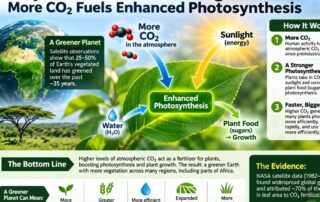
The Economist Acknowledges Benefits of CO2!
The Economist deserves credit for its recent article, which acknowledges that portions of Africa long predicted to suffer relentless desertification due to climate change are becoming wetter and greener, instead. It is refreshing to see a major publication acknowledge correctly that climate change and rising atmospheric carbon dioxide produce benefits for plant life and ecosystems, says Anthony Watts.

COP31 Collides with Dangerous New “Stop Fossil Fuel” Movement
The Transitioning Away from Fossil Fuels (TAFF) movement is now firmly established as a major and dangerous force in international climate policy, says David Wojick.

COP31 Ends in a Trainwreck
For the first time in years there was no final agreement to announce at the end of a COP meeting. Jo Nova reflects on the failure of COP31. “The UN plan to advertise and promote more Chinese wind and solar products isn’t working this week.”
The post COP31: After 31 Climate Summits, Failure Is Always an Option appeared first on Clintel.
Please consider helping!
Awake Freedom TV On Roku is Broken! 🙂

I could no longer maintain the costs on my own, so I moved the off of a dedicated server which was needed for the TV platform to work. On top of that, I want to build an app Awake Freedom TV app, for mobile phones. We need your help to first resurrect our TV channel, and then build the mobile app. In order to do that, I need a minimum of 800/month on subscription payments. Please help anyway you can with the form below.

Leave A Comment