


Climate Change Is an Effect, Not a Cause!
Dr. John Robson of Climate Discussion Nexus argues that one of the most persistent errors in the climate debate is also one of the simplest: confusing cause and effect. Historian Robson says the phrase “climate change” is routinely presented as if it were an active force causing rising temperatures, extreme weather, droughts, wildfires and even economic problems. But logically, he argues, climate change cannot be the cause of these phenomena because the term itself describes the changes that are supposedly being caused.

Dr. John Robson
Clintel Foundation
Date: 29 November 2026
“Climate change is not a cause, it’s an effect,” John Robson says in a recent presentation for Climate Discussion Nexus. It is a statistical description of changes in weather patterns occurring somewhere, over a period of at least 30 years. Those changes, he argues, must themselves have causes. Climate change therefore cannot logically be invoked as the cause of climate change.
You can see the entire presentation below:
Robson compares this to inflation. Inflation does not cause prices to rise; rather, it describes a situation in which prices are rising, presumably because of underlying causes. Similarly, blaming rising temperatures on climate change would be like saying that a teenager’s growth spurt caused the teenager to become taller. The growth spurt describes the growth; it does not explain what caused it.
He points to numerous examples in the media where, in his view, this distinction is routinely ignored. Statements that “climate change” is making extreme heat more common, intensifying wildfires or causing drought effectively turn a description into an agent. Robson argues that if temperatures are rising, that warming is itself an example of climate change. It cannot simultaneously be the result of climate change.
Unified force
The problem becomes even clearer, he says, when climate change is personified as a single, unified force. Robson depicts this as a kind of invisible “troll” that supposedly moves through the world, causing different and sometimes contradictory changes. Egypt becoming drier centuries ago, the end of the last ice age and Britain becoming wetter today can all technically be described as climate changes, he notes, but they are obviously not one single phenomenon acting as a causal agent.
This confusion also obscures the actual scientific questions that should be debated. Robson says that if advocates instead argued that rising atmospheric CO2 is causing temperatures to rise, that would constitute a clear causal claim that could be examined using evidence and competing explanations. Likewise, one could debate whether warming causes particular changes in storms, droughts or other weather patterns, and how large those effects might be.
But saying that society must “stop climate change” is, in his view, fundamentally different. Climate has always changed, and preventing all changes in weather is neither physically possible nor even necessarily desirable. Some changes could conceivably make conditions better in particular places.
Robson therefore says he is not denying that climate changes, nor is he necessarily denying particular causal relationships involving CO2. His objection is primarily logical and linguistic: observed changes should not themselves be treated as the explanation for those changes.
His conclusion is a call for greater precision in the climate debate. Rather than blaming an amorphous “climate change” for every undesirable development, he argues, scientists, journalists and policymakers should identify specific causes and mechanisms and then test those claims against evidence. As he puts it, the debate should begin by “stop calling effect cause and start doing actual science.”
The article you have just read was made possible by our donors.
Every day, Clintel publishes articles on climate, energy and science. We also translate and share international analyses in multiple languages, produce videos, publish reports and organize conferences and events around the world.
We receive no government funding and rely entirely on the support of our donors. Your support helps us promote independent research and contribute to a more open and balanced debate on climate and energy issues.
Would you like to support our work? Choose the option that suits you best:
• Become a Friend of Clintel – support us with an annual contribution
• Make a recurring donation – provide ongoing support and help us plan ahead
• Make a one-time donation – every contribution helps
Thank you for your support.
more news

Wind Turbines Now Kill 1.5 Million Bats Annually in the US
New evidence suggests American bat fatalities following collisions with wind turbine blades have reached a number comparable to the extinction-level impact of white-nose disease, says Chris Morrison. Where are the Greens?

COP31: After 31 Climate Summits, Failure Is Always an Option
COP31 didn’t merely fail to produce an agreement. After 31 meetings, it provided a remarkably clear demonstration of the futility of the entire exercise, says Anthony Watts.
The Economist Acknowledges Benefits of CO2!
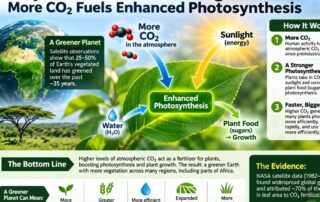
The Economist deserves credit for its recent article, which acknowledges that portions of Africa long predicted to suffer relentless desertification due to climate change are becoming wetter and greener, instead. It is refreshing to see a major publication acknowledge correctly that climate change and rising atmospheric carbon dioxide produce benefits for plant life and ecosystems, says Anthony Watts.
The post Climate Change Is an Effect, Not a Cause! appeared first on Clintel.
Please consider helping!
Awake Freedom TV On Roku is Broken! 🙂
I could no longer maintain the costs on my own, so I moved the off of a dedicated server which was needed for the TV platform to work. On top of that, I want to build an app Awake Freedom TV app, for mobile phones. We need your help to first resurrect our TV channel, and then build the mobile app. In order to do that, I need a minimum of 800/month on subscription payments. Please help anyway you can with the form below.

Leave A Comment