


Imagine your household gets an unexpected bonus: a big jump in income you never planned for. The sensible move is obvious. You pay down the credit card. The Carney government got exactly that kind of bonus this year. Then it turned around and spent it.
That is the real story of Budget 2026, which Finance Minister François-Philippe Champagne tabled on Thursday, November 5 under the title “Masters of our Destiny.” Strip away the slogans and the numbers tell a simple tale: Ottawa caught a break, and chose to keep borrowing anyway.
The windfall
Last spring, the government’s own Spring Economic Update projected a $66.9 billion deficit for 2025-26. According to the budget, the year actually closed at about $39.3 billion, roughly $27.6 billion better than forecast. Higher oil prices, stronger income tax revenue and lower-than-planned spending did the heavy lifting. iPolitics reported the improvement at $27.6 billion, and said Finance Canada expects the better outlook to lower deficits by $21.5 billion to $38.3 billion a year going forward.
That is real money. It could have meant a much smaller deficit and a real path back toward balance.
Where it went
Instead, CBC News reports the budget announced $142 billion in new measures, on top of $9.5 billion announced since the spring update. In CBC’s words, the Liberals “have largely opted to put that money back into the economy.”
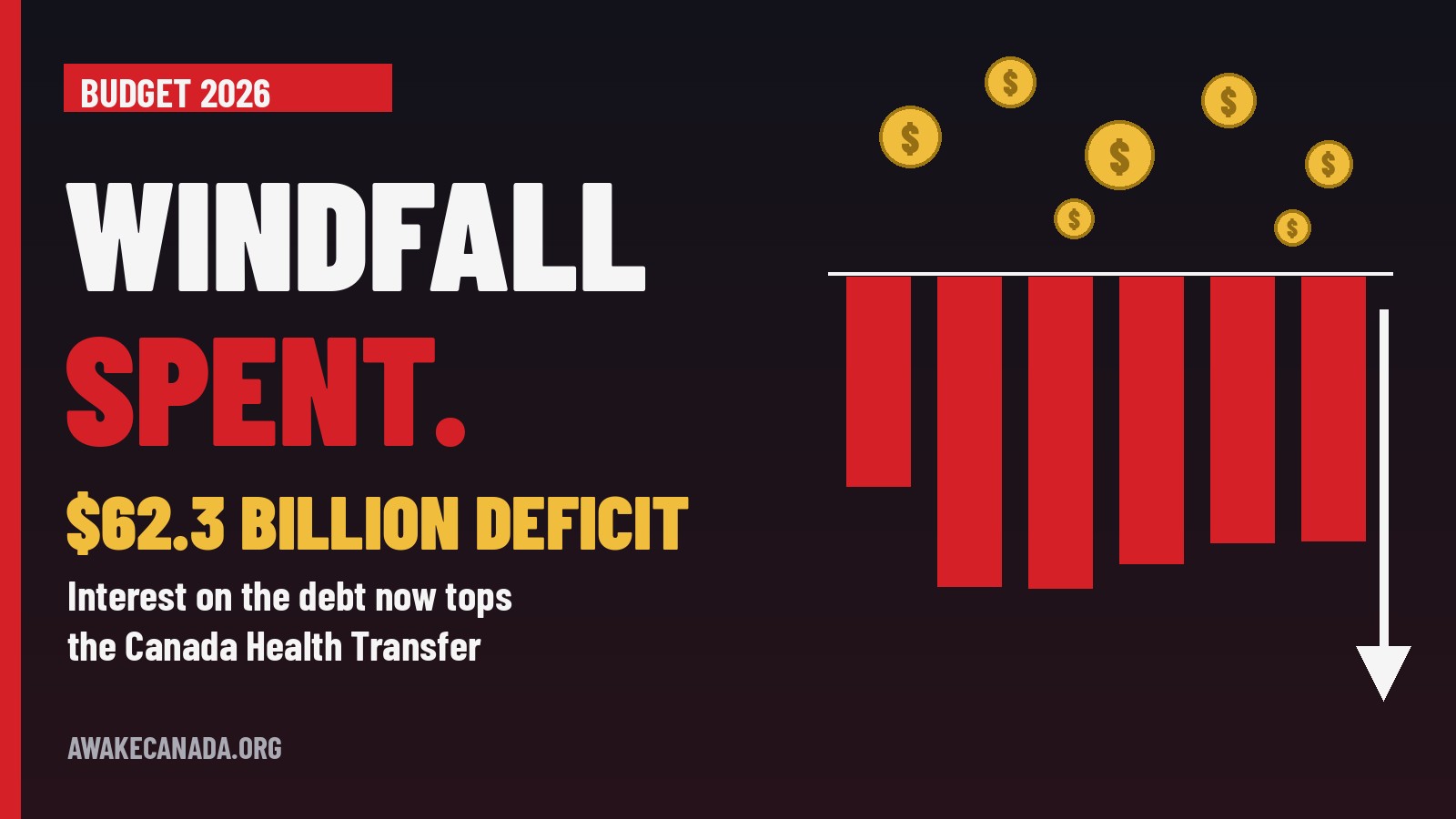
The budget’s own tables show what that choice costs. In Table A1.4, Finance Canada shows that before any new policy decisions, the 2026-27 deficit would have been $43.8 billion. After the government’s new measures and other policy actions, it is $62.3 billion. In other words, about $18.4 billion of this year’s red ink is a deliberate choice made by this government.
Over five years, the pattern holds. RBC Economics titled its analysis “Windfall fuels spending, not savings,” and calculated that $158 billion in positive economic and fiscal developments from 2026-27 onward is matched by $152 billion in new spending. Nearly every dollar of good luck has already been spoken for.
Deficits as far as the eye can see
The budget does not project a balanced budget at any point. Its own summary table shows deficits of $62.3 billion this year, $62.5 billion next year, then $57.6 billion, $53.4 billion and $52.9 billion by 2030-31.
The Vancouver Sun reported that this year’s $62.3 billion deficit would be the largest in Canadian history in a non-pandemic year. And it is not a deficit caused by a recession. The private-sector forecast the budget is built on assumes the economy keeps growing every year of the plan.
Federal debt, by the budget’s count, rises from about $1.31 trillion in 2025-26 to about $1.59 trillion in 2030-31. That is nearly $287 billion more in five years. RBC calculates Ottawa’s total five-year financial requirement, the cash it needs to raise, at about $765 billion.
Interest now beats health care
Here is the number every Canadian should remember. The budget projects $60.2 billion in public debt charges this year. That is more than the $57.4 billion Ottawa will send the provinces through the Canada Health Transfer.
It gets worse. Debt charges are forecast to climb to $85.5 billion by 2030-31. CBC notes they will account for nearly 13 per cent of government spending by 2031. iPolitics reported that Champagne himself acknowledged interest on the debt is the “single biggest” area of spending growth in the budget.
Every one of those dollars buys nothing. Not a hospital bed, not a soldier, not a tax cut. It just pays the bondholders.
The “savings” that are not cuts
The government will point to restraint. Look closely at what that restraint actually is. The budget lowers its forecast of direct program spending by about $12.4 billion a year. But the budget document itself admits this is “an aggregate forecasting adjustment” that “is not attributed to particular departments, programs, or policy decisions, and it does not change approved funding.”
That is not cutting waste. It is assuming money won’t get spent as fast as planned. RBC notes the adjustment is “pitched as a permanent downward adjustment.” If departments spend what they have been approved to spend, those “savings” disappear.
RBC also found that half of the budget’s roughly $150 billion in new measures is day-to-day spending, not long-term capital investment. That cuts against the government’s pitch that this is mostly about building.
To be fair
The government can point to some real positives. Federal debt is projected to stay around 40 per cent of GDP, and the budget says day-to-day operating spending will be balanced by revenue in 2027-28, a year ahead of its own target. The deficit as a share of the economy is projected to shrink slowly.
But those targets were designed by the same government that is grading itself on them. A debt ratio that only holds steady because oil is trading near US$100 a barrel is not a plan. It is a bet. Economists quoted by the Vancouver Sun warn that oil prices may fall and that the income tax surge is likely temporary.
The bottom line
Before the budget, Champagne told a business crowd, “The market has seen we have the fiscal discipline.” Discipline is what you show when you get a windfall and use it to pay down what you owe. Mark Carney was sold to Canadians as the grown-up economist who would fix the books. Given the best fiscal luck in years, his government spent it, and left our kids a bigger bill.
Canadians deserve better than another budget that treats borrowed money like free money.
Please consider helping!
Awake Freedom TV On Roku is Broken! 🙂

I could no longer maintain the costs on my own, so I moved the off of a dedicated server which was needed for the TV platform to work. On top of that, I want to build an app Awake Freedom TV app, for mobile phones. We need your help to first resurrect our TV channel, and then build the mobile app. In order to do that, I need a minimum of 800/month on subscription payments. Please help anyway you can with the form below.

Leave A Comment