


ICSF/Clintel lecture by Lars Schernikau: Wind and Solar Cannot Power Europe
Europe is facing a growing energy challenge that cannot be solved by simply adding more wind and solar power, said energy economist Lars Schernikau in his recent ICSF/Clintel lecture. “Germany could see serious power shortages before the end of the decade.”


The ‘energy recipe’ according to Lars Schernikau
Clintel Foundation
Date: 20 September 2026
In his ICSF/Clintel-lecture, energy economist Lars Schernikau argued that Europe’s electricity system is already struggling to provide sufficient reliable generating capacity, while demand is likely to increase substantially in the coming decades. Germany, he suggested, provides a particularly revealing example: after spending more than €1 trillion on its energy transition, the country is now openly acknowledging that it does not have enough reliable generation capacity.
You can see the entire presentation by Schernikau below:
Schernikau began by pointing to a statement made by Germany’s chancellor Merz in January 2026 that the country simply did not have sufficient electricity-generation capacity. According to Schernikau, discussions involving Germany’s Federal Network Agency indicate that an additional 25–35 GW of dispatchable power-plant capacity may be required within the next five to ten years. He questioned whether Germany could realistically build such capacity within that timeframe, noting that the country had taken 25 years to complete Berlin’s airport.
For Schernikau, the problem is not opposition to technological progress or economic development. Rather, it is that an advanced industrial society needs reliable electricity whenever it is required. “I simply assumed it would include having the lights on literally,” he said, warning that Germany could face serious power shortages before the end of the decade.
Rising demand in an increasingly electrified economy
Schernikau argues that the debate about Europe’s future electricity supply must begin with demand rather than with the preferred technologies for producing electricity. He expects total energy demand to rise by roughly 40% over the next 25 years. At the same time, new sources of demand are emerging rapidly, most notably artificial intelligence and the data centres required to run it.
According to the figures Schernikau presented, global AI-related data-centre electricity consumption could increase several-fold over the next five years. He described AI as essentially an energy-intensive activity: the more computing capacity society wants, the more electricity it needs. This creates an important contradiction for a European energy strategy that simultaneously seeks rapid electrification and a reduction in dispatchable generation capacity.
Schernikau’s central argument is that wind and solar have three inherent characteristics that make them unsuitable as the backbone of a modern electricity system: relatively low energy density, intermittency and shorter asset lifetimes.
The problem of energy density
The first issue is energy density. Wind and sunlight provide energy that is widely dispersed across large areas. Collecting sufficient quantities therefore requires substantial physical infrastructure. Schernikau stressed that technological improvements can make turbines and solar panels more efficient at capturing available energy, but cannot fundamentally alter the amount of solar radiation or wind energy available at a particular location.
This, he argued, creates a physical constraint rather than a political one. “There’s only so much energy coming down per square meter from the sun or from the wind that we can use,” he explained.
The consequences are particularly significant because electricity demand must be met continuously. A power system cannot simply compare the annual electricity produced by wind or solar with annual demand; it must also be capable of meeting demand during periods when renewable output is low.
Intermittency and the enormous storage requirement
Schernikau devoted much of his presentation to the consequences of intermittency. Solar power, for example, produces electricity during daylight hours but not at night, while wind generation varies according to weather conditions. Even in areas with favourable conditions, the natural capacity factor of solar and wind remains substantially below that of dispatchable thermal generation.
In Germany, Schernikau cited a natural solar capacity factor of around 10%. This means that a very large amount of installed capacity is required to generate sufficient electricity over time. Storage then has to be added to shift electricity from periods of high production to periods of low production.
Batteries, he argued, involve substantial losses, while hydrogen-based storage involves even greater energy losses. Once storage requirements are incorporated, the amount of generation capacity required to guarantee electricity during prolonged periods of low renewable output becomes extremely large.
This is particularly problematic because the electricity system must be designed for the worst periods, not the average ones. Schernikau presented German data showing that during every month of the previous six years there had been periods of approximately 12 hours in which wind and solar generation was practically zero. Consequently, even a system with very large installed renewable capacity would still require other forms of generation or very substantial storage.
Capacity is not the same as reliable power
This distinction between installed capacity and reliable capacity was central to Schernikau’s argument. Germany has installed more than 200 GW of wind and solar capacity, while peak electricity demand is only around 80 GW. At first glance, that might suggest that Germany has more than enough generation capacity.
But installed capacity is not equivalent to electricity that can be delivered when required. Schernikau argued that dispatchable generation remains indispensable because electricity demand must be met at every moment, including during periods of low wind and solar output.
He contrasted Germany with China and the United States. China has enormous amounts of wind and solar capacity but also maintains a large dispatchable generation fleet. The United States, meanwhile, has a substantially larger reserve margin and a much smaller share of wind and solar in its total generating capacity. Schernikau linked this difference to electricity-system costs and argued that adding increasing quantities of intermittent generation can raise rather than lower the overall cost of maintaining a reliable system.
Why more wind and solar can increase costs
Schernikau’s third fundamental objection concerns economics. Replacing a conventional power plant with wind and solar does not, in his view, mean replacing one asset with another equivalent asset. Instead, it requires a much larger and more complex system.
In his description, a conventional generating plant is effectively replaced by wind and solar capacity, batteries, long-duration storage such as hydrogen, backup generation and an expanded transmission and grid infrastructure. The resulting system therefore contains several additional layers that all have to be financed and maintained.
“Show me anyone who can tell me this is going to be cheaper,” Schernikau challenged his audience.
He argued that the economics become progressively less favourable as the penetration of wind and solar increases. Each additional gigawatt provides less useful additional electricity during periods when renewable generation is already abundant, while backup capacity becomes less heavily utilized. At the same time, the market value of renewable electricity can decline as more identical generation enters the market.
Schernikau cited German data indicating that the capture rate of wind power has fallen to around 80% of the average electricity price, while solar has fallen to around 50%. In other words, the electricity produced by these technologies increasingly tends to arrive at times when electricity is relatively abundant and therefore less valuable.
The overlooked cost of short lifetimes
The third physical characteristic Schernikau emphasized was the lifetime of the infrastructure. Wind turbines and solar installations, he argued, generally have much shorter useful lifetimes than conventional power plants. Whereas coal, gas and nuclear plants can potentially operate for several decades, wind and solar assets require replacement much sooner.
This means that, over the lifetime of an electricity system, renewable infrastructure may have to be built and rebuilt several times. Schernikau linked this directly to the additional consumption of raw materials and energy required to manufacture the equipment.
He also highlighted the industrial supply chains behind solar panels, including the large quantities of energy and carbon required to produce high-purity silicon. In his view, describing the resulting system simply as “carbon-free” obscures the energy and material inputs needed to construct it.
Germany as a warning
Schernikau returned repeatedly to Germany as a case study. He argued that the country’s energy transition has reduced dispatchable capacity while increasing dependence on gas. The combination of reduced nuclear and coal generation and continued reliance on intermittent renewable sources, he said, has left Germany increasingly exposed to shortages and high costs.
He also pointed to German industrial companies that have publicly cited energy prices, energy security and related factors when reducing operations or considering moving production elsewhere. For Schernikau, this is evidence of a broader risk of de-industrialization if electricity becomes both expensive and unreliable.
What should replace the current strategy?
Despite his criticism, Schernikau did not end his presentation with a call to abandon technological development. On the contrary, he argued for a new energy revolution based on research and development.
He identified nuclear energy, fusion, geothermal energy and potentially new technologies that have yet to be discovered as possible components of the long-term future. In the meantime, however, he argued that Europe should maintain and improve its existing conventional generation fleet rather than prematurely abandoning it.
“We will not combust coal, oil, and gas forever in the same way we do today,” Schernikau said. The goal, in his view, should be to develop cleaner, more efficient and more energy-dense ways of producing electricity.
His immediate policy prescription is therefore twofold: increase investment in energy R&D while maintaining sufficient dispatchable generation to guarantee reliability. He also argued that wind and solar should be charged for their full system costs, including storage, backup generation and grid requirements, rather than receiving subsidies that obscure those costs.
The underlying message of Schernikau’s presentation was that Europe cannot solve its energy problem by looking only at the amount of renewable electricity generated over a year. The decisive questions, he argued, are whether electricity is available when needed, how much infrastructure and storage are required to guarantee that availability, and what the complete system ultimately costs. Until new technologies can provide abundant and reliable energy at scale, he believes Europe will continue to need conventional and nuclear generation alongside whatever contribution wind and solar can economically provide.
The article you have just read was made possible by our donors.
Every day, Clintel publishes articles on climate, energy and science. We also translate and share international analyses in multiple languages, produce videos, publish reports and organize conferences and events around the world.
We receive no government funding and rely entirely on the support of our donors. Your support helps us promote independent research and contribute to a more open and balanced debate on climate and energy issues.
Would you like to support our work? Choose the option that suits you best:
• Become a Friend of Clintel – support us with an annual contribution
• Make a recurring donation – provide ongoing support and help us plan ahead
• Make a one-time donation – every contribution helps
Thank you for your support.

more news

Lucy Biggers: How I Became a Biased Climate Reporter
As a young journalist, Lucy Biggers wanted to do good but gradually lost confidence in her own judgment. She now describes how group pressure, guilt and fear of exclusion shaped her climate reporting.
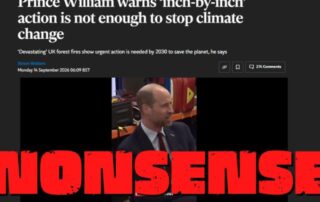
Prince William is Wrong: Sweeping Climate Action Will Only Harm People
Prince William is behind the curve when it comes to climate change. He is also very misinformed about the history of European and global wildfire occurrences, says Linnea Lueken.

OECD and Brussels Still Want Banks to Pick ‘Climate Winners’
The OECD is risking US wrath by pushing ahead with green finance initiatives despite Washington calling time on Net Zero, says Tilak Doshi. Its new report on climate regulation has Brussels’s fingerprints all over it.
The post ICSF/Clintel lecture by Lars Schernikau: Wind and Solar Cannot Power Europe appeared first on Clintel.
Please consider helping!
Awake Freedom TV On Roku is Broken! 🙂

I could no longer maintain the costs on my own, so I moved the off of a dedicated server which was needed for the TV platform to work. On top of that, I want to build an app Awake Freedom TV app, for mobile phones. We need your help to first resurrect our TV channel, and then build the mobile app. In order to do that, I need a minimum of 800/month on subscription payments. Please help anyway you can with the form below.

Leave A Comment