Deployable Energy’s new compact nuclear reactor
The American company Deployable Energy has developed a compact nuclear reactor in a very short space of time. Energy and climate expert Andy May is enthusiastic about it.

The entire reactor fits onto the flatbed of a Ford F150 pickup. Source: Deployable Energy.
Andy May
Date: 24 August 2026
I first read about Deployable Energy on Joanne Nova’s website and was very interested in their innovative small modular nuclear reactor and how it worked. The reactor was produced under President Trump’s 2025 nuclear reactor plan. It was designed by Australian Bobby Gallagher and his team in Houston. It can produce one megawatt of power, at a cost of 15 cents per kilowatt hour, for five years before refuelling is required.
Pickup
The entire reactor can fit on the bed of a Ford F150 pickup, as shown in the photo. More importantly, it can be manufactured in a factory, fits into one 20-foot shipping container, uses the existing conventional supply chain, and requires no exotic custom-made components.

The first Deployable Energy reactor on its way to Idaho National Laboratory for testing
The advantages are obvious, the reactor has less than a six-month lead time, it is transportable by rail, ship, conventional trucks, and normal logistics. It fits on an ordinary slab or other small structure and can be easily installed with off-the-shelf plumbing and wiring. It is cooled with either helium or water, or the excess heat can be used for additional power generation. It has inherent safety and security and does not require full-time monitoring; it is walk-away safe. The fuel is standard 4.95% enriched uranium oxide; that must be replaced every five years at a current cost of $1.3 million. The fuel is well below weapons grade and is readily available.
Tests
In the photo you can see Deployable Energy’s first reactor being trucked to Idaho National Laboratory to be tested. Their reactor first went critical on June 30, 2026. They recently signed a billion dollar contract for three GW of cumulative clean nuclear power deployments with Gridmarket.
What is truly amazing is the company built its first reactor and brought it online in 150 days and did it all with less than $10 million in private funding. They did this by utilizing low enriched uranium-235 (<5%), standard manufactured components, and mass manufacturing processes. Their original design was elegant and beautiful, but required a lot of exotic components and materials so it was abandoned. They quickly realized that the design was not scalable or economic. They redesigned it to use off-the-shelf readily available components wherever possible. Their goal was to make nuclear a commodity product; they needed a mass-producible reactor.
Help
Gallagher admits that without the considerable help he received from Chris Wright and the Department of Energy he and his team could never have accomplished what they did. I was surprised to see the government and government employees helping him, as opposed to fighting against him.
Their next steps are to complete the full suite of required tests of their reactor and staff up for manufacturing. They also need a factory, and they are looking at several possible building locations in Texas. They also plan to build similar special reactors for ships and hope to become the first manufacturer of commercial maritime nuclear power plants. Their plants are ideal for critical infrastructure, like data centres, military installations, or hospitals.
Gallagher mentions in his interview on the Oilfield 360 interview that both China and Russia are building small reactors and have contracts to provide them around the world, in the USA we have none. China and Russia are leading today, and the USA has done nothing so far in the commercial nuclear space.
Additional resources and videos:
This article was published first on wattsupwiththat.com on 21 August 2026.

Andy May
Andy May is a retired petrophysicist and has published six books. He worked on oil, gas and CO2 fields in the USA, Argentina, Brazil, Indonesia, Thailand, China, UK North Sea, Canada, Mexico, Venezuela and Russia. He specialized in shale petrophysics, fractured reservoirs, wireline and core image interpretation, and capillary pressure analysis, besides conventional log analysis. His full resume is here: AndyMay
The article you have just read was made possible by our donors.
Every day, Clintel publishes articles on climate, energy and science. We also translate and share international analyses in multiple languages, produce videos, publish reports and organize conferences and events around the world.
We receive no government funding and rely entirely on the support of our donors. Your support helps us promote independent research and contribute to a more open and balanced debate on climate and energy issues.
Would you like to support our work? Choose the option that suits you best:
• Become a Friend of Clintel – support us with an annual contribution
• Make a recurring donation – provide ongoing support and help us plan ahead
• Make a one-time donation – every contribution helps
Thank you for your support.
more news

The Energy Nobody Counts
We spend a great deal of time discussing how much energy our electricity systems can “produce” but far less attention is given to a different question: how much energy does it take to build them in the first place? Energy expert dr. Lars Schernikau explains why this is important.

“Svensmark’s research must continue”
Henrik Svensmark has lost his position at the Technical University of Denmark (DTU), and the research field he helped establish is being significantly downgraded. Now private donors, companies, philanthropic foundations and research funders around the world have an opportunity to demonstrate whether they genuinely support scientific freedom – including research where the politically convenient answer is not known in advance, says Karl Iver Dahl-Madsen.

How Roger Pielke Jr. Became Voldemort in Climate Science
Climate scientist and public-policy scholar Roger Pielke Jr. argues that the climate debate has become increasingly detached from the underlying evidence. In a wide-ranging interview on the Love Journalism show, Pielke discussed extreme weather, climate scenarios, decarbonisation, energy policy, political polarisation, journalism and his transition from academia to becoming one of Substack’s most widely read climate writers.
The post Deployable Energy’s new compact nuclear reactor appeared first on Clintel.
Please consider helping!
Awake Freedom TV On Roku is Broken! 🙂
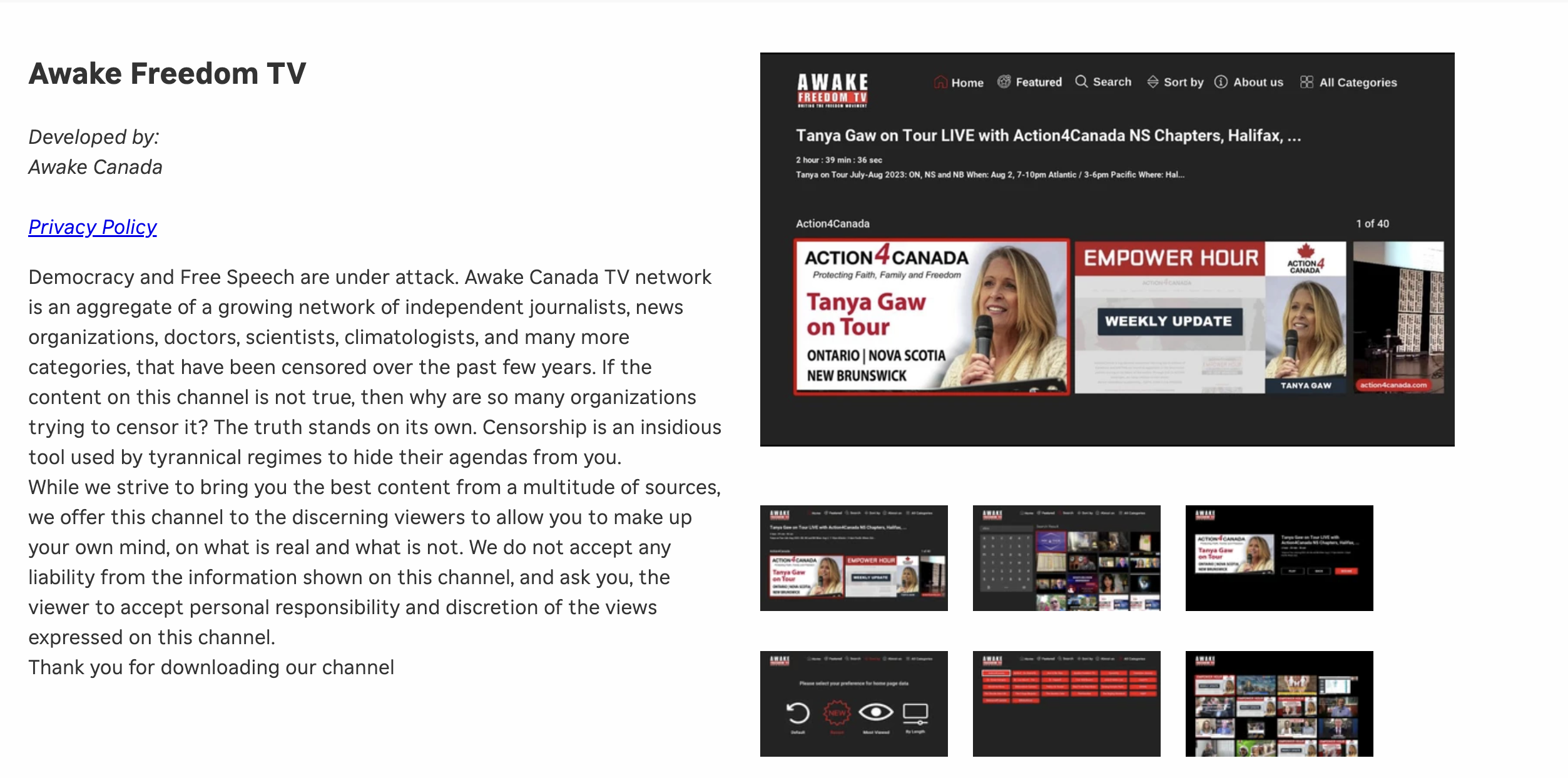
I could no longer maintain the costs on my own, so I moved the off of a dedicated server which was needed for the TV platform to work. On top of that, I want to build an app Awake Freedom TV app, for mobile phones. We need your help to first resurrect our TV channel, and then build the mobile app. In order to do that, I need a minimum of 800/month on subscription payments. Please help anyway you can with the form below.