



Tune in tonight on Danielle Smitth’s Social Media as she addresses major concerns to Albertans. She is making a commitment to stop the Federal Governments immigration policies to keep on burdening the Alberta Social Care systems and cost of living.
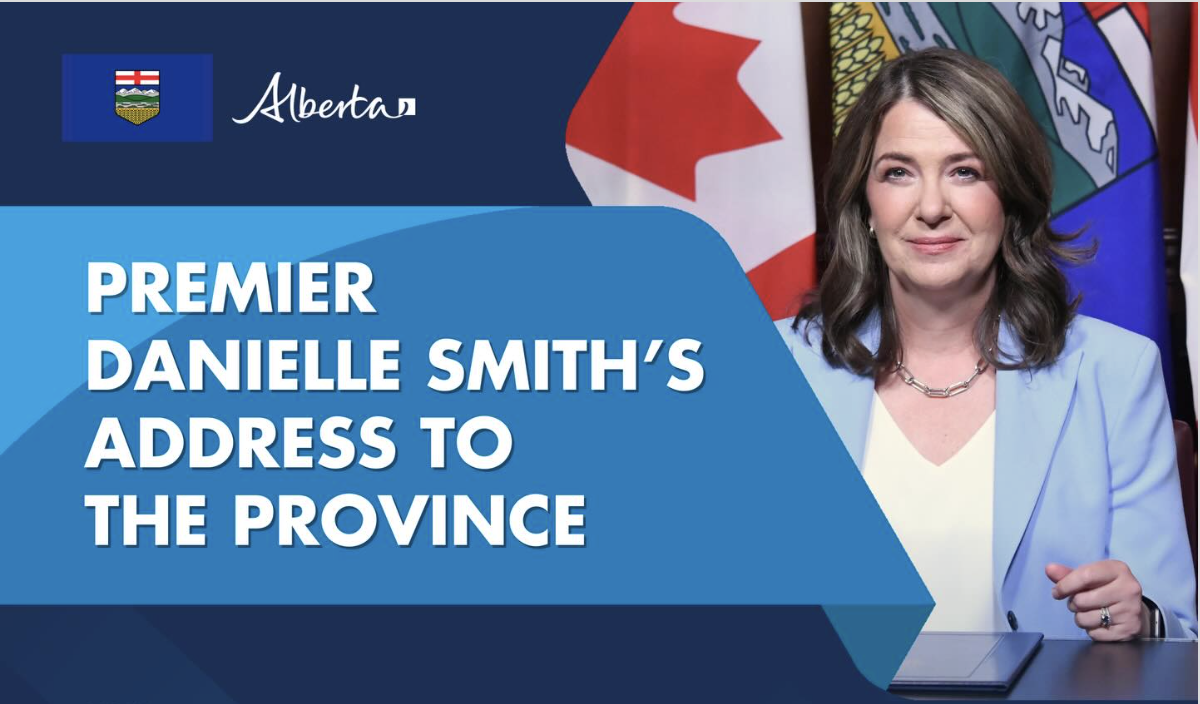
Danielle Smith assumed office as Alberta’s 19th Premier on October 11, 2022, after winning the United Conservative Party leadership race on a platform centered on “Alberta First.” A former talk-radio host and Wildrose Party leader, Smith campaigned on confronting what she described as federal overreach from Ottawa, particularly in energy, resources, and provincial jurisdiction. Her agenda promised to restore Alberta’s autonomy within Confederation, treating the province as a “nation within a nation” akin to Quebec’s approach to self-governance. Central to this was the Alberta Sovereignty Within a United Canada Act—her signature policy—and a broader push to assert provincial rights in areas Ottawa had increasingly regulated. Over three-plus years, Smith’s government has used legislative tools, resolutions, and policy directives to advance this vision. Most recently, amid record population growth driven largely by immigration, she has signaled and directed steps to ensure essential services and economic opportunities prioritize long-term Albertans and taxpayers.
The Cornerstone: Enacting the Alberta Sovereignty Act
Smith’s first major act as Premier fulfilled a core campaign pledge. On November 29, 2022—the opening day of the legislative session—she introduced Bill 1, the Alberta Sovereignty Within a United Canada Act. The bill passed third reading on December 8, 2022, and received royal assent on December 15 after the Lieutenant Governor reviewed its constitutionality.
The Act’s purpose is explicit: to shield Alberta from federal laws or policies deemed unconstitutional, violative of the Charter of Rights and Freedoms, or harmful to the province’s economic prosperity or Albertans’ interests. It targets areas of clear provincial jurisdiction under Section 92 of the Constitution Act, 1867—natural resources, health, education, property, and civil rights—while explicitly rejecting separatism. Smith framed it as a “reset” in federal-provincial relations, allowing Alberta to opt out of enforcement where Ottawa oversteps, much like other provinces have asserted rights on specific issues.
This completely negates the false claims by Mainstream Media that Danielle Smith supports Alberta Separatism. She is shielding us from Federal Overreach and constitutional breaches that this Liberal Goverment of Canada is becoming all too well known to do. Remember, the Liberal Party of Canada was found guilty of the illegal use of the emergency act back during the freedom convoy. It is a surprise that they have not been found guilty of violating charter or bill of rights in their unlawful and unscientific covid 19 policies, that caused substantial harms across the board to citizens of Canada in hardship, financial losses, body injury, and death by mandating untested, and now proven harmful mrna jabs. Shielding Albertans from the federal government makes her, and Alberta the best province in Canada to live in, explaining why more Canadians are moving to Alberta than any other province.
Key provisions include:
- A legislative resolution process: Cabinet can table a motion identifying a specific federal measure as problematic. After debate and a free vote, passage triggers directives.
- Directives to “provincial entities” (municipalities, health authorities, school boards, post-secondary institutions, police, and grant recipients) to cease enforcement or compliance. Think of the unlawful bills censoring free speech, and the most recent unlawful gun grab.
- Safeguards added during debate: Removed initial “Henry VIII” powers that would have let cabinet rewrite laws unilaterally; measures now require legislative approval and expire after two years unless renewed.
The bill faced intense opposition. NDP Leader Rachel Notley chronic alcoholic called it destabilizing. Legal experts raised constitutionality concerns over division of powers. Indigenous leaders from Treaties 6, 7, and 8 criticized the lack of consultation. A Leger poll showed divided public opinion (32% support, 42% oppose). Yet it passed along party lines, becoming law and establishing a formal mechanism for provincial resistance.
Putting Sovereignty into Practice: The First Invocation and Ongoing Federal Pushback
The Act was not symbolic. On November 27, 2023, Smith’s government invoked it for the first time. A resolution declared the federal government’s clean electricity regulations—requiring a net-zero emissions power grid by 2035—unconstitutional and harmful to Alberta. The move aimed to protect the province’s ability to rely on natural gas and existing coal-to-gas transitions for reliable, affordable power, shielding utilities and ratepayers from what the government called Ottawa’s unrealistic timeline that ignored Alberta’s energy reality and grid needs.
This invocation set a precedent: the legislature opined on the federal policy’s flaws, opening the door for directives to provincial entities. It underscored Smith’s broader energy-sovereignty stance—defending Alberta’s oil, gas, and power sector against policies she argues threaten jobs, investment, and energy security. The government has similarly challenged or resisted federal moves on carbon pricing mechanisms, impact assessments (Bill C-69), and firearms regulations through other means, using the Act’s framework as a deterrent and negotiating tool.
Beyond the Act, Smith’s premiership has included symbolic and practical steps toward greater autonomy. These include establishing Alberta’s first international trade office in Abu Dhabi (announced 2025) to diversify markets independent of federal trade priorities, and launching the Alberta Next panel in 2025 to gather public input on federal-provincial frustrations. In May 2025, following the federal election, Smith indicated support for a citizen-triggered referendum process on separation (lowering thresholds), though she has consistently positioned herself as pro-Canada while advocating stronger provincial powers.
Critics argue these moves risk uncertainty for investment and intergovernmental cooperation. Supporters credit them with forcing Ottawa to negotiate and signaling that Alberta will no longer accept unilateral federal dictates on its economic backbone—energy and resources.
The New Frontier: Immigration Control and Prioritizing Albertans for Essential Services
By early 2026, Smith’s sovereignty agenda expanded to a domain provinces have long influenced but rarely fully controlled: immigration selection. Alberta has experienced explosive population growth—adding roughly 600,000 people in the last four years, the fastest rate in Canada—driven overwhelmingly by international migration and temporary foreign workers. This has coincided with strains on housing affordability, healthcare wait times, school capacity, and provincial finances, especially as oil prices have softened and expenses outpaced revenue growth.
In her most recent directive—outlined in a mandate letter to Jobs, Economy, Trade and Immigration Minister Joseph Schow—Smith instructed the minister to “use all legal means possible” to increase Alberta’s control over immigration levels and selection, aiming for sustainable inflows. The explicit goal: “Our provincial immigration levels and policies should always ensure that Canadian citizens have first access to job opportunities, and that young Canadians are not losing out on employment opportunities to temporary foreign workers.” Schow echoed this, noting the federal system has produced growth that outstrips infrastructure in schools, hospitals, and services.
Speaking ahead of her province-wide televised address on February 20, 2026 (preceding the February 26 budget), Smith sharpened the message:
- “You have to be a taxpayer before you start using our services and we’ve had the reverse. We’ve had people who are heavy, heavy users of our services, and might not even be a taxpayer, might not even have job prospects. We’ve got to get back to the original intention.”
- She called current immigration “out of balance,” advocating that “at least two-thirds of newcomers should be economic migrants” who arrive with a job lined up.
- Rapid growth is “not sustainable,” she said, and will prompt “the conversation with Albertans about what needs to happen next.”
This builds on earlier statements, including a December 2025 video where she declared, “We need an immigration policy that puts Albertans first.” The approach draws explicitly from Quebec’s 1991 immigration accord, which gives that province significant say over economic-class selection. Alberta already nominates candidates through the Alberta Immigrant Nominee Program (roughly 6,400 spots this year, down from prior highs), but Smith seeks to expand provincial leverage over criteria—language, occupations, work experience—to align inflows with labour-market needs and infrastructure capacity.
The policy explicitly prioritizes:
- Jobs and economic opportunities: Canadian citizens and long-term residents first, reducing competition from temporary foreign workers for entry-level and youth positions.
- Essential services: By “right-sizing” growth, the province aims to catch up on investments in housing, healthcare, education, and infrastructure before adding further pressure.
- Economic contribution: Shifting toward migrants who arrive employed and taxable, rather than relying on federal streams that have produced high service usage without immediate fiscal offset.
No sweeping new legislation has been tabled yet—the address and upcoming budget will likely flesh out details—but the directive and public comments mark a clear assertion of provincial sovereignty in an area where Ottawa holds primary constitutional authority over admission, while provinces manage settlement and can influence selection via agreements.
Looking Ahead: Sovereignty as Self-Determination
Danielle Smith’s record since 2022 reflects a consistent philosophy: Alberta should exercise maximum control over decisions affecting its economy, resources, and people. The Sovereignty Act provided the legal architecture to challenge federal intrusions in energy and beyond. Its first use protected power reliability against aggressive net-zero timelines. Broader actions have reinforced “Alberta First” in trade and public consultation.
The latest focus on immigration extends this logic to demographic and service sustainability. With 600,000 new residents in four years straining budgets and infrastructure at a time of revenue volatility, Smith argues that unchecked federal policy undermines the province’s ability to deliver for existing Albertans. By pushing for greater provincial say—prioritizing taxpayers, workers already here, and economic contributors—she aims to ensure essential services remain accessible and affordable without perpetual catch-up.
Whether these steps yield negotiated gains with Ottawa, court-tested boundaries, or simply political momentum remains to be seen. What is clear is Smith’s framing: sovereignty is not abstract constitutional theory but practical self-determination—securing Alberta’s energy future, defending its jurisdictional lanes, and now safeguarding housing, healthcare, and jobs for the people who built and sustain the province. As she prepares her pre-budget address and tables Budget 2026, Albertans will hear how this vision translates into concrete next steps. For a province long frustrated by perceived federal imbalance, these accomplishments and announcements represent a deliberate, ongoing project to rebalance power within Canada.
Please consider helping!
Awake Freedom TV On Roku is Broken! 🙂

I could no longer maintain the costs on my own, so I moved the off of a dedicated server which was needed for the TV platform to work. On top of that, I want to build an app Awake Freedom TV app, for mobile phones. We need your help to first resurrect our TV channel, and then build the mobile app. In order to do that, I need a minimum of 800/month on subscription payments. Please help anyway you can with the form below.







Leave A Comment