


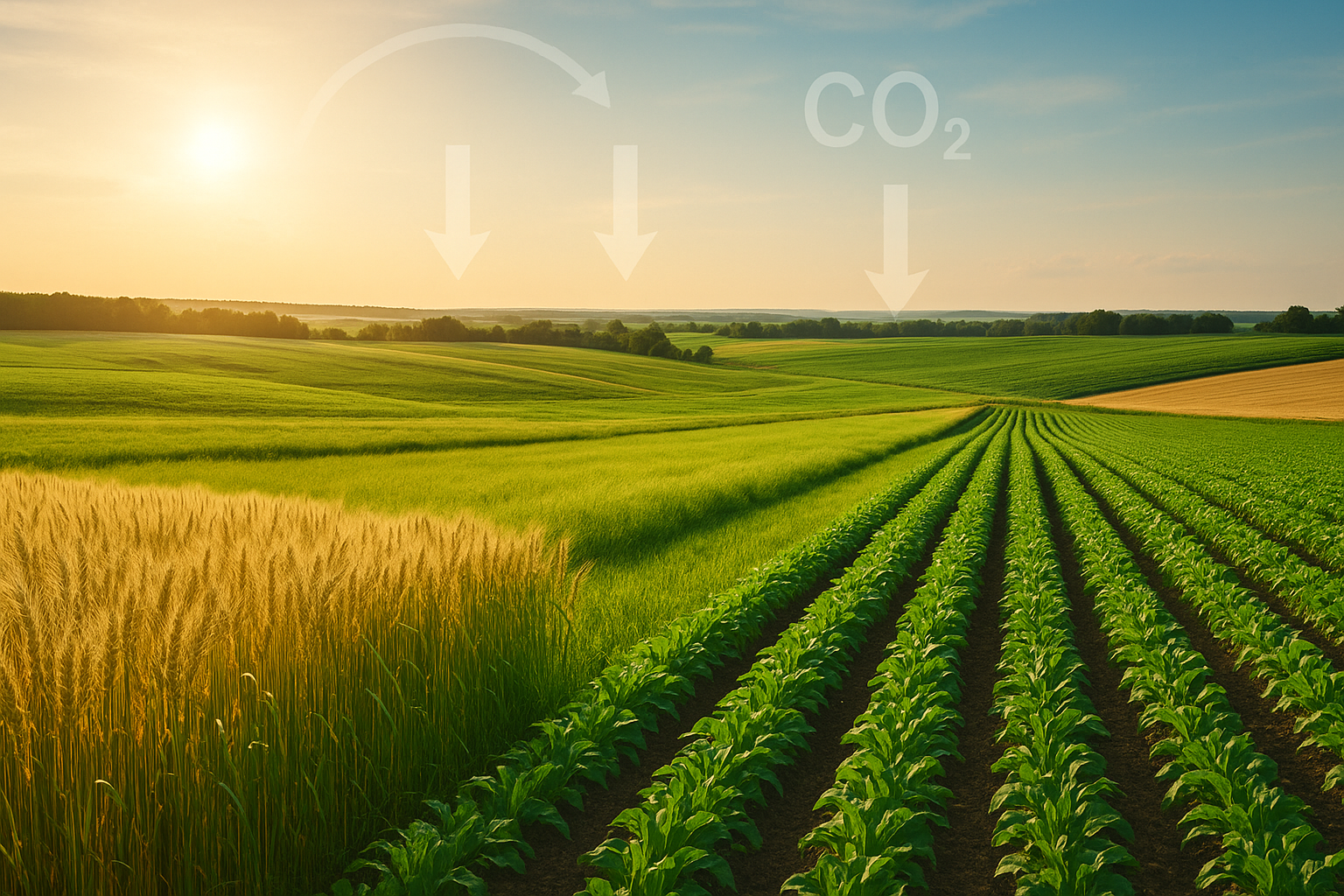
Agriculture is a big player in the global carbon cycle
A new study highlights the overlooked role of cultivated plants in the global carbon cycle, showing that agriculture makes a major contribution to CO₂ absorption.

Arnaud Muller-Feuga
Clintel Foundation
Date: 27 August 2025
In the intricate puzzle of global climate change, one piece has been consistently overlooked: the role of cultivated plants in absorbing carbon dioxide. A groundbreaking new study by the French scientist Arnaud Muller-Feuga, published in September 2025 in the journal Voice of the Publisher, challenges long-standing assumptions about the role of agriculture in the carbon cycle.
Titled “Reappraisal of the Place of Cultivated Plants in the World Carbon Budget,” this paper argues that annual crops and grasslands, often dismissed as too short-lived to matter, play a significant role in mitigating atmospheric CO₂. By bringing agriculture into the spotlight, Muller-Feuga’s work calls for a rethinking of climate models and policies, offering a fresh perspective on how humanity can leverage natural systems to address global warming.
Muller-Feuga, an agricultural engineer and former research director at IFREMER in France, brings decades of expertise to this analysis. His study delves into the carbon dynamics of cultivated ecosystems, which include everything from wheat fields to managed forests. These systems, he argues, have been unfairly sidelined in global carbon budgets due to their seasonal nature. Traditional models, such as those used by the IPCC, often focus on long-term sinks like forests and peats, assuming annual crops contribute little because their carbon is quickly released. Muller-Feuga’s research upends this view, demonstrating that these plants are not only significant carbon sinks but also store carbon for far longer than previously thought.
Through detailed simulations spanning half a century, the study reveals the scale of carbon capture by cultivated plants. In 2023 alone, these ecosystems absorbed approximately 39.2 billion tons of CO₂ from the atmosphere, a figure that dwarfs many other natural sinks. When accounting for the net impact after carbon release, cultivated plants offset around 82% of global fossil fuel emissions for that year. This is a staggering contribution, suggesting that agriculture is not just a bystander in the carbon cycle but a central player. In this context, the share of annual crops is far from being negligeable as previously stated. Moreover, the half-life of this carbon capture and storage is over 10 years.
Over time, these systems have accumulated a net stock of 123.3 billion tons of carbon, equivalent to about 14% of the carbon content in the atmosphere. Such numbers demand attention, as they indicate that cultivated plants are a powerhouse in reducing atmospheric CO₂.
Oceans
Perhaps most surprising is the study’s implication for the ocean’s role in the carbon cycle. Conventional wisdom holds that oceans act as a major carbon sink, absorbing CO₂ to mitigate human emissions. Muller-Feuga’s findings challenge this, suggesting that the ocean may actually be a source of CO₂, possibly due to warming-induced changes in its physico-chemistry. This revelation disrupts established carbon budgets and underscores the need to reassess how we model global carbon flows. If the ocean is not the reliable sink we thought, the role of cultivated plants becomes even more critical.
The implications of this research extend far beyond academic debate. By highlighting the carbon-sequestering potential of agriculture, Muller-Feuga’s work calls for a shift in climate strategy. Agricultural systems, from small farms to sprawling plantations, must be recognized as vital components of carbon management. This means rethinking land-use policies to prioritize practices that enhance carbon storage. It also means integrating these systems into global carbon budgets, ensuring that their contributions are no longer overlooked. For policymakers, this could translate into incentives for farmers to adopt carbon-friendly practices, transforming agriculture into a cornerstone of climate mitigation.
Muller-Feuga’s findings also invite a broader reflection on how we approach climate solutions. For too long, the focus has been on cutting fossil fuel emissions, often at the expense of exploring natural systems that already work to balance the carbon cycle. By recognizing the role of cultivated plants, we can develop more holistic strategies that combine emission reductions with enhanced carbon sequestration.
However, the study is not without its caveats. While intensified agricultural practices demonstrate the robustness of findings on CO2 capture, questions persist about their accuracy and the role of other factors in carbon sequestration.
Especially, the share of unexploited plant covers, animal and necromasses sequestration and the influence of management practices must be defined further. More research is needed to refine these findings and ensure they hold across different time and space contexts. Still, the scale of the contribution—tens of billions of tons of CO₂ absorbed annually—suggests that cultivated plants are a force to be reckoned with.
In conclusion, Muller-Feuga’s research offers a transformative perspective on the global carbon budget. By revealing the immense carbon-sequestering potential of cultivated plants, it challenges us to rethink the role of agriculture in the carbon cycle. Far from being a minor player, it emerges as a powerful ally, capable of offsetting a significant portion of human CO2 emissions. As we refine our understanding of these systems, we have an opportunity to craft climate policies that are more inclusive, effective, and grounded in the realities of the natural world. This study brings agriculture to the forefront of the climate conversation.

About the Author
Arnaud Muller-Feuga, an agricultural engineer with a doctorate in biological oceanography from Aix-Marseille University, retired as a research director at IFREMER in 2008. He founded Microphyt SA in 2007, focusing on microalgae production for cosmetics and food complements, and has since 2015 explored the interplay of CO₂ and climate, advocating for a revaluation of agriculture and forestry as full environmental actors. He is a signatory of the Clintel World Climate Declaration.

more news
Agriculture is a big player in the global carbon cycle
A new study highlights the overlooked role of cultivated plants in the global carbon cycle, showing that agriculture makes a major contribution to CO₂ absorption.
Offshore Wind’s Epic Fail
Feds pull plug on Revolution Wind amid security fears.

INTERVIEW. Dr. Judith Curry on Global Warming: Where Is the Danger?
Renowned climatologist Dr. Judith Curry says it is very tough to make the case of warming becoming dangerous.
The post Agriculture is a big player in the global carbon cycle appeared first on Clintel.
Please consider helping!
Awake Freedom TV On Roku is Broken! 🙂

I could no longer maintain the costs on my own, so I moved the off of a dedicated server which was needed for the TV platform to work. On top of that, I want to build an app Awake Freedom TV app, for mobile phones. We need your help to first resurrect our TV channel, and then build the mobile app. In order to do that, I need a minimum of 800/month on subscription payments. Please help anyway you can with the form below.

Leave A Comment