


Claim of 50,000 heat-related deaths not based on facts
Once again, the media were reporting on heat-related deaths. As many as 50,000 people were said to have succumbed to the heat in European cities this summer. The media reported the news uncritically. However, a fact-check by Marcel Crok reveals that the researchers did not use any mortality figures at all in this study and that assumptions were piled upon assumptions.

Downtown Valencia during a heat wave this summer. (Source: Shutterstock)
Marcel Crok
Date: 28 October 2026
Whilst autumn has set in across the Netherlands, last week the Dutch (and other) media went into overdrive once more over last summer’s European heatwave and the number of heat-related deaths it was claimed to have caused. Here is a selection of headlines:
‘Worst on record’: Brutal summer heat wave killed more than 50,000 in Europe’s cities (CNN)
Heat killed ‘staggering’ 50,000 people in Europe’s cities this summer, scientists warn (The Guardian)
Scorching summer leads to record number of heat-related deaths in European cities (NOS)
Nature Health
The gist is clear: an estimated 50,000 additional heat-related deaths this summer due to the extreme heat. The headlines were prompted by a British study published in Nature Health entitled Heat-related urban mortality attributable to human-induced climate change in Europe from 2000 to 2025. In other words, heat-related deaths caused by climate change.
The Dutch public broadcasting company NOS used the data from the study to produce the graph below:
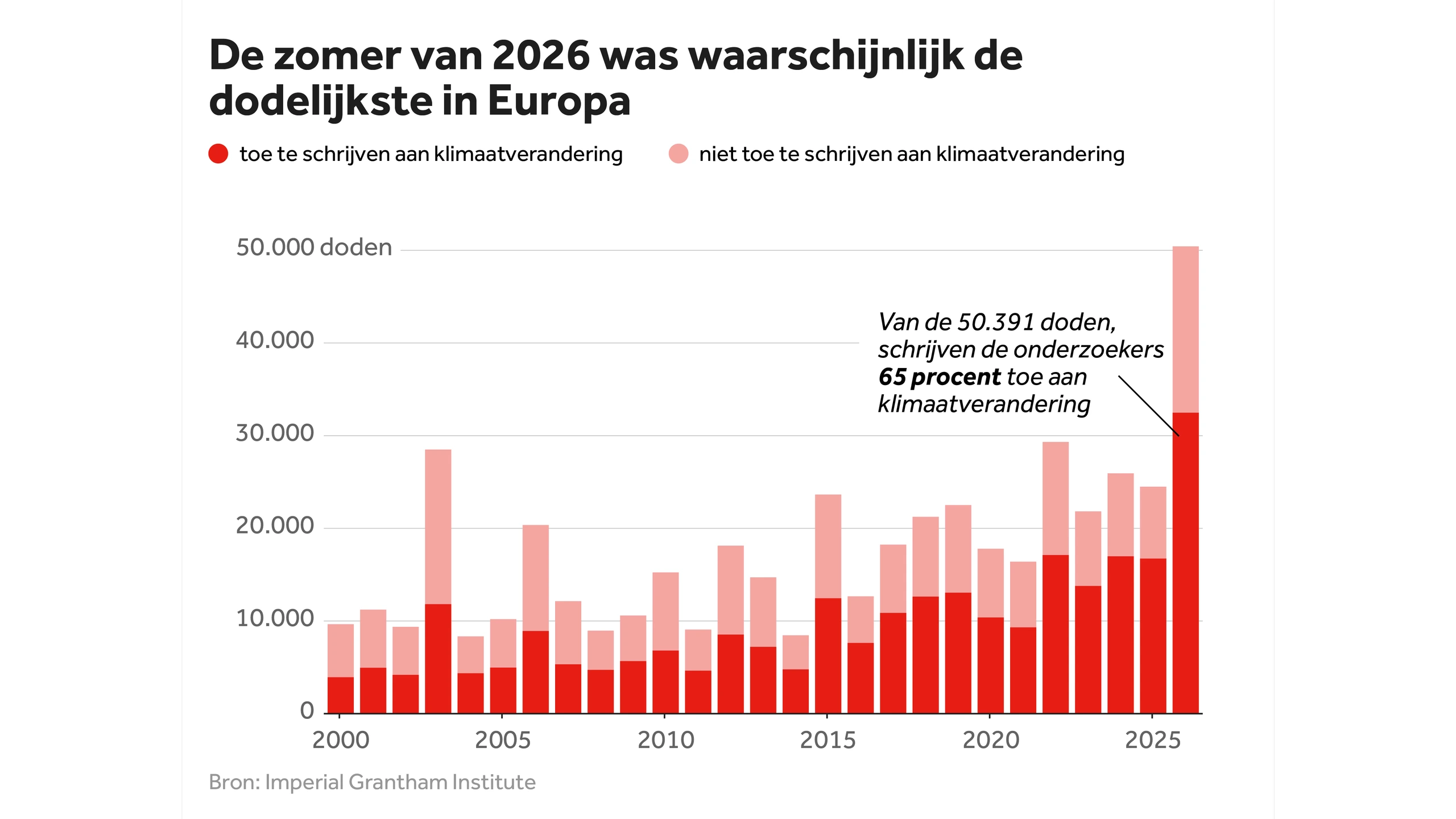
The height of the bar indicates the total number of heat-related deaths, and the red colour represents the proportion that, according to the researchers, is attributable to climate change.
Summer is over, so it seems logical that we can now take stock. The deaths have been counted. Or have they? Here is how the Dutch newspaper NRC describes the study:
“The summer of 2026 was probably the deadliest in Europe to date due to its high temperatures. That is the conclusion reached by scientists from Imperial College London and the London School of Hygiene and Tropical Medicine, based on an analysis of deaths resulting from the heat. According to the researchers, far more people died from the heat last summer than in the previous record years of 2022 and 2003.
The scientists estimate that during the hot months of June, July and August, there were more than 50,000 additional deaths due to the extreme weather. In reaching this conclusion, they drew on data from 854 European cities in thirty different countries, home to a total of 40 per cent of the continent’s population.”
Read the passages I’ve highlighted in bold carefully once more: “An analysis of deaths”, “they drew on data from 854 European cities”. This reads as though: the death certificates have been studied, the figures have been tallied. Nothing could be further from the truth. The published study is based on zero mortality data from 2026. You read that correctly: zero. As the American researcher Willis Eschenbach wryly remarked in an article about the study: it seems that using actual facts is soooo 20th century.
If no mortality figures from 2026 have been used, how do the researchers arrive at their estimate of 50,391 (yes, that ‘exact’ figure is mentioned in the study) heat-related deaths? They use historical temperature-mortality relationships and apply them to this summer.
Here, step by step, is what the researchers did:
- They derived statistical correlations between temperature and mortality based on historical data (2000–2019) from 232 European cities.
- These relationships were extrapolated to 622 other European cities for which no data were available. This brings the total to 854 ‘studied’ cities.
- The temperatures in those cities in 2026 were analysed. Using climate models, an estimate was made of the proportion of the warming caused by climate change (i.e. by CO2).
- Next, subtract the ‘human contribution’ from this summer’s temperatures to create a hypothetical cooler summer without climate change.
- You now apply the temperature–mortality relationships identified in the past to ‘both’ 2026 summers and subtract the results from one another. This gives you the total heat-related deaths in 2026 and the contributions to this from the natural background climate (pink in the NOS graph) and the additional contribution from human-induced climate change (red in the NOS graph).
Bang, and you’re done. Suddenly, you’ve ‘proven’ – and published in one of the Nature journals – that 2026 was the deadliest heatwave year. Without even needing the actual mortality figures for that summer. Journalists won’t read the study anyway (see the extract from NRC) or won’t understand what tricks you’ve been up to. Media attention guaranteed. And critical comments such as this article and that by Willis Eschenbach won’t reach the masses. Mission accomplished.
More elderly people
Of course, there’s a quagmire of assumptions behind the study. But who’s going to quibble about that? Let’s name a few anyway. The study uses temperature-mortality relationships from the period 2000–2019 and assumes that these correlations remain constant thereafter. Why would that be the case? If summers are getting hotter and hotter, it stands to reason that more people would install air conditioning or that countries would draw up and implement heatwave plans, wouldn’t they? The study takes no account of this. Another study – albeit also based on model estimates (so caution is advised) – suggests that heat-related deaths would have been 80 per cent higher without adaptation. This indicates that it is a factor to be taken into account, something which was not done in the current study.
The researchers use data from just 232 cities and apply it, without any checks, to 622 other cities. Not all cities are the same, are they? One city might be much greener than another, making the heat more bearable.
But probably the most important factor is age. Whilst the researchers do use different age groups, the distribution across those groups for the period 2000–2019 is kept constant. Yet a significant shift has occurred during that period: Europe is ageing. Here is a comparison between 2000 and 2026:
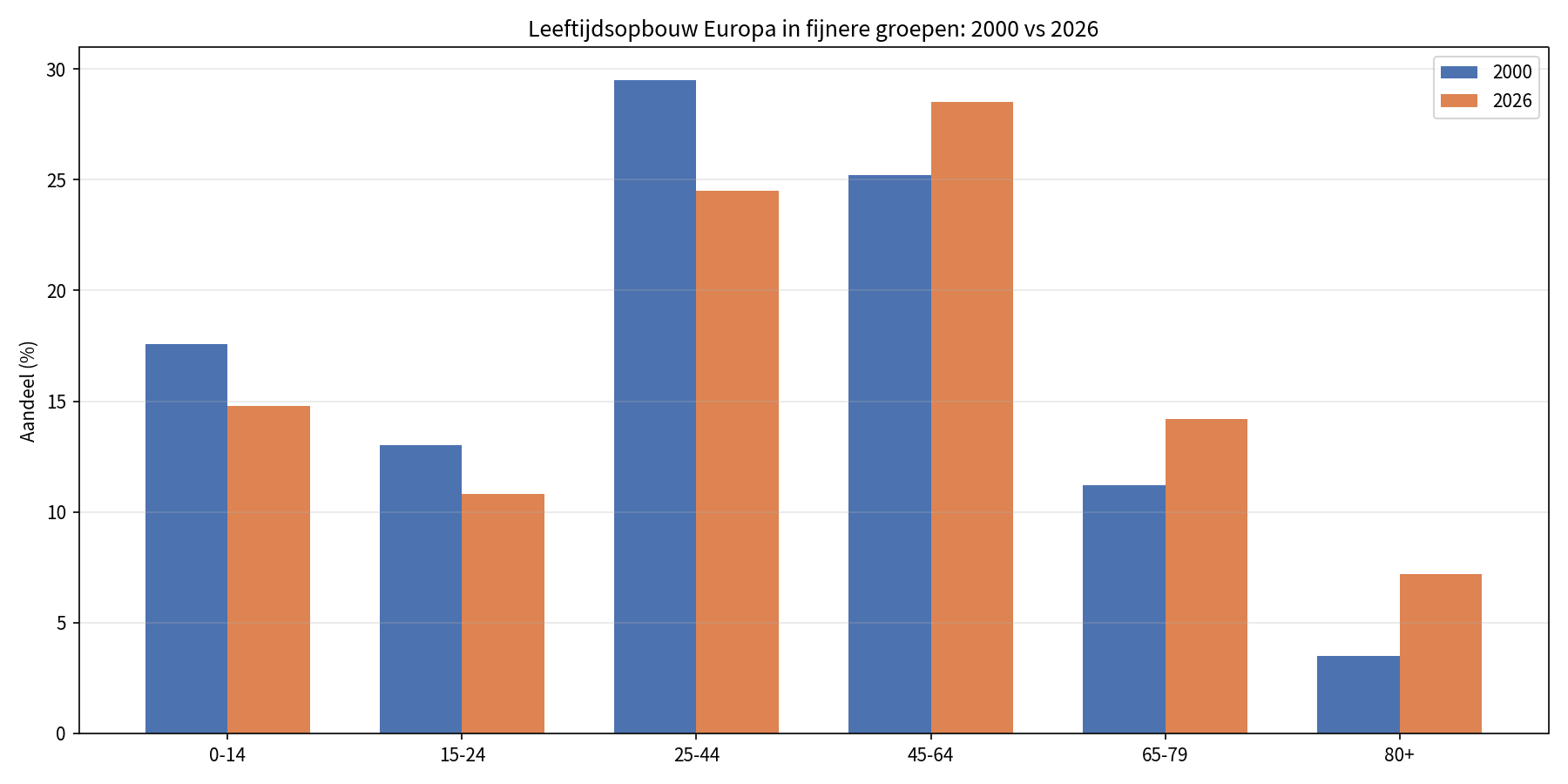
The proportion of people aged 65 and over and those aged 80 and over has risen sharply. Older people (aged 80 and over) in particular are especially vulnerable to heat. The Danish environmental economist Bjorn Lomborg had already pointed this out earlier in the year when The Lancet published alarming figures on heat-related deaths in Europe. Lomborg described it on X as “textbook climate deception”. According to him, virtually the entire increase in heat-related deaths can be explained by the ageing population:
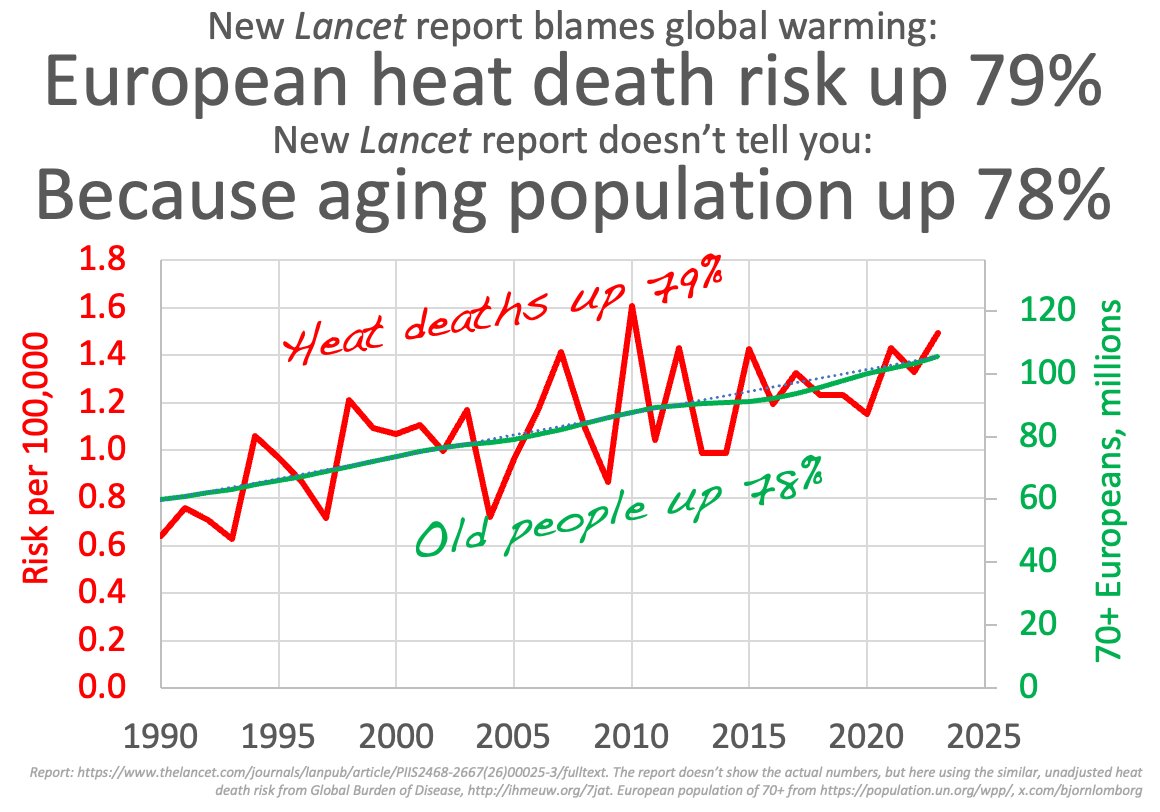
Source: Lomborg
When adjusted for age, Lomborg finds only a minimal increase in heat-related deaths:
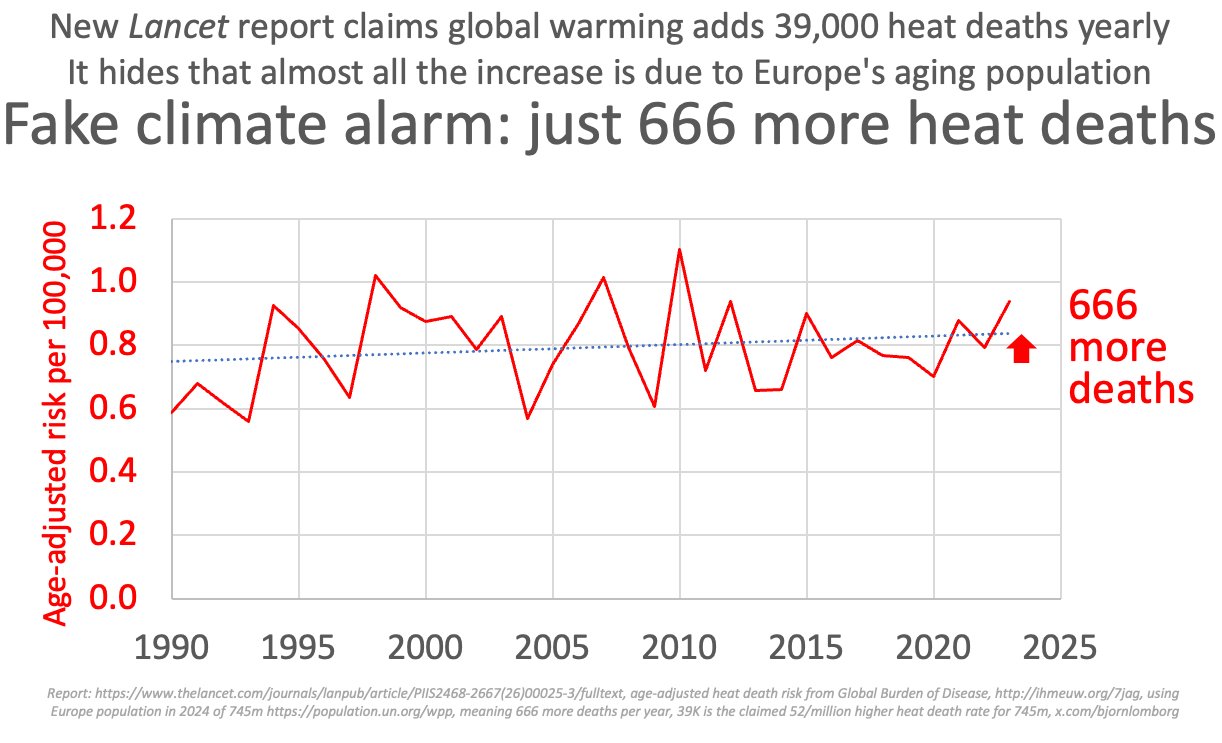
Source: Lomborg
Cold is far more dangerous
The other, equally important point that Lomborg consistently makes, is that the obsession with heat is misplaced because, worldwide and in Europe too, cold still claims far more victims than heat. Whilst global warming in Europe will indeed lead to (slightly) more heat-related deaths, the reduction in the number of cold-related deaths is much greater. This is therefore good news overall, which is never highlighted when the focus is solely on heat.
Remarkably, the Dutch National Institute for Public Health and the Environment (RIVM) published a study last week which confirmed this ratio for the Netherlands as well. According to RIVM, there are around 350 additional deaths from heat each year, compared with no fewer than 12,000 (!) deaths from cold. Thirty-five times as many!
Naturally – one might almost say – NRC focused on the heat in an article on the subject (“People in some neighbourhoods are more resilient to heat than in others”). But columnist Marianne Zwagerman was quick to point out, in De Telegraaf, the large number of cold-related deaths reported by RIVM. She concludes: “We combat the heat, but let thousands of Dutch people die from the cold.”
One of the researchers involved in the RIVM study is Hein Daanen from VU University Amsterdam. Coincidentally, I heard him explaining on the radio this summer why older people actually die more quickly from heat than younger people. In the clip, however, Daanen also highlighted the far greater danger posed by the cold and noted that it is strange that the Netherlands has a National Heat Plan but no National Cold Plan.

This article was originally published in Dutch on Indepen.eu on 27 October 2026

Marcel Crok
Marcel Crok is a Dutch science journalist who has been writing full-time about the climate debate and climate policy since an award winning article about the notorious hockey stick graph in 2005. He published two books in Dutch (De Staat van het Klimaat (The State of the Climate) and was co-author of the book Ecomodernisme (Ecomodernism)). With the British independent researcher Nic Lewis he wrote an extensive report about climate sensitivity, titled A Sensitive Matter. He was asked by the Dutch government to become expert reviewer of the IPCC AR5 report. Together with the Dutch climate institutes KNMI and PBL, Crok set up an international discussion platform Climate Dialogue.
In 2019, Crok and emeritus professor Guus Berkhout founded the Clintel Foundation. They published the World Climate Declaration, which has now been signed by over 2000 scientists and experts. Together with Andy May and a team of scientists from the Clintel network, Crok contributed to and edited the book The Frozen Climate Views of the IPCC.
The article you have just read was made possible by our donors.
Every day, Clintel publishes articles on climate, energy and science. We also translate and share international analyses in multiple languages, produce videos, publish reports and organize conferences and events around the world.
We receive no government funding and rely entirely on the support of our donors. Your support helps us promote independent research and contribute to a more open and balanced debate on climate and energy issues.
Would you like to support our work? Choose the option that suits you best:
• Become a Friend of Clintel – support us with an annual contribution
• Make a recurring donation – provide ongoing support and help us plan ahead
• Make a one-time donation – every contribution helps
Thank you for your support.

more news

Roger Pielke Jr.: “I would scrap the temperature targets”
The international community, and especially the EU, should abandon the Paris Agreement’s temperature targets of limiting global warming to well below 2°C, says independent researcher Roger Pielke Jr, in an interview by Clintel Director Marcel Crok. This would open the door to a more pragmatic approach that would avoid sacrificing economic prosperity.

Ideologues try a grid powered only by “renewables”
The island of El Hierro only has about 11,000 people, but in 2008 it set out to show the world how to do a full transition to an electric system powered only by wind turbines backed up by a hydro-electric energy storage system. Francis Menton wonders what has happened since.

The analogy between Chairman Mao and current Western leaders
It is impossible not to notice the analogy between the events that led to China’s Great Famine in 1958-1962 and the ongoing energy disaster being imposed on various U.S. states and other Western countries by an equally ignorant clique of political ideologues, says Francis Menton.
The post Claim of 50,000 heat-related deaths not based on facts appeared first on Clintel.
Please consider helping!
Awake Freedom TV On Roku is Broken! 🙂

I could no longer maintain the costs on my own, so I moved the off of a dedicated server which was needed for the TV platform to work. On top of that, I want to build an app Awake Freedom TV app, for mobile phones. We need your help to first resurrect our TV channel, and then build the mobile app. In order to do that, I need a minimum of 800/month on subscription payments. Please help anyway you can with the form below.

Leave A Comment